

108
K. Kawakami
spray-drying, freeze-drying, and hot-melt extrusion. The glasses produced by sprayand freeze-drying have large surface areas. Those obtained from hot-melt extrusion
are subjected to milling during the formulation process. Thus, the practical amorphous formulations are anticipated to be unstable compared to the melt-quenched
glasses. On the other hand, the polymeric excipients typically included in amorphous
formulations are expected to retard the crystallization of the drug molecules because
of two reasons: steric hindrance between the drug molecules and low crystallization
tendency of the polymeric excipients.
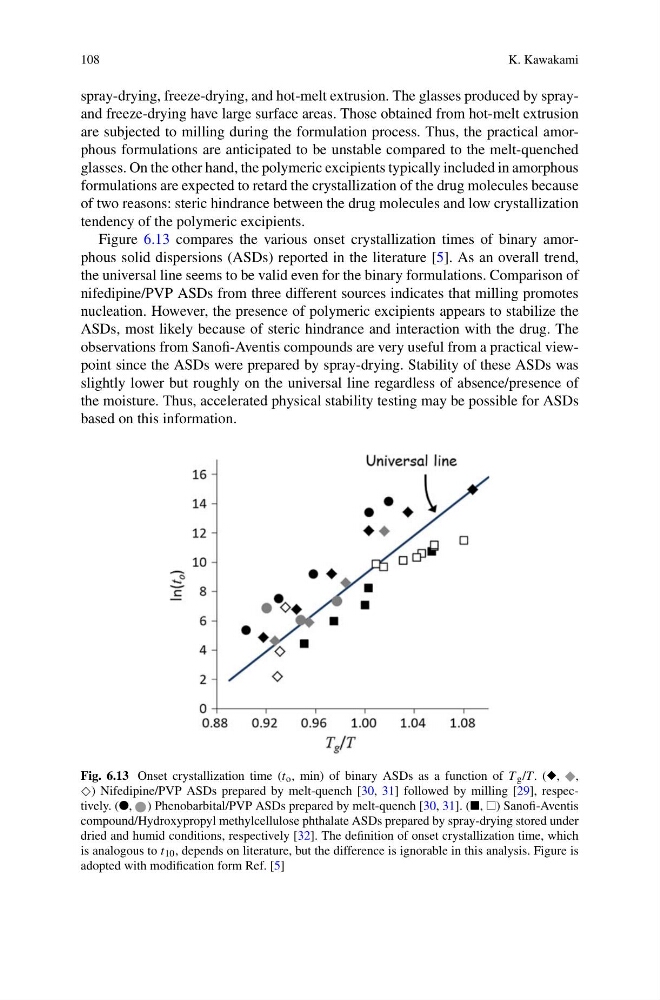
Figure 6.13 compares the various onset crystallization times of binary amorphous solid dispersions (ASDs) reported in the literature [5]. As an overall trend,
the universal line seems to be valid even for the binary formulations. Comparison of
nifedipine/PVP ASDs from three different sources indicates that milling promotes
nucleation. However, the presence of polymeric excipients appears to stabilize the
ASDs, most likely because of steric hindrance and interaction with the drug. The
observations from Sanofi-Aventis compounds are very useful from a practical viewpoint since the ASDs were prepared by spray-drying. Stability of these ASDs was
slightly lower but roughly on the universal line regardless of absence/presence of
the moisture. Thus, accelerated physical stability testing may be possible for ASDs
based on this information.
Fig. 6.13 Onset crystallization time (t o , min) of binary ASDs as a function of T g /T. (◆, ,
◇) Nifedipine/PVP ASDs prepared by melt-quench [30, 31] followed by milling [29], respectively. (●, ) Phenobarbital/PVP ASDs prepared by melt-quench [30, 31]. (, ) Sanofi-Aventis
compound/Hydroxypropyl methylcellulose phthalate ASDs prepared by spray-drying stored under
dried and humid conditions, respectively [32]. The definition of onset crystallization time, which
is analogous to t 10 , depends on literature, but the difference is ignorable in this analysis. Figure is
adopted with modification form Ref. [5]
K. Kawakami
spray-drying, freeze-drying, and hot-melt extrusion. The glasses produced by sprayand freeze-drying have large surface areas. Those obtained from hot-melt extrusion
are subjected to milling during the formulation process. Thus, the practical amorphous formulations are anticipated to be unstable compared to the melt-quenched
glasses. On the other hand, the polymeric excipients typically included in amorphous
formulations are expected to retard the crystallization of the drug molecules because
of two reasons: steric hindrance between the drug molecules and low crystallization
tendency of the polymeric excipients.
Figure 6.13 compares the various onset crystallization times of binary amorphous solid dispersions (ASDs) reported in the literature [5]. As an overall trend,
the universal line seems to be valid even for the binary formulations. Comparison of
nifedipine/PVP ASDs from three different sources indicates that milling promotes
nucleation. However, the presence of polymeric excipients appears to stabilize the
ASDs, most likely because of steric hindrance and interaction with the drug. The
observations from Sanofi-Aventis compounds are very useful from a practical viewpoint since the ASDs were prepared by spray-drying. Stability of these ASDs was
slightly lower but roughly on the universal line regardless of absence/presence of
the moisture. Thus, accelerated physical stability testing may be possible for ASDs
based on this information.
Fig. 6.13 Onset crystallization time (t o , min) of binary ASDs as a function of T g /T. (◆, ,
◇) Nifedipine/PVP ASDs prepared by melt-quench [30, 31] followed by milling [29], respectively. (●, ) Phenobarbital/PVP ASDs prepared by melt-quench [30, 31]. (, ) Sanofi-Aventis
compound/Hydroxypropyl methylcellulose phthalate ASDs prepared by spray-drying stored under
dried and humid conditions, respectively [32]. The definition of onset crystallization time, which
is analogous to t 10 , depends on literature, but the difference is ignorable in this analysis. Figure is
adopted with modification form Ref. [5]