

6 Managing Thermal History to Stabilize/Destabilize …
107
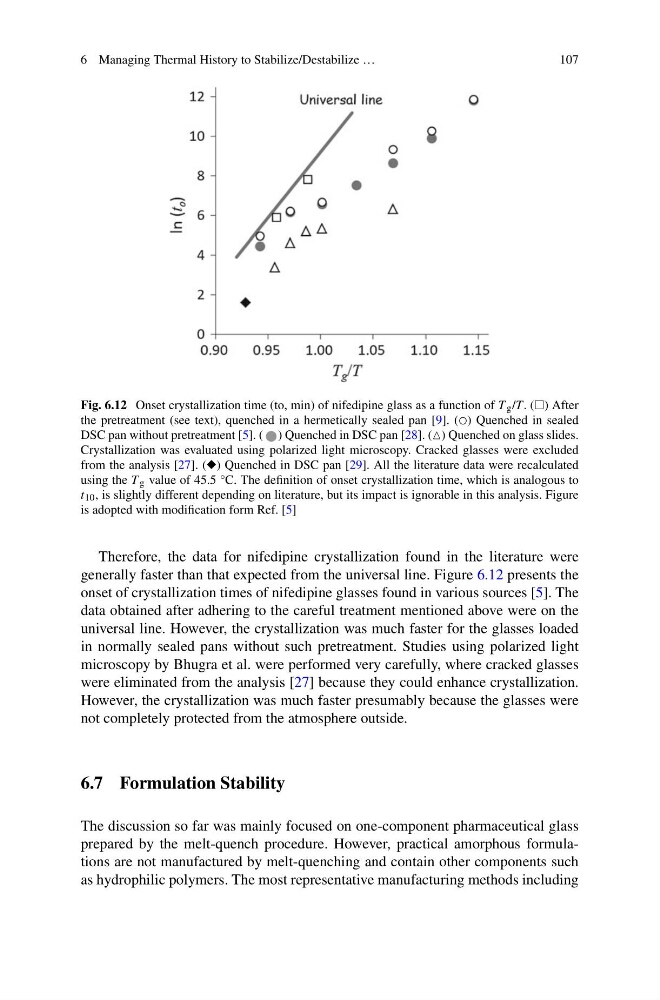
Fig. 6.12 Onset crystallization time (to, min) of nifedipine glass as a function of T g /T. () After
the pretreatment (see text), quenched in a hermetically sealed pan [9]. (◯) Quenched in sealed
DSC pan without pretreatment [5]. ( ) Quenched in DSC pan [28]. () Quenched on glass slides.
Crystallization was evaluated using polarized light microscopy. Cracked glasses were excluded
from the analysis [27]. (◆) Quenched in DSC pan [29]. All the literature data were recalculated
using the T g value of 45.5 °C. The definition of onset crystallization time, which is analogous to
t 10 , is slightly different depending on literature, but its impact is ignorable in this analysis. Figure
is adopted with modification form Ref. [5]
Therefore, the data for nifedipine crystallization found in the literature were
generally faster than that expected from the universal line. Figure 6.12 presents the
onset of crystallization times of nifedipine glasses found in various sources [5]. The
data obtained after adhering to the careful treatment mentioned above were on the
universal line. However, the crystallization was much faster for the glasses loaded
in normally sealed pans without such pretreatment. Studies using polarized light
microscopy by Bhugra et al. were performed very carefully, where cracked glasses
were eliminated from the analysis [27] because they could enhance crystallization.
However, the crystallization was much faster presumably because the glasses were
not completely protected from the atmosphere outside.
6.7 Formulation Stability
The discussion so far was mainly focused on one-component pharmaceutical glass
prepared by the melt-quench procedure. However, practical amorphous formulations are not manufactured by melt-quenching and contain other components such
as hydrophilic polymers. The most representative manufacturing methods including
107
Fig. 6.12 Onset crystallization time (to, min) of nifedipine glass as a function of T g /T. () After
the pretreatment (see text), quenched in a hermetically sealed pan [9]. (◯) Quenched in sealed
DSC pan without pretreatment [5]. ( ) Quenched in DSC pan [28]. () Quenched on glass slides.
Crystallization was evaluated using polarized light microscopy. Cracked glasses were excluded
from the analysis [27]. (◆) Quenched in DSC pan [29]. All the literature data were recalculated
using the T g value of 45.5 °C. The definition of onset crystallization time, which is analogous to
t 10 , is slightly different depending on literature, but its impact is ignorable in this analysis. Figure
is adopted with modification form Ref. [5]
Therefore, the data for nifedipine crystallization found in the literature were
generally faster than that expected from the universal line. Figure 6.12 presents the
onset of crystallization times of nifedipine glasses found in various sources [5]. The
data obtained after adhering to the careful treatment mentioned above were on the
universal line. However, the crystallization was much faster for the glasses loaded
in normally sealed pans without such pretreatment. Studies using polarized light
microscopy by Bhugra et al. were performed very carefully, where cracked glasses
were eliminated from the analysis [27] because they could enhance crystallization.
However, the crystallization was much faster presumably because the glasses were
not completely protected from the atmosphere outside.
6.7 Formulation Stability
The discussion so far was mainly focused on one-component pharmaceutical glass
prepared by the melt-quench procedure. However, practical amorphous formulations are not manufactured by melt-quenching and contain other components such
as hydrophilic polymers. The most representative manufacturing methods including