

98
K. Kawakami
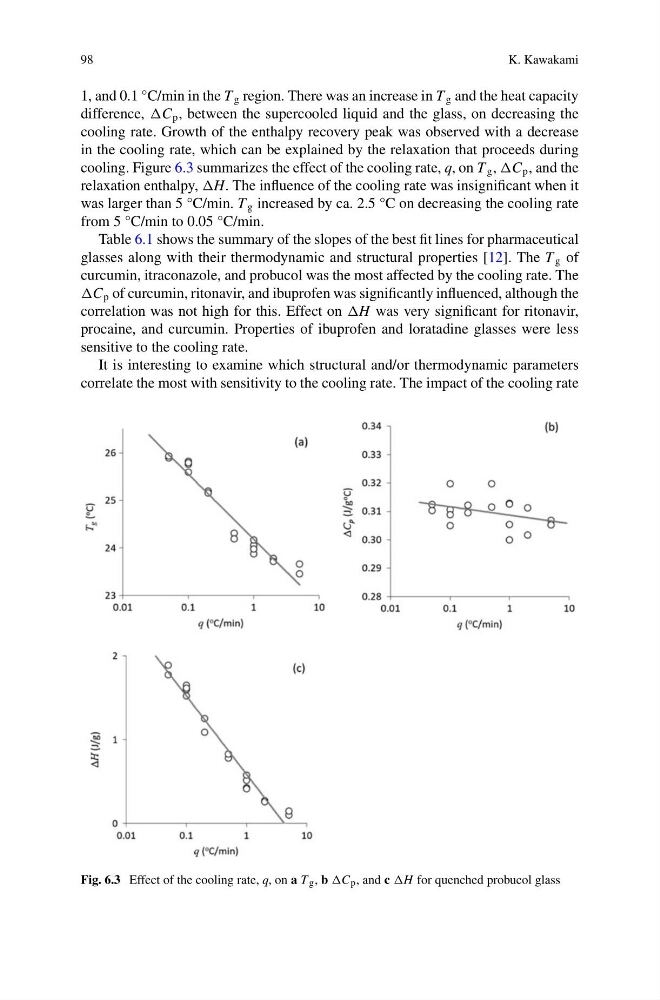
1, and 0.1 °C/min in the T g region. There was an increase in T g and the heat capacity
difference, C p , between the supercooled liquid and the glass, on decreasing the
cooling rate. Growth of the enthalpy recovery peak was observed with a decrease
in the cooling rate, which can be explained by the relaxation that proceeds during
cooling. Figure 6.3 summarizes the effect of the cooling rate, q, on T g , C p , and the
relaxation enthalpy, H. The influence of the cooling rate was insignificant when it
was larger than 5 °C/min. T g increased by ca. 2.5 °C on decreasing the cooling rate
from 5 °C/min to 0.05 °C/min.
Table 6.1 shows the summary of the slopes of the best fit lines for pharmaceutical
glasses along with their thermodynamic and structural properties [12]. The T g of
curcumin, itraconazole, and probucol was the most affected by the cooling rate. The
C p of curcumin, ritonavir, and ibuprofen was significantly influenced, although the
correlation was not high for this. Effect on H was very significant for ritonavir,
procaine, and curcumin. Properties of ibuprofen and loratadine glasses were less
sensitive to the cooling rate.
It is interesting to examine which structural and/or thermodynamic parameters
correlate the most with sensitivity to the cooling rate. The impact of the cooling rate
Fig. 6.3 Effect of the cooling rate, q, on a T g , b C p , and c H for quenched probucol glass
K. Kawakami
1, and 0.1 °C/min in the T g region. There was an increase in T g and the heat capacity
difference, C p , between the supercooled liquid and the glass, on decreasing the
cooling rate. Growth of the enthalpy recovery peak was observed with a decrease
in the cooling rate, which can be explained by the relaxation that proceeds during
cooling. Figure 6.3 summarizes the effect of the cooling rate, q, on T g , C p , and the
relaxation enthalpy, H. The influence of the cooling rate was insignificant when it
was larger than 5 °C/min. T g increased by ca. 2.5 °C on decreasing the cooling rate
from 5 °C/min to 0.05 °C/min.
Table 6.1 shows the summary of the slopes of the best fit lines for pharmaceutical
glasses along with their thermodynamic and structural properties [12]. The T g of
curcumin, itraconazole, and probucol was the most affected by the cooling rate. The
C p of curcumin, ritonavir, and ibuprofen was significantly influenced, although the
correlation was not high for this. Effect on H was very significant for ritonavir,
procaine, and curcumin. Properties of ibuprofen and loratadine glasses were less
sensitive to the cooling rate.
It is interesting to examine which structural and/or thermodynamic parameters
correlate the most with sensitivity to the cooling rate. The impact of the cooling rate
Fig. 6.3 Effect of the cooling rate, q, on a T g , b C p , and c H for quenched probucol glass