

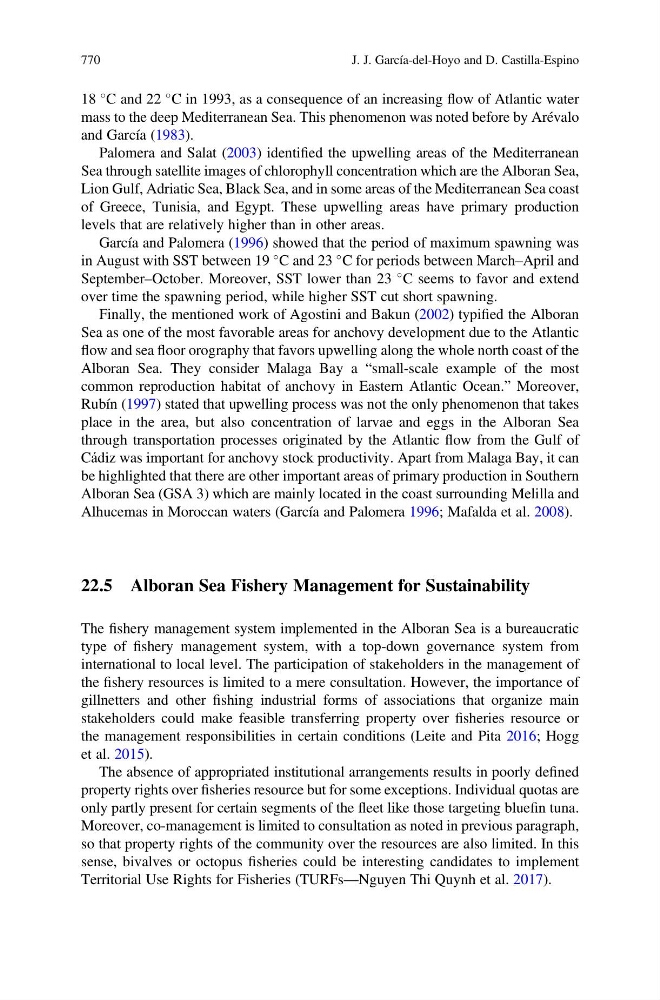
18
C and 22
C in 1993, as a consequence of an increasing flow of Atlantic water
mass to the deep Mediterranean Sea. This phenomenon was noted before by Arévalo
and García (1983).
Palomera and Salat (2003) identified the upwelling areas of the Mediterranean
Sea through satellite images of chlorophyll concentration which are the Alboran Sea,
Lion Gulf, Adriatic Sea, Black Sea, and in some areas of the Mediterranean Sea coast
of Greece, Tunisia, and Egypt. These upwelling areas have primary production
levels that are relatively higher than in other areas.
García and Palomera (1996) showed that the period of maximum spawning was
in August with SST between 19
C and 23
C for periods between March–April and
September–October. Moreover, SST lower than 23
C seems to favor and extend
over time the spawning period, while higher SST cut short spawning.
Finally, the mentioned work of Agostini and Bakun (2002) typified the Alboran
Sea as one of the most favorable areas for anchovy development due to the Atlantic
flow and sea floor orography that favors upwelling along the whole north coast of the
Alboran Sea. They consider Malaga Bay a “small-scale example of the most
common reproduction habitat of anchovy in Eastern Atlantic Ocean.” Moreover,
Rubín (1997) stated that upwelling process was not the only phenomenon that takes
place in the area, but also concentration of larvae and eggs in the Alboran Sea
through transportation processes originated by the Atlantic flow from the Gulf of
Cádiz was important for anchovy stock productivity. Apart from Malaga Bay, it can
be highlighted that there are other important areas of primary production in Southern
Alboran Sea (GSA 3) which are mainly located in the coast surrounding Melilla and
Alhucemas in Moroccan waters (García and Palomera 1996; Mafalda et al. 2008).
22.5 Alboran Sea Fishery Management for Sustainability
The fishery management system implemented in the Alboran Sea is a bureaucratic
type of fishery management system, with a top-down governance system from
international to local level. The participation of stakeholders in the management of
the fishery resources is limited to a mere consultation. However, the importance of
gillnetters and other fishing industrial forms of associations that organize main
stakeholders could make feasible transferring property over fisheries resource or
the management responsibilities in certain conditions (Leite and Pita 2016; Hogg
et al. 2015).
The absence of appropriated institutional arrangements results in poorly defined
property rights over fisheries resource but for some exceptions. Individual quotas are
only partly present for certain segments of the fleet like those targeting bluefin tuna.
Moreover, co-management is limited to consultation as noted in previous paragraph,
so that property rights of the community over the resources are also limited. In this
sense, bivalves or octopus fisheries could be interesting candidates to implement
Territorial Use Rights for Fisheries (TURFs—Nguyen Thi Quynh et al. 2017).
770
J. J. García-del-Hoyo and D. Castilla-Espino