

markets, impeding their development and constraining their survival (FENIP 2010;
Orbi et al. 2011; Nhhala 2018). Restrictions in terms of sanitary measures adopted
by the European Union since the end of the 1980s, in particular for cultured shellfish,
have seriously affected national aquaculture production. Bivalve culture development, such as flat oysters and clams, have been limited for reasons of commercial
precautions. This was the case of Marost farm, whose production consisted mostly of
small quantities intended for domestic market needs.
Fish culture, mainly sea bass and sea bream, has experienced major marketing
difficulties on the European market. Domestic marketing possibilities were
constrained by the specific regulations governing the importation in temporary
admission way of aquaculture inputs (fry and feed). In addition, the European market
was considered as a very interesting alternative for its high prices, especially during
the 1980s, but the price depression experimented in the 1990s affected seriously the
production. Despite its technical progress, Moroccan marine aquaculture farms have
been very vulnerable to European aquaculture farms’ competitiveness. In addition to
the declining sale prices of these major aquaculture products, Moroccan aquaculture
farms could not be competitive, particularly because they did not receive any
subsidies or benefits from national authorities such as European Union aquaculture
farms.
20.4.3 Current State and Overview
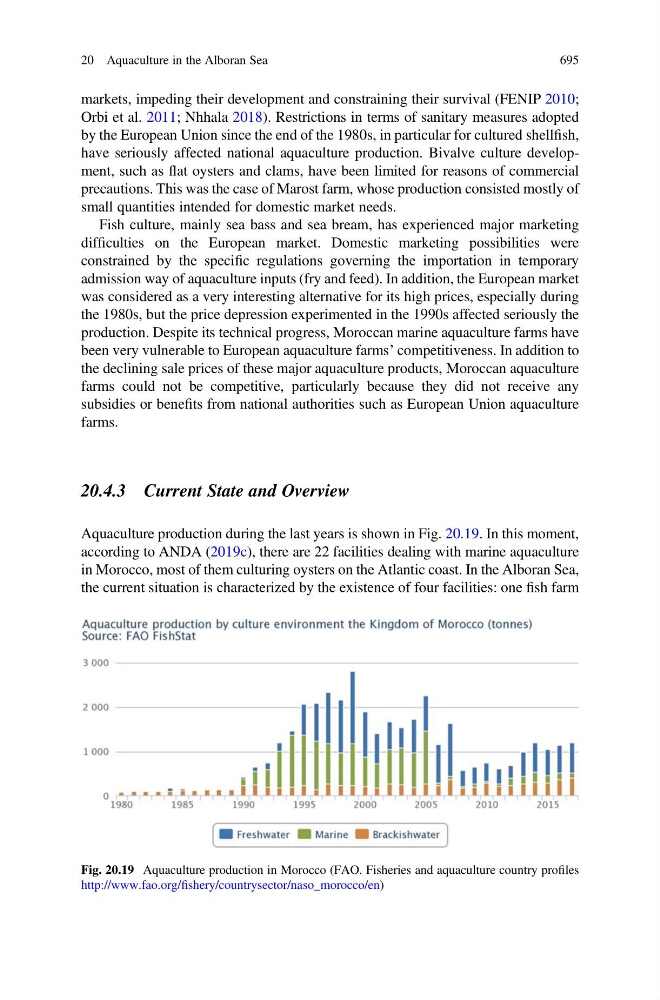
Aquaculture production during the last years is shown in Fig. 20.19. In this moment,
according to ANDA (2019c), there are 22 facilities dealing with marine aquaculture
in Morocco, most of them culturing oysters on the Atlantic coast. In the Alboran Sea,
the current situation is characterized by the existence of four facilities: one fish farm
Fig. 20.19 Aquaculture production in Morocco (FAO. Fisheries and aquaculture country profiles
http://www.fao.org/fishery/countrysector/naso_morocco/en)
20 Aquaculture in the Alboran Sea
695