

20.3.4 Sea Cucumber
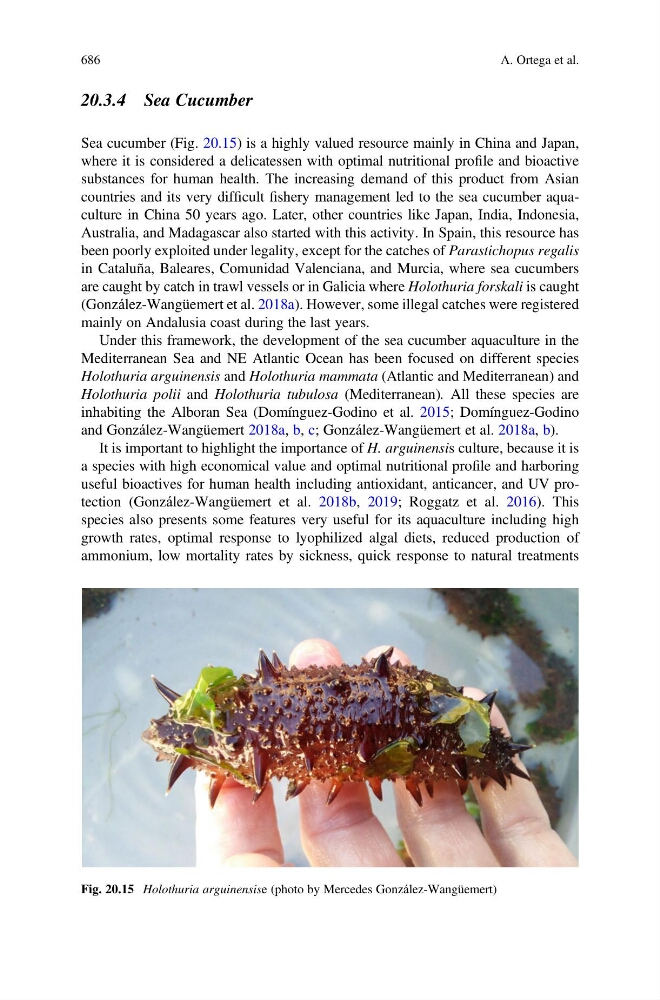
Sea cucumber (Fig. 20.15) is a highly valued resource mainly in China and Japan,
where it is considered a delicatessen with optimal nutritional profile and bioactive
substances for human health. The increasing demand of this product from Asian
countries and its very difficult fishery management led to the sea cucumber aquaculture in China 50 years ago. Later, other countries like Japan, India, Indonesia,
Australia, and Madagascar also started with this activity. In Spain, this resource has
been poorly exploited under legality, except for the catches of Parastichopus regalis
in Cataluña, Baleares, Comunidad Valenciana, and Murcia, where sea cucumbers
are caught by catch in trawl vessels or in Galicia where Holothuria forskali is caught
(González-Wangüemert et al. 2018a). However, some illegal catches were registered
mainly on Andalusia coast during the last years.
Under this framework, the development of the sea cucumber aquaculture in the
Mediterranean Sea and NE Atlantic Ocean has been focused on different species
Holothuria arguinensis and Holothuria mammata (Atlantic and Mediterranean) and
Holothuria polii and Holothuria tubulosa (Mediterranean). All these species are
inhabiting the Alboran Sea (Domínguez-Godino et al. 2015; Domínguez-Godino
and González-Wangüemert 2018a, b, c; González-Wangüemert et al. 2018a, b).
It is important to highlight the importance of H. arguinensis culture, because it is
a species with high economical value and optimal nutritional profile and harboring
useful bioactives for human health including antioxidant, anticancer, and UV protection (González-Wangüemert et al. 2018b, 2019; Roggatz et al. 2016). This
species also presents some features very useful for its aquaculture including high
growth rates, optimal response to lyophilized algal diets, reduced production of
ammonium, low mortality rates by sickness, quick response to natural treatments
Fig. 20.15 Holothuria arguinensise (photo by Mercedes González-Wangüemert)
686
A. Ortega et al.