

In view of this situation, it will not be easy for aquaculture of sea bream and sea
bass to develop in this area. Notwithstanding, two aspects can play in its favor: the
existence of some places where windy and stormy days are not prevalent. In the
Mediterranean, aquaculture is developing mainly in the open sea, and on days of
heavy weather, fish cannot be fed. Areas with lower hydrodynamic have a beneficial
effect on the growth of these fish so that they can achieve more days of feeding,
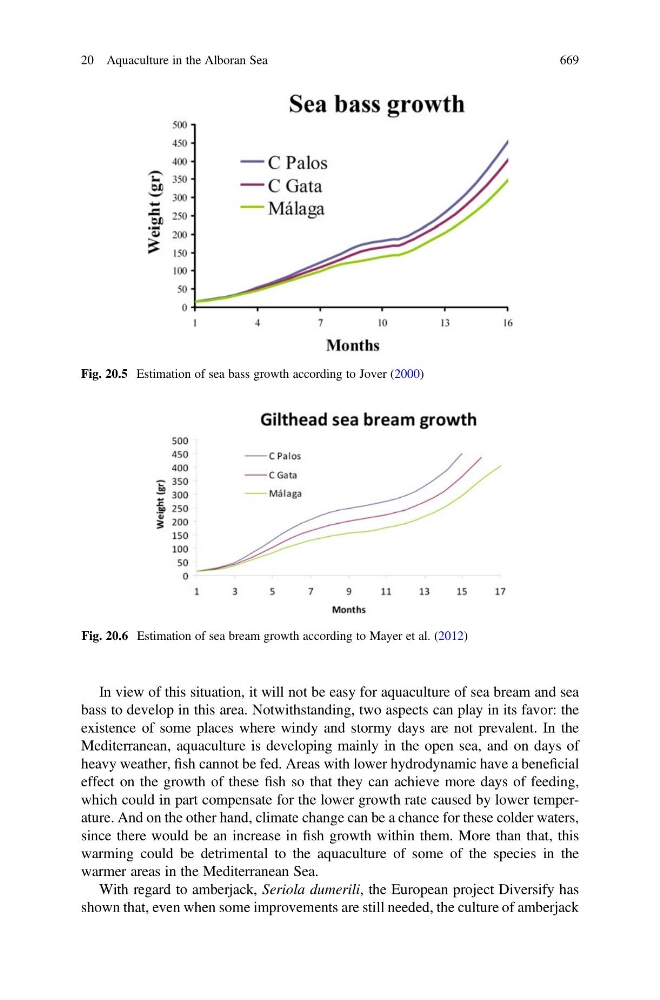
which could in part compensate for the lower growth rate caused by lower temperature. And on the other hand, climate change can be a chance for these colder waters,
since there would be an increase in fish growth within them. More than that, this
warming could be detrimental to the aquaculture of some of the species in the
warmer areas in the Mediterranean Sea.
With regard to amberjack, Seriola dumerili, the European project Diversify has
shown that, even when some improvements are still needed, the culture of amberjack
Fig. 20.5 Estimation of sea bass growth according to Jover (2000)
Fig. 20.6 Estimation of sea bream growth according to Mayer et al. (2012)
20 Aquaculture in the Alboran Sea
669