

20.3.1.2 Current State and Overview
At present, fish aquaculture in cages in the Spanish Alboran Sea has its focus almost
exclusively on sea bass, and there is only a facility running in Almeria. There is also
another installation in Granada belonging to the Aquaculture of Granada that in 2016
launched a project concerning the integrated multitrophic aquaculture (IMTA) of sea
bream in floating cages and also of mussel on longline but currently only produces
mussels. Another facility located in Malaga was recently closed.
There is also a nursery that pre-ongrows sea bream and sea bass fingerlings to sell
them to nearby facilities. In these last years, they focus on gilthead sea bream (about
7 million juveniles in 2017 and 10 million juveniles in 2018).
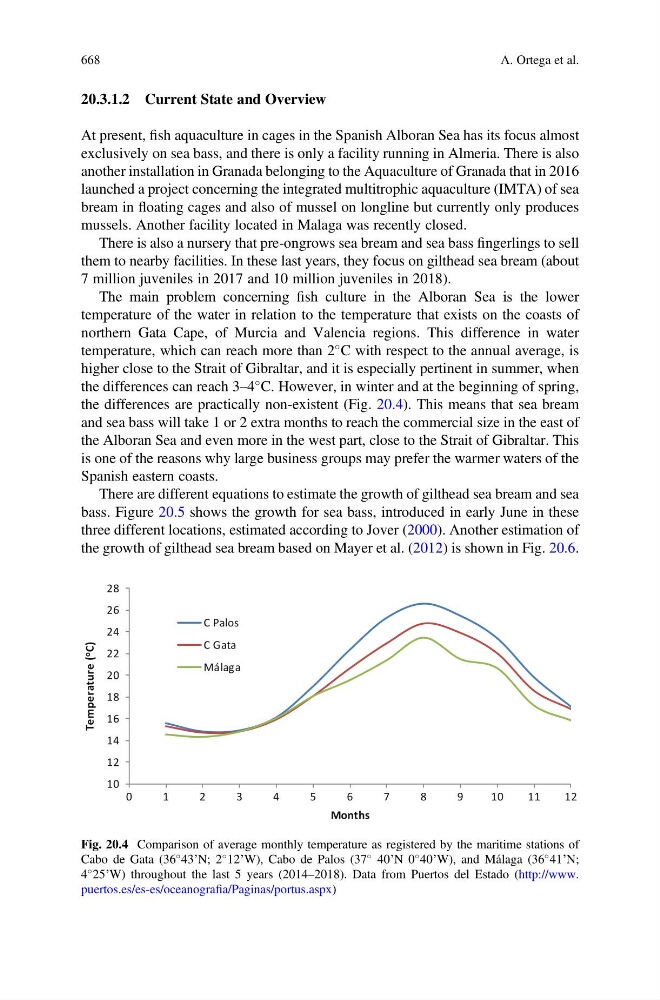
The main problem concerning fish culture in the Alboran Sea is the lower
temperature of the water in relation to the temperature that exists on the coasts of
northern Gata Cape, of Murcia and Valencia regions. This difference in water
temperature, which can reach more than 2
C with respect to the annual average, is
higher close to the Strait of Gibraltar, and it is especially pertinent in summer, when
the differences can reach 3–4
C. However, in winter and at the beginning of spring,
the differences are practically non-existent (Fig. 20.4). This means that sea bream
and sea bass will take 1 or 2 extra months to reach the commercial size in the east of
the Alboran Sea and even more in the west part, close to the Strait of Gibraltar. This
is one of the reasons why large business groups may prefer the warmer waters of the
Spanish eastern coasts.
There are different equations to estimate the growth of gilthead sea bream and sea
bass. Figure 20.5 shows the growth for sea bass, introduced in early June in these
three different locations, estimated according to Jover (2000). Another estimation of
the growth of gilthead sea bream based on Mayer et al. (2012) is shown in Fig. 20.6.
10
12
14
16
18
20
22
24
26
28
0
1
2
3
4
5
6
7
8
9
10
11
12
Temperature ( o
C)
Months
C Palos
C Gata
Málaga
Fig. 20.4 Comparison of average monthly temperature as registered by the maritime stations of
Cabo de Gata (36
43’N; 2
12’W), Cabo de Palos (37
40’N 0
40’W), and Málaga (36
41’N;
4
25’W) throughout the last 5 years (2014–2018). Data from Puertos del Estado (http://www.
puertos.es/es-es/oceanografia/Paginas/portus.aspx)
668
A. Ortega et al.