

basins than in the western basin. Biomass is higher between 200 and 400 m depth
with a marked size-dependent distribution by depth: small individuals are found at
the edge of the continental shelf while larger individuals are distributed in deeper
waters (Abelló et al. 2002). In addition, some authors suggest that adults move
during the spawning period to shallower waters, where the occurrence of larvae has
been detected (Dos Santos 1998). In the Northern Alboran Sea, one of the most
representative species on the upper continental slope (200–500 m depth) is
Plesionika heterocarpus and Solenocera membranacea (Ciércoles et al. 2018).
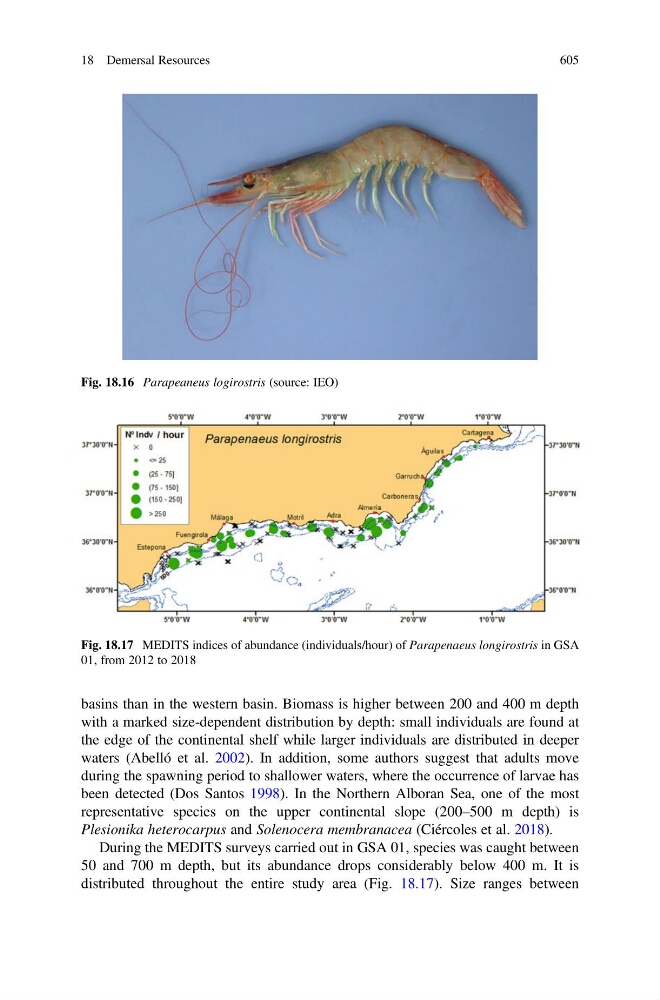
During the MEDITS surveys carried out in GSA 01, species was caught between
50 and 700 m depth, but its abundance drops considerably below 400 m. It is
distributed throughout the entire study area (Fig. 18.17). Size ranges between
Fig. 18.16 Parapeaneus logirostris (source: IEO)
Fig. 18.17 MEDITS indices of abundance (individuals/hour) of Parapenaeus longirostris in GSA
01, from 2012 to 2018
18 Demersal Resources
605
with a marked size-dependent distribution by depth: small individuals are found at
the edge of the continental shelf while larger individuals are distributed in deeper
waters (Abelló et al. 2002). In addition, some authors suggest that adults move
during the spawning period to shallower waters, where the occurrence of larvae has
been detected (Dos Santos 1998). In the Northern Alboran Sea, one of the most
representative species on the upper continental slope (200–500 m depth) is
Plesionika heterocarpus and Solenocera membranacea (Ciércoles et al. 2018).
During the MEDITS surveys carried out in GSA 01, species was caught between
50 and 700 m depth, but its abundance drops considerably below 400 m. It is
distributed throughout the entire study area (Fig. 18.17). Size ranges between
Fig. 18.16 Parapeaneus logirostris (source: IEO)
Fig. 18.17 MEDITS indices of abundance (individuals/hour) of Parapenaeus longirostris in GSA
01, from 2012 to 2018
18 Demersal Resources
605