

(Fig. 18.14) closely followed this pattern. A total of 35% of the landings from the
fishing grounds of the island were red shrimp, while the landings coming from the
fishing grounds closest to the peninsula only accounted for 5%.
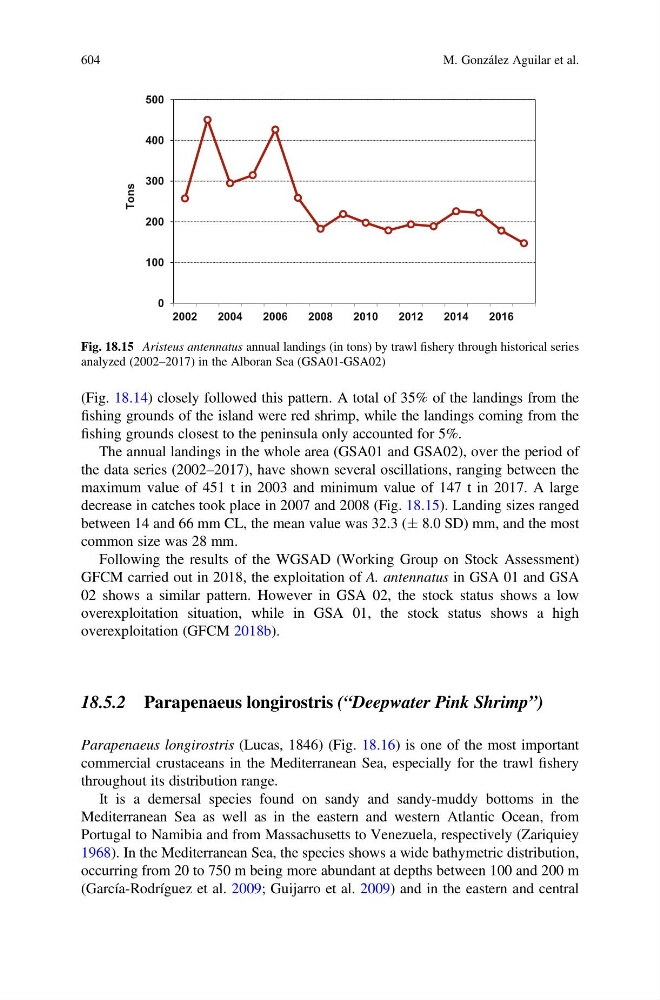
The annual landings in the whole area (GSA01 and GSA02), over the period of
the data series (2002–2017), have shown several oscillations, ranging between the
maximum value of 451 t in 2003 and minimum value of 147 t in 2017. A large
decrease in catches took place in 2007 and 2008 (Fig. 18.15). Landing sizes ranged
between 14 and 66 mm CL, the mean value was 32.3 (Æ 8.0 SD) mm, and the most
common size was 28 mm.
Following the results of the WGSAD (Working Group on Stock Assessment)
GFCM carried out in 2018, the exploitation of A. antennatus in GSA 01 and GSA
02 shows a similar pattern. However in GSA 02, the stock status shows a low
overexploitation situation, while in GSA 01, the stock status shows a high
overexploitation (GFCM 2018b).
18.5.2 Parapenaeus longirostris (“Deepwater Pink Shrimp”)
Parapenaeus longirostris (Lucas, 1846) (Fig. 18.16) is one of the most important
commercial crustaceans in the Mediterranean Sea, especially for the trawl fishery
throughout its distribution range.
It is a demersal species found on sandy and sandy-muddy bottoms in the
Mediterranean Sea as well as in the eastern and western Atlantic Ocean, from
Portugal to Namibia and from Massachusetts to Venezuela, respectively (Zariquiey
1968). In the Mediterranean Sea, the species shows a wide bathymetric distribution,
occurring from 20 to 750 m being more abundant at depths between 100 and 200 m
(García-Rodríguez et al. 2009; Guijarro et al. 2009) and in the eastern and central
0
100
200
300
400
500
2002
2004
2006
2008
2010
2012
2014
2016
Tons
Fig. 18.15 Aristeus antennatus annual landings (in tons) by trawl fishery through historical series
analyzed (2002–2017) in the Alboran Sea (GSA01-GSA02)
604
M. González Aguilar et al.
fishing grounds of the island were red shrimp, while the landings coming from the
fishing grounds closest to the peninsula only accounted for 5%.
The annual landings in the whole area (GSA01 and GSA02), over the period of
the data series (2002–2017), have shown several oscillations, ranging between the
maximum value of 451 t in 2003 and minimum value of 147 t in 2017. A large
decrease in catches took place in 2007 and 2008 (Fig. 18.15). Landing sizes ranged
between 14 and 66 mm CL, the mean value was 32.3 (Æ 8.0 SD) mm, and the most
common size was 28 mm.
Following the results of the WGSAD (Working Group on Stock Assessment)
GFCM carried out in 2018, the exploitation of A. antennatus in GSA 01 and GSA
02 shows a similar pattern. However in GSA 02, the stock status shows a low
overexploitation situation, while in GSA 01, the stock status shows a high
overexploitation (GFCM 2018b).
18.5.2 Parapenaeus longirostris (“Deepwater Pink Shrimp”)
Parapenaeus longirostris (Lucas, 1846) (Fig. 18.16) is one of the most important
commercial crustaceans in the Mediterranean Sea, especially for the trawl fishery
throughout its distribution range.
It is a demersal species found on sandy and sandy-muddy bottoms in the
Mediterranean Sea as well as in the eastern and western Atlantic Ocean, from
Portugal to Namibia and from Massachusetts to Venezuela, respectively (Zariquiey
1968). In the Mediterranean Sea, the species shows a wide bathymetric distribution,
occurring from 20 to 750 m being more abundant at depths between 100 and 200 m
(García-Rodríguez et al. 2009; Guijarro et al. 2009) and in the eastern and central
0
100
200
300
400
500
2002
2004
2006
2008
2010
2012
2014
2016
Tons
Fig. 18.15 Aristeus antennatus annual landings (in tons) by trawl fishery through historical series
analyzed (2002–2017) in the Alboran Sea (GSA01-GSA02)
604
M. González Aguilar et al.