

other Mediterranean bottom trawling fisheries. It can be considered as a
monoespecific fishery (Demestre and Martin 1993); it is very lucrative, due to the
high commercial value of the product, and it is performed at depths where the
abundance of other commercial species is very low, since the majority of the catch
is blue-red shrimp (Fig. 18.11). It does not usually contribute more than 5% of the
landings by weight; it can amount to 50% of the landings by value in some ports. The
fishing involves high risks as it is conducted in deep waters, and commercial
trawling catches are made on the continental slope depths of 350 to 850 m (Carbonell
et al. 2000), on grounds where the continental shelf and slope form submarine
canyons (Sardà et al. 1994, 1997; Tudela et al. 2003). Rose shrimp abundance is
higher on the slope in spring and summer (Sardà et al. 1997).
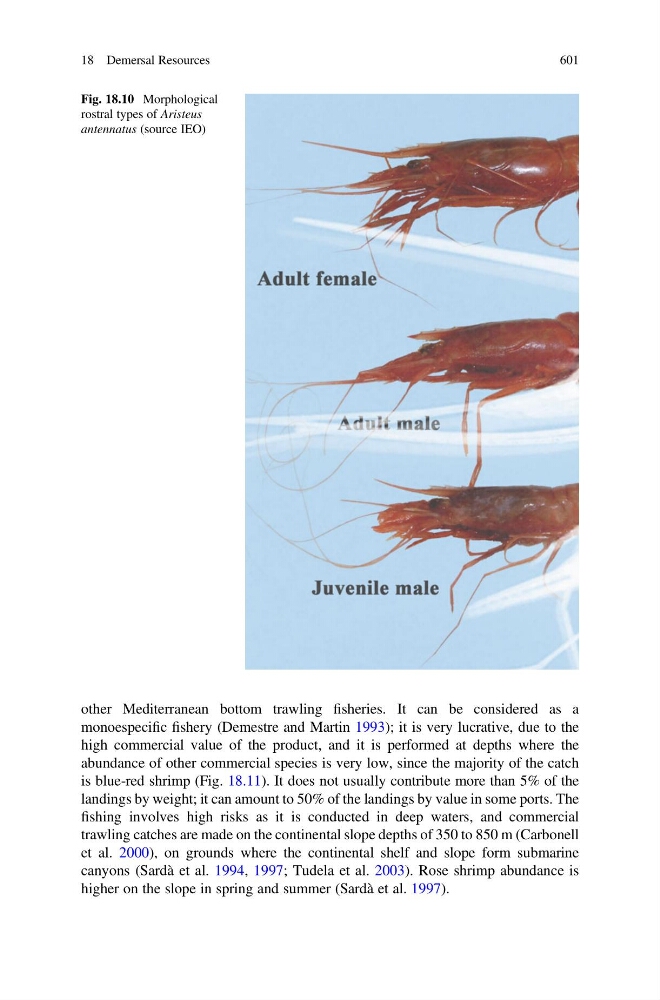
Fig. 18.10 Morphological
rostral types of Aristeus
antennatus (source IEO)
18 Demersal Resources
601
monoespecific fishery (Demestre and Martin 1993); it is very lucrative, due to the
high commercial value of the product, and it is performed at depths where the
abundance of other commercial species is very low, since the majority of the catch
is blue-red shrimp (Fig. 18.11). It does not usually contribute more than 5% of the
landings by weight; it can amount to 50% of the landings by value in some ports. The
fishing involves high risks as it is conducted in deep waters, and commercial
trawling catches are made on the continental slope depths of 350 to 850 m (Carbonell
et al. 2000), on grounds where the continental shelf and slope form submarine
canyons (Sardà et al. 1994, 1997; Tudela et al. 2003). Rose shrimp abundance is
higher on the slope in spring and summer (Sardà et al. 1997).
Fig. 18.10 Morphological
rostral types of Aristeus
antennatus (source IEO)
18 Demersal Resources
601