

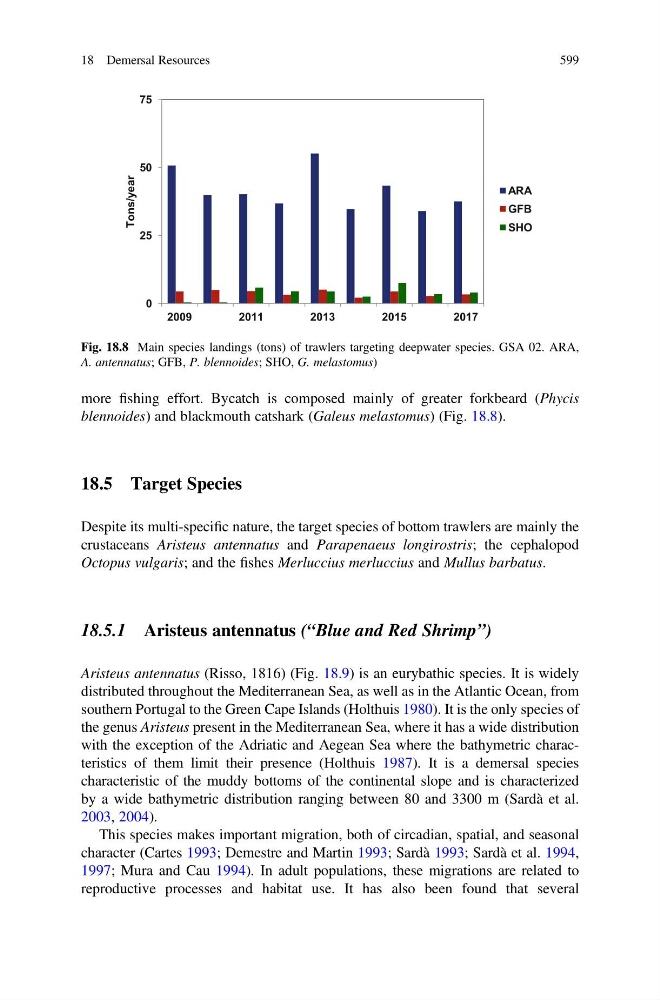
more fishing effort. Bycatch is composed mainly of greater forkbeard (Phycis
blennoides) and blackmouth catshark (Galeus melastomus) (Fig. 18.8).
18.5 Target Species
Despite its multi-specific nature, the target species of bottom trawlers are mainly the
crustaceans Aristeus antennatus and Parapenaeus longirostris; the cephalopod
Octopus vulgaris; and the fishes Merluccius merluccius and Mullus barbatus.
18.5.1 Aristeus antennatus (“Blue and Red Shrimp”)
Aristeus antennatus (Risso, 1816) (Fig. 18.9) is an eurybathic species. It is widely
distributed throughout the Mediterranean Sea, as well as in the Atlantic Ocean, from
southern Portugal to the Green Cape Islands (Holthuis 1980). It is the only species of
the genus Aristeus present in the Mediterranean Sea, where it has a wide distribution
with the exception of the Adriatic and Aegean Sea where the bathymetric characteristics of them limit their presence (Holthuis 1987). It is a demersal species
characteristic of the muddy bottoms of the continental slope and is characterized
by a wide bathymetric distribution ranging between 80 and 3300 m (Sardà et al.
2003, 2004).
This species makes important migration, both of circadian, spatial, and seasonal
character (Cartes 1993; Demestre and Martin 1993; Sardà 1993; Sardà et al. 1994,
1997; Mura and Cau 1994). In adult populations, these migrations are related to
reproductive processes and habitat use. It has also been found that several
0
25
50
75
2009
2011
2013
2015
2017
Tons/year
ARA
GFB
SHO
Fig. 18.8 Main species landings (tons) of trawlers targeting deepwater species. GSA 02. ARA,
A. antennatus; GFB, P. blennoides; SHO, G. melastomus)
18 Demersal Resources
599
blennoides) and blackmouth catshark (Galeus melastomus) (Fig. 18.8).
18.5 Target Species
Despite its multi-specific nature, the target species of bottom trawlers are mainly the
crustaceans Aristeus antennatus and Parapenaeus longirostris; the cephalopod
Octopus vulgaris; and the fishes Merluccius merluccius and Mullus barbatus.
18.5.1 Aristeus antennatus (“Blue and Red Shrimp”)
Aristeus antennatus (Risso, 1816) (Fig. 18.9) is an eurybathic species. It is widely
distributed throughout the Mediterranean Sea, as well as in the Atlantic Ocean, from
southern Portugal to the Green Cape Islands (Holthuis 1980). It is the only species of
the genus Aristeus present in the Mediterranean Sea, where it has a wide distribution
with the exception of the Adriatic and Aegean Sea where the bathymetric characteristics of them limit their presence (Holthuis 1987). It is a demersal species
characteristic of the muddy bottoms of the continental slope and is characterized
by a wide bathymetric distribution ranging between 80 and 3300 m (Sardà et al.
2003, 2004).
This species makes important migration, both of circadian, spatial, and seasonal
character (Cartes 1993; Demestre and Martin 1993; Sardà 1993; Sardà et al. 1994,
1997; Mura and Cau 1994). In adult populations, these migrations are related to
reproductive processes and habitat use. It has also been found that several
0
25
50
75
2009
2011
2013
2015
2017
Tons/year
ARA
GFB
SHO
Fig. 18.8 Main species landings (tons) of trawlers targeting deepwater species. GSA 02. ARA,
A. antennatus; GFB, P. blennoides; SHO, G. melastomus)
18 Demersal Resources
599