

of the interaction of the cold outflow with the marine boundary layer (SánchezLaulhé et al. 2017).
3.1.3 Aerosols
The Mediterranean region is affected by large aerosol loads from anthropogenic and
natural sources forcing the regional climate. These aerosols include sea-salt aerosols
from the Mediterranean Sea and the Atlantic Ocean, pollution aerosols from Europe,
dust from the Sahara Desert, and biomass burning aerosols. The largest and most
active dust source worldwide is the Sahara Desert. Saharan dust outbreaks can carry
large amounts of particulate material over the Mediterranean region and the Atlantic
Ocean. Figure 3.15 shows the global dust aerosol optical depth (AOD) averaged
over the period 2003–2012, with data taken from the ECMWF MACC reanalysis
dataset (Inness et al. 2013). Dust peaks in summer over the western Mediterranean
(not shown).
Dust affects climate modifying not only the radiative budget through their
microphysical and optical properties (e.g., Foltz and McPhaden 2008; Bergamo
et al. 2008). Moreover, Saharan dust deposition triggers marine phytoplankton
growth in both the North Atlantic (Ravelo-Pérez et al. 2016) and the Mediterranean
Sea (Gallisai et al. 2014), playing a key subsequent role in controlling the chemical
composition of sea water and hence in the carbon cycle (Conway and John 2014).
African dust emission and transport exhibit a high variability from diurnal
(Cuesta et al. 2009) to multi-decadal time scales (Wang et al. 2015; Evan et al.
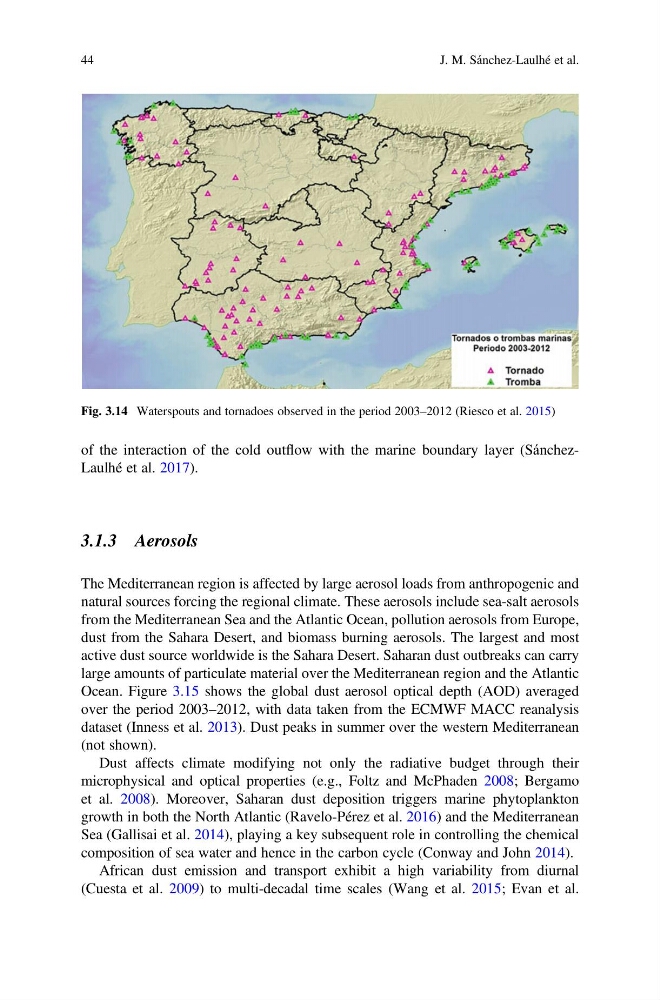
Fig. 3.14 Waterspouts and tornadoes observed in the period 2003–2012 (Riesco et al. 2015)
44
J. M. Sánchez-Laulhé et al.
3.1.3 Aerosols
The Mediterranean region is affected by large aerosol loads from anthropogenic and
natural sources forcing the regional climate. These aerosols include sea-salt aerosols
from the Mediterranean Sea and the Atlantic Ocean, pollution aerosols from Europe,
dust from the Sahara Desert, and biomass burning aerosols. The largest and most
active dust source worldwide is the Sahara Desert. Saharan dust outbreaks can carry
large amounts of particulate material over the Mediterranean region and the Atlantic
Ocean. Figure 3.15 shows the global dust aerosol optical depth (AOD) averaged
over the period 2003–2012, with data taken from the ECMWF MACC reanalysis
dataset (Inness et al. 2013). Dust peaks in summer over the western Mediterranean
(not shown).
Dust affects climate modifying not only the radiative budget through their
microphysical and optical properties (e.g., Foltz and McPhaden 2008; Bergamo
et al. 2008). Moreover, Saharan dust deposition triggers marine phytoplankton
growth in both the North Atlantic (Ravelo-Pérez et al. 2016) and the Mediterranean
Sea (Gallisai et al. 2014), playing a key subsequent role in controlling the chemical
composition of sea water and hence in the carbon cycle (Conway and John 2014).
African dust emission and transport exhibit a high variability from diurnal
(Cuesta et al. 2009) to multi-decadal time scales (Wang et al. 2015; Evan et al.
Fig. 3.14 Waterspouts and tornadoes observed in the period 2003–2012 (Riesco et al. 2015)
44
J. M. Sánchez-Laulhé et al.