

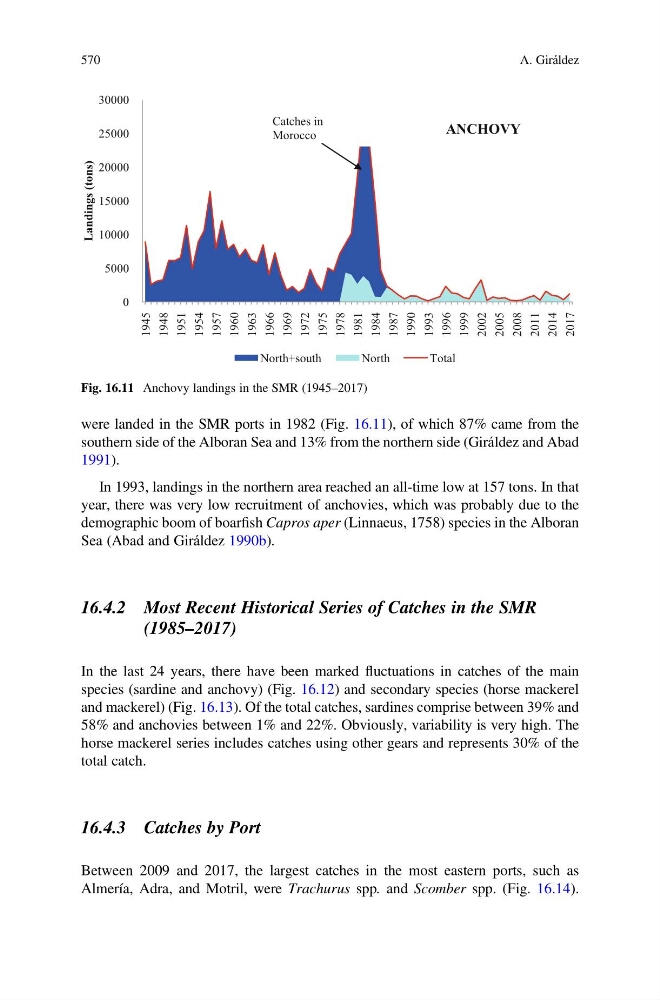
were landed in the SMR ports in 1982 (Fig. 16.11), of which 87% came from the
southern side of the Alboran Sea and 13% from the northern side (Giráldez and Abad
1991).
In 1993, landings in the northern area reached an all-time low at 157 tons. In that
year, there was very low recruitment of anchovies, which was probably due to the
demographic boom of boarfish Capros aper (Linnaeus, 1758) species in the Alboran
Sea (Abad and Giráldez 1990b).
16.4.2 Most Recent Historical Series of Catches in the SMR
(1985–2017)
In the last 24 years, there have been marked fluctuations in catches of the main
species (sardine and anchovy) (Fig. 16.12) and secondary species (horse mackerel
and mackerel) (Fig. 16.13). Of the total catches, sardines comprise between 39% and
58% and anchovies between 1% and 22%. Obviously, variability is very high. The
horse mackerel series includes catches using other gears and represents 30% of the
total catch.
16.4.3 Catches by Port
Between 2009 and 2017, the largest catches in the most eastern ports, such as
Almería, Adra, and Motril, were Trachurus spp. and Scomber spp. (Fig. 16.14).
0
5000
10000
15000
20000
25000
30000
1945
1948
1951
1954
1957
1960
1963
1966
1969
1972
1975
1978
1981
1984
1987
1990
1993
1996
1999
2002
2005
2008
2011
2014
2017
Landings (tons)
ANCHOVY
North+south
North
Total
Catches in
Morocco
Fig. 16.11 Anchovy landings in the SMR (1945–2017)
570
A. Giráldez
southern side of the Alboran Sea and 13% from the northern side (Giráldez and Abad
1991).
In 1993, landings in the northern area reached an all-time low at 157 tons. In that
year, there was very low recruitment of anchovies, which was probably due to the
demographic boom of boarfish Capros aper (Linnaeus, 1758) species in the Alboran
Sea (Abad and Giráldez 1990b).
16.4.2 Most Recent Historical Series of Catches in the SMR
(1985–2017)
In the last 24 years, there have been marked fluctuations in catches of the main
species (sardine and anchovy) (Fig. 16.12) and secondary species (horse mackerel
and mackerel) (Fig. 16.13). Of the total catches, sardines comprise between 39% and
58% and anchovies between 1% and 22%. Obviously, variability is very high. The
horse mackerel series includes catches using other gears and represents 30% of the
total catch.
16.4.3 Catches by Port
Between 2009 and 2017, the largest catches in the most eastern ports, such as
Almería, Adra, and Motril, were Trachurus spp. and Scomber spp. (Fig. 16.14).
0
5000
10000
15000
20000
25000
30000
1945
1948
1951
1954
1957
1960
1963
1966
1969
1972
1975
1978
1981
1984
1987
1990
1993
1996
1999
2002
2005
2008
2011
2014
2017
Landings (tons)
ANCHOVY
North+south
North
Total
Catches in
Morocco
Fig. 16.11 Anchovy landings in the SMR (1945–2017)
570
A. Giráldez