

16.4 Historical Series of Catches
16.4.1 Historical Series of Catches in the SMR (1945–2017)
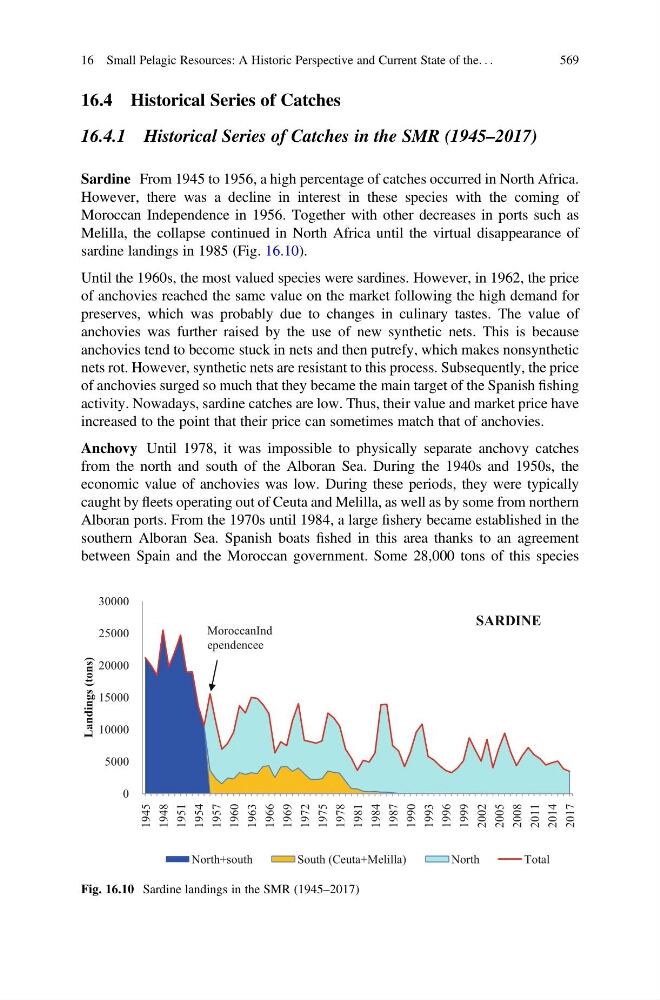
Sardine From 1945 to 1956, a high percentage of catches occurred in North Africa.
However, there was a decline in interest in these species with the coming of
Moroccan Independence in 1956. Together with other decreases in ports such as
Melilla, the collapse continued in North Africa until the virtual disappearance of
sardine landings in 1985 (Fig. 16.10).
Until the 1960s, the most valued species were sardines. However, in 1962, the price
of anchovies reached the same value on the market following the high demand for
preserves, which was probably due to changes in culinary tastes. The value of
anchovies was further raised by the use of new synthetic nets. This is because
anchovies tend to become stuck in nets and then putrefy, which makes nonsynthetic
nets rot. However, synthetic nets are resistant to this process. Subsequently, the price
of anchovies surged so much that they became the main target of the Spanish fishing
activity. Nowadays, sardine catches are low. Thus, their value and market price have
increased to the point that their price can sometimes match that of anchovies.
Anchovy Until 1978, it was impossible to physically separate anchovy catches
from the north and south of the Alboran Sea. During the 1940s and 1950s, the
economic value of anchovies was low. During these periods, they were typically
caught by fleets operating out of Ceuta and Melilla, as well as by some from northern
Alboran ports. From the 1970s until 1984, a large fishery became established in the
southern Alboran Sea. Spanish boats fished in this area thanks to an agreement
between Spain and the Moroccan government. Some 28,000 tons of this species
0
5000
10000
15000
20000
25000
30000
1945
1948
1951
1954
1957
1960
1963
1966
1969
1972
1975
1978
1981
1984
1987
1990
1993
1996
1999
2002
2005
2008
2011
2014
2017
Landings (tons)
SARDINE
North+south
South (Ceuta+Melilla)
North
Total
MoroccanInd
ependencee
Fig. 16.10 Sardine landings in the SMR (1945–2017)
16 Small Pelagic Resources: A Historic Perspective and Current State of the. . .
569
16.4.1 Historical Series of Catches in the SMR (1945–2017)
Sardine From 1945 to 1956, a high percentage of catches occurred in North Africa.
However, there was a decline in interest in these species with the coming of
Moroccan Independence in 1956. Together with other decreases in ports such as
Melilla, the collapse continued in North Africa until the virtual disappearance of
sardine landings in 1985 (Fig. 16.10).
Until the 1960s, the most valued species were sardines. However, in 1962, the price
of anchovies reached the same value on the market following the high demand for
preserves, which was probably due to changes in culinary tastes. The value of
anchovies was further raised by the use of new synthetic nets. This is because
anchovies tend to become stuck in nets and then putrefy, which makes nonsynthetic
nets rot. However, synthetic nets are resistant to this process. Subsequently, the price
of anchovies surged so much that they became the main target of the Spanish fishing
activity. Nowadays, sardine catches are low. Thus, their value and market price have
increased to the point that their price can sometimes match that of anchovies.
Anchovy Until 1978, it was impossible to physically separate anchovy catches
from the north and south of the Alboran Sea. During the 1940s and 1950s, the
economic value of anchovies was low. During these periods, they were typically
caught by fleets operating out of Ceuta and Melilla, as well as by some from northern
Alboran ports. From the 1970s until 1984, a large fishery became established in the
southern Alboran Sea. Spanish boats fished in this area thanks to an agreement
between Spain and the Moroccan government. Some 28,000 tons of this species
0
5000
10000
15000
20000
25000
30000
1945
1948
1951
1954
1957
1960
1963
1966
1969
1972
1975
1978
1981
1984
1987
1990
1993
1996
1999
2002
2005
2008
2011
2014
2017
Landings (tons)
SARDINE
North+south
South (Ceuta+Melilla)
North
Total
MoroccanInd
ependencee
Fig. 16.10 Sardine landings in the SMR (1945–2017)
16 Small Pelagic Resources: A Historic Perspective and Current State of the. . .
569