

damming in the Mediterranean basin. Frequent surges of cold air from the North
Atlantic cross Western Europe and fill the western Mediterranean with subsiding air,
being often these air masses shallow enough to be blocked by coastal mountain
ranges. In these circumstances, the cool air filling the Alboran Sea escapes through
the Strait of Gibraltar toward the Atlantic Ocean like water through a broken dam
(Scorer 1986).
High-speed levanter winds (18–24 ms
À1 ) occur at about the same frequency in
summer and winter, but frequency of these wind synoptic events strongly increases
in the summer just following an El Niño event (Sanchez-Laulhe 2018).
In the Western Mediterranean, cold air associated to extratropical cyclones enters
most frequently through northern mountain gaps, principally Rhone and Ebro
Valleys. This cold air mass can expand first southward along the coastal mountain
ranges at the eastern of the Iberian Peninsula, and then westward, along the north
coast of the Alboran Sea. This expansion is associated to the displacement along the
coast of a trough or a sea level pressure low, generated by downslope flow to the
south of an extratropical cyclone. Sometimes, the easterly “cold” Mediterranean
airstream converges over the Alboran Sea with the warm terral winds creating strong
temperature, humidity, and density gradients. These gradients create imbalances on
the north coast resulting in the advance westward of the cold air as a density stream
along the coast (Sánchez-Laulhé and Polvorinos 1999).
Because of damming, very often, the Alboran sub-basin behaves as a channel for
the atmospheric marine boundary layer, as reflected in the climatological wind roses
shown in Fig. 3.13a, b (Guijarro et al. 2015).
Other phenomena related to wind blocking in the marine boundary layer (MBL)
are the formation of hydraulic features along the coast when flows are transcritical
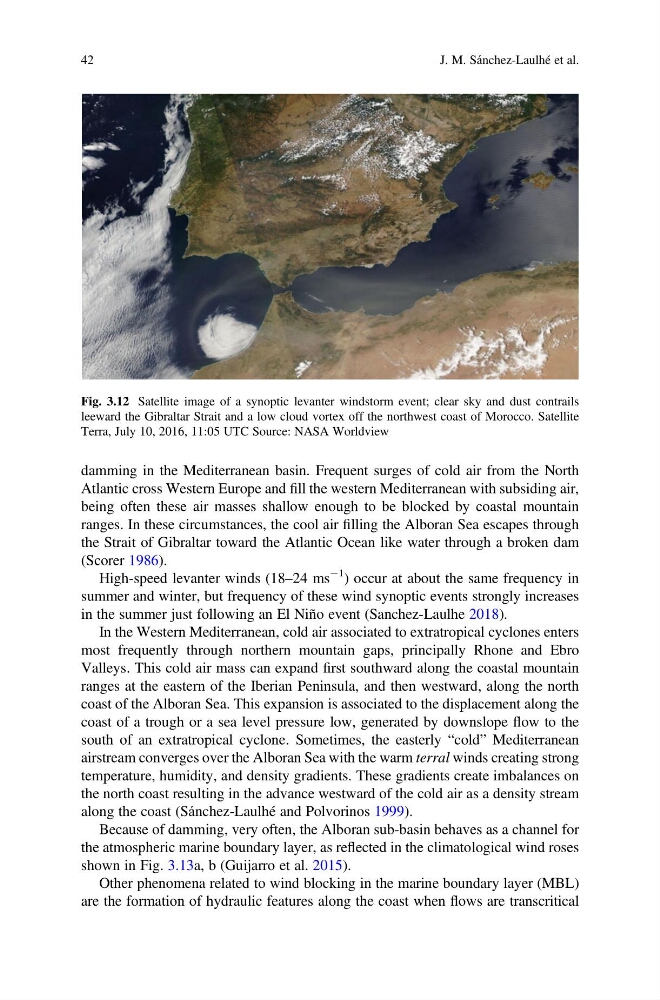
Fig. 3.12 Satellite image of a synoptic levanter windstorm event; clear sky and dust contrails
leeward the Gibraltar Strait and a low cloud vortex off the northwest coast of Morocco. Satellite
Terra, July 10, 2016, 11:05 UTC Source: NASA Worldview
42
J. M. Sánchez-Laulhé et al.
Atlantic cross Western Europe and fill the western Mediterranean with subsiding air,
being often these air masses shallow enough to be blocked by coastal mountain
ranges. In these circumstances, the cool air filling the Alboran Sea escapes through
the Strait of Gibraltar toward the Atlantic Ocean like water through a broken dam
(Scorer 1986).
High-speed levanter winds (18–24 ms
À1 ) occur at about the same frequency in
summer and winter, but frequency of these wind synoptic events strongly increases
in the summer just following an El Niño event (Sanchez-Laulhe 2018).
In the Western Mediterranean, cold air associated to extratropical cyclones enters
most frequently through northern mountain gaps, principally Rhone and Ebro
Valleys. This cold air mass can expand first southward along the coastal mountain
ranges at the eastern of the Iberian Peninsula, and then westward, along the north
coast of the Alboran Sea. This expansion is associated to the displacement along the
coast of a trough or a sea level pressure low, generated by downslope flow to the
south of an extratropical cyclone. Sometimes, the easterly “cold” Mediterranean
airstream converges over the Alboran Sea with the warm terral winds creating strong
temperature, humidity, and density gradients. These gradients create imbalances on
the north coast resulting in the advance westward of the cold air as a density stream
along the coast (Sánchez-Laulhé and Polvorinos 1999).
Because of damming, very often, the Alboran sub-basin behaves as a channel for
the atmospheric marine boundary layer, as reflected in the climatological wind roses
shown in Fig. 3.13a, b (Guijarro et al. 2015).
Other phenomena related to wind blocking in the marine boundary layer (MBL)
are the formation of hydraulic features along the coast when flows are transcritical
Fig. 3.12 Satellite image of a synoptic levanter windstorm event; clear sky and dust contrails
leeward the Gibraltar Strait and a low cloud vortex off the northwest coast of Morocco. Satellite
Terra, July 10, 2016, 11:05 UTC Source: NASA Worldview
42
J. M. Sánchez-Laulhé et al.