

growth occurs during spring when temperatures increase (Ramírez et al. 2004;
Mercado et al. 2007).
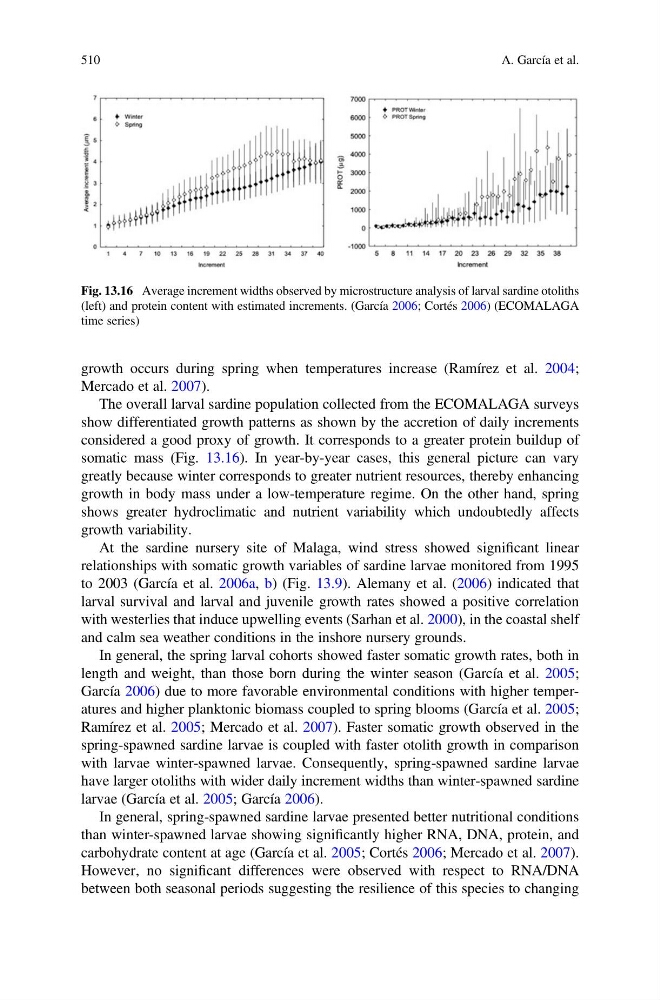
The overall larval sardine population collected from the ECOMALAGA surveys
show differentiated growth patterns as shown by the accretion of daily increments
considered a good proxy of growth. It corresponds to a greater protein buildup of
somatic mass (Fig. 13.16). In year-by-year cases, this general picture can vary
greatly because winter corresponds to greater nutrient resources, thereby enhancing
growth in body mass under a low-temperature regime. On the other hand, spring
shows greater hydroclimatic and nutrient variability which undoubtedly affects
growth variability.
At the sardine nursery site of Malaga, wind stress showed significant linear
relationships with somatic growth variables of sardine larvae monitored from 1995
to 2003 (García et al. 2006a, b) (Fig. 13.9). Alemany et al. (2006) indicated that
larval survival and larval and juvenile growth rates showed a positive correlation
with westerlies that induce upwelling events (Sarhan et al. 2000), in the coastal shelf
and calm sea weather conditions in the inshore nursery grounds.
In general, the spring larval cohorts showed faster somatic growth rates, both in
length and weight, than those born during the winter season (García et al. 2005;
García 2006) due to more favorable environmental conditions with higher temperatures and higher planktonic biomass coupled to spring blooms (García et al. 2005;
Ramírez et al. 2005; Mercado et al. 2007). Faster somatic growth observed in the
spring-spawned sardine larvae is coupled with faster otolith growth in comparison
with larvae winter-spawned larvae. Consequently, spring-spawned sardine larvae
have larger otoliths with wider daily increment widths than winter-spawned sardine
larvae (García et al. 2005; García 2006).
In general, spring-spawned sardine larvae presented better nutritional conditions
than winter-spawned larvae showing significantly higher RNA, DNA, protein, and
carbohydrate content at age (García et al. 2005; Cortés 2006; Mercado et al. 2007).
However, no significant differences were observed with respect to RNA/DNA
between both seasonal periods suggesting the resilience of this species to changing
Fig. 13.16 Average increment widths observed by microstructure analysis of larval sardine otoliths
(left) and protein content with estimated increments. (García 2006; Cortés 2006) (ECOMALAGA
time series)
510
A. García et al.
Mercado et al. 2007).
The overall larval sardine population collected from the ECOMALAGA surveys
show differentiated growth patterns as shown by the accretion of daily increments
considered a good proxy of growth. It corresponds to a greater protein buildup of
somatic mass (Fig. 13.16). In year-by-year cases, this general picture can vary
greatly because winter corresponds to greater nutrient resources, thereby enhancing
growth in body mass under a low-temperature regime. On the other hand, spring
shows greater hydroclimatic and nutrient variability which undoubtedly affects
growth variability.
At the sardine nursery site of Malaga, wind stress showed significant linear
relationships with somatic growth variables of sardine larvae monitored from 1995
to 2003 (García et al. 2006a, b) (Fig. 13.9). Alemany et al. (2006) indicated that
larval survival and larval and juvenile growth rates showed a positive correlation
with westerlies that induce upwelling events (Sarhan et al. 2000), in the coastal shelf
and calm sea weather conditions in the inshore nursery grounds.
In general, the spring larval cohorts showed faster somatic growth rates, both in
length and weight, than those born during the winter season (García et al. 2005;
García 2006) due to more favorable environmental conditions with higher temperatures and higher planktonic biomass coupled to spring blooms (García et al. 2005;
Ramírez et al. 2005; Mercado et al. 2007). Faster somatic growth observed in the
spring-spawned sardine larvae is coupled with faster otolith growth in comparison
with larvae winter-spawned larvae. Consequently, spring-spawned sardine larvae
have larger otoliths with wider daily increment widths than winter-spawned sardine
larvae (García et al. 2005; García 2006).
In general, spring-spawned sardine larvae presented better nutritional conditions
than winter-spawned larvae showing significantly higher RNA, DNA, protein, and
carbohydrate content at age (García et al. 2005; Cortés 2006; Mercado et al. 2007).
However, no significant differences were observed with respect to RNA/DNA
between both seasonal periods suggesting the resilience of this species to changing
Fig. 13.16 Average increment widths observed by microstructure analysis of larval sardine otoliths
(left) and protein content with estimated increments. (García 2006; Cortés 2006) (ECOMALAGA
time series)
510
A. García et al.