

unlike the beach seine (boliche) did not trawl over the seabed (Fig. 13.2). Such was
the expansion of this type of gear during the early 1980s when as many as over a
hundred small boats could be counted from the beach near the Malaga port entrance
(A. García, unpublished data counts).
.
Upon the integration of young scientists in the late 1970s to work in the
Oceanographic Center of Malaga, it was considered necessary to provide proof for
banning this obsolete fishing practice. Fry fishing was so intensive and out of
regulation control measures that strong management measures were urgently
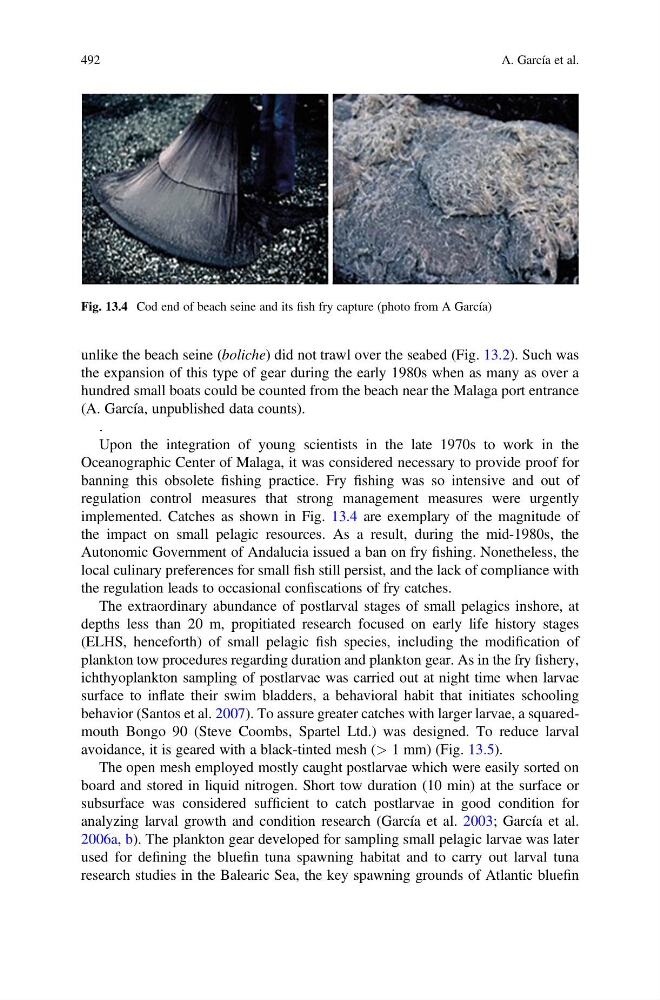
implemented. Catches as shown in Fig. 13.4 are exemplary of the magnitude of
the impact on small pelagic resources. As a result, during the mid-1980s, the
Autonomic Government of Andalucia issued a ban on fry fishing. Nonetheless, the
local culinary preferences for small fish still persist, and the lack of compliance with
the regulation leads to occasional confiscations of fry catches.
The extraordinary abundance of postlarval stages of small pelagics inshore, at
depths less than 20 m, propitiated research focused on early life history stages
(ELHS, henceforth) of small pelagic fish species, including the modification of
plankton tow procedures regarding duration and plankton gear. As in the fry fishery,
ichthyoplankton sampling of postlarvae was carried out at night time when larvae
surface to inflate their swim bladders, a behavioral habit that initiates schooling
behavior (Santos et al. 2007). To assure greater catches with larger larvae, a squaredmouth Bongo 90 (Steve Coombs, Spartel Ltd.) was designed. To reduce larval
avoidance, it is geared with a black-tinted mesh (> 1 mm) (Fig. 13.5).
The open mesh employed mostly caught postlarvae which were easily sorted on
board and stored in liquid nitrogen. Short tow duration (10 min) at the surface or
subsurface was considered sufficient to catch postlarvae in good condition for
analyzing larval growth and condition research (García et al. 2003; García et al.
2006a, b). The plankton gear developed for sampling small pelagic larvae was later
used for defining the bluefin tuna spawning habitat and to carry out larval tuna
research studies in the Balearic Sea, the key spawning grounds of Atlantic bluefin
Fig. 13.4 Cod end of beach seine and its fish fry capture (photo from A García)
492
A. García et al.
the expansion of this type of gear during the early 1980s when as many as over a
hundred small boats could be counted from the beach near the Malaga port entrance
(A. García, unpublished data counts).
.
Upon the integration of young scientists in the late 1970s to work in the
Oceanographic Center of Malaga, it was considered necessary to provide proof for
banning this obsolete fishing practice. Fry fishing was so intensive and out of
regulation control measures that strong management measures were urgently
implemented. Catches as shown in Fig. 13.4 are exemplary of the magnitude of
the impact on small pelagic resources. As a result, during the mid-1980s, the
Autonomic Government of Andalucia issued a ban on fry fishing. Nonetheless, the
local culinary preferences for small fish still persist, and the lack of compliance with
the regulation leads to occasional confiscations of fry catches.
The extraordinary abundance of postlarval stages of small pelagics inshore, at
depths less than 20 m, propitiated research focused on early life history stages
(ELHS, henceforth) of small pelagic fish species, including the modification of
plankton tow procedures regarding duration and plankton gear. As in the fry fishery,
ichthyoplankton sampling of postlarvae was carried out at night time when larvae
surface to inflate their swim bladders, a behavioral habit that initiates schooling
behavior (Santos et al. 2007). To assure greater catches with larger larvae, a squaredmouth Bongo 90 (Steve Coombs, Spartel Ltd.) was designed. To reduce larval
avoidance, it is geared with a black-tinted mesh (> 1 mm) (Fig. 13.5).
The open mesh employed mostly caught postlarvae which were easily sorted on
board and stored in liquid nitrogen. Short tow duration (10 min) at the surface or
subsurface was considered sufficient to catch postlarvae in good condition for
analyzing larval growth and condition research (García et al. 2003; García et al.
2006a, b). The plankton gear developed for sampling small pelagic larvae was later
used for defining the bluefin tuna spawning habitat and to carry out larval tuna
research studies in the Balearic Sea, the key spawning grounds of Atlantic bluefin
Fig. 13.4 Cod end of beach seine and its fish fry capture (photo from A García)
492
A. García et al.