

lower layers, the north-south hydrodynamic connectivity could be more easily
achievable since the AJ is no longer a constraining feature. However, velocities
there are much smaller, one order magnitude less than in the surface layer, a fact that
does not help connecting both shores: the sluggishness of the flow is the limiting
factor in this case.
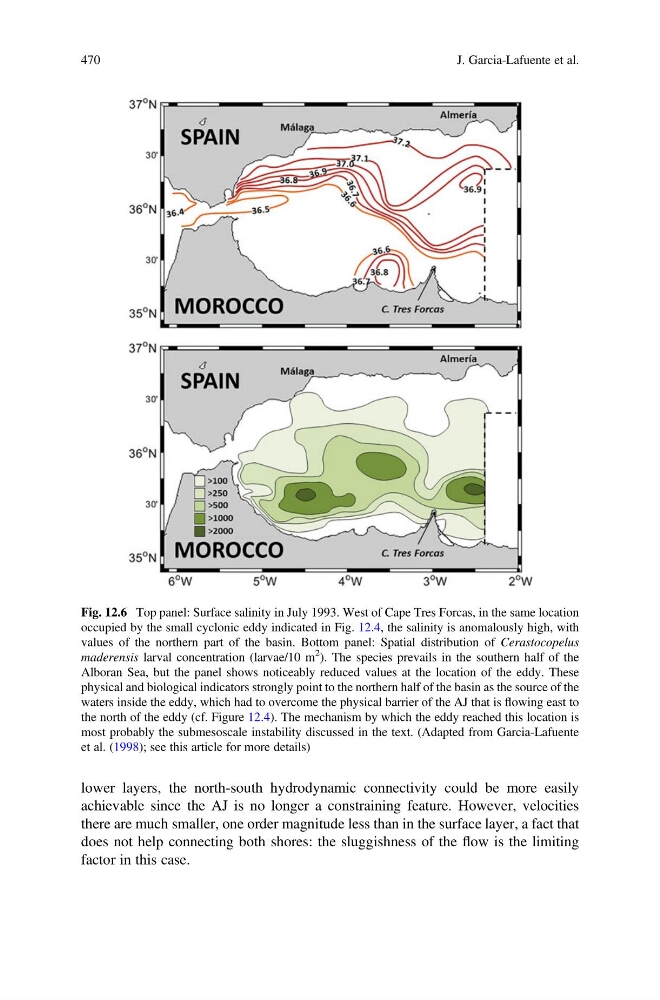
Fig. 12.6 Top panel: Surface salinity in July 1993. West of Cape Tres Forcas, in the same location
occupied by the small cyclonic eddy indicated in Fig. 12.4, the salinity is anomalously high, with
values of the northern part of the basin. Bottom panel: Spatial distribution of Cerastocopelus
maderensis larval concentration (larvae/10 m
2
). The species prevails in the southern half of the
Alboran Sea, but the panel shows noticeably reduced values at the location of the eddy. These
physical and biological indicators strongly point to the northern half of the basin as the source of the
waters inside the eddy, which had to overcome the physical barrier of the AJ that is flowing east to
the north of the eddy (cf. Figure 12.4). The mechanism by which the eddy reached this location is
most probably the submesoscale instability discussed in the text. (Adapted from Garcia-Lafuente
et al. (1998); see this article for more details)
470
J. Garcia-Lafuente et al.
achievable since the AJ is no longer a constraining feature. However, velocities
there are much smaller, one order magnitude less than in the surface layer, a fact that
does not help connecting both shores: the sluggishness of the flow is the limiting
factor in this case.
Fig. 12.6 Top panel: Surface salinity in July 1993. West of Cape Tres Forcas, in the same location
occupied by the small cyclonic eddy indicated in Fig. 12.4, the salinity is anomalously high, with
values of the northern part of the basin. Bottom panel: Spatial distribution of Cerastocopelus
maderensis larval concentration (larvae/10 m
2
). The species prevails in the southern half of the
Alboran Sea, but the panel shows noticeably reduced values at the location of the eddy. These
physical and biological indicators strongly point to the northern half of the basin as the source of the
waters inside the eddy, which had to overcome the physical barrier of the AJ that is flowing east to
the north of the eddy (cf. Figure 12.4). The mechanism by which the eddy reached this location is
most probably the submesoscale instability discussed in the text. (Adapted from Garcia-Lafuente
et al. (1998); see this article for more details)
470
J. Garcia-Lafuente et al.