

systems in the Atlantic, where filaments generated by favorable winds transport
labile products from coastal areas offshore across the upwelling jet. Comparable
processes have been modelled in the Strait of Sicily in the Mediterranean, where
wind-induced upwelling can produce larval drifts across the Atlantic-Ionian stream,
which is the prolongation of the Atlantic inflow (Falcini et al. 2015), allowing for
chances of connecting north (Sicilian) and south (African) shores.
The vertical reach of the surface structures is 100–200 m, which is the typical
thickness of the Atlantic layer in the Alboran Sea.
1 Below these depths, i.e., in the
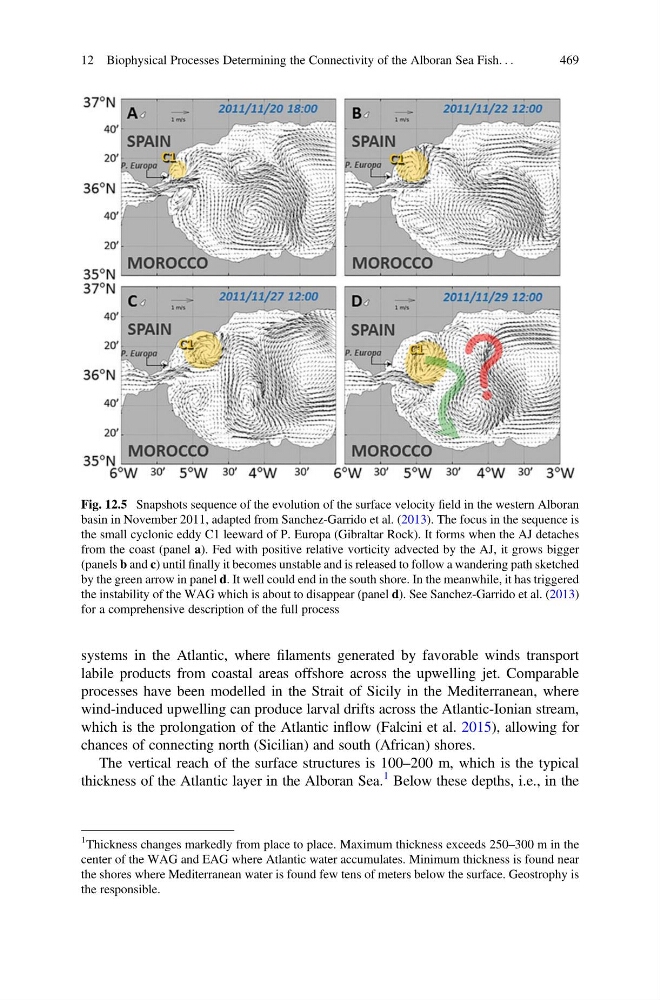
Fig. 12.5 Snapshots sequence of the evolution of the surface velocity field in the western Alboran
basin in November 2011, adapted from Sanchez-Garrido et al. (2013). The focus in the sequence is
the small cyclonic eddy C1 leeward of P. Europa (Gibraltar Rock). It forms when the AJ detaches
from the coast (panel a). Fed with positive relative vorticity advected by the AJ, it grows bigger
(panels b and c) until finally it becomes unstable and is released to follow a wandering path sketched
by the green arrow in panel d. It well could end in the south shore. In the meanwhile, it has triggered
the instability of the WAG which is about to disappear (panel d). See Sanchez-Garrido et al. (2013)
for a comprehensive description of the full process
1 Thickness changes markedly from place to place. Maximum thickness exceeds 250–300 m in the
center of the WAG and EAG where Atlantic water accumulates. Minimum thickness is found near
the shores where Mediterranean water is found few tens of meters below the surface. Geostrophy is
the responsible.
12 Biophysical Processes Determining the Connectivity of the Alboran Sea Fish. . .
469
labile products from coastal areas offshore across the upwelling jet. Comparable
processes have been modelled in the Strait of Sicily in the Mediterranean, where
wind-induced upwelling can produce larval drifts across the Atlantic-Ionian stream,
which is the prolongation of the Atlantic inflow (Falcini et al. 2015), allowing for
chances of connecting north (Sicilian) and south (African) shores.
The vertical reach of the surface structures is 100–200 m, which is the typical
thickness of the Atlantic layer in the Alboran Sea.
1 Below these depths, i.e., in the
Fig. 12.5 Snapshots sequence of the evolution of the surface velocity field in the western Alboran
basin in November 2011, adapted from Sanchez-Garrido et al. (2013). The focus in the sequence is
the small cyclonic eddy C1 leeward of P. Europa (Gibraltar Rock). It forms when the AJ detaches
from the coast (panel a). Fed with positive relative vorticity advected by the AJ, it grows bigger
(panels b and c) until finally it becomes unstable and is released to follow a wandering path sketched
by the green arrow in panel d. It well could end in the south shore. In the meanwhile, it has triggered
the instability of the WAG which is about to disappear (panel d). See Sanchez-Garrido et al. (2013)
for a comprehensive description of the full process
1 Thickness changes markedly from place to place. Maximum thickness exceeds 250–300 m in the
center of the WAG and EAG where Atlantic water accumulates. Minimum thickness is found near
the shores where Mediterranean water is found few tens of meters below the surface. Geostrophy is
the responsible.
12 Biophysical Processes Determining the Connectivity of the Alboran Sea Fish. . .
469