

12.4.2 Physical Processes to Overcome the Barrier
Quasi-geostrophic theory, which addresses small departures from geostrophic balance, has been applied to the Alboran Sea in order to investigate vertical and
horizontal ageostrophic motions (Tintore et al. 1991; Viudez et al. 1996, 1998;
Allen et al. 2001). These motions have no null component of cross-stream velocity
and, therefore, provide a mechanism for crossing the jet (Pollard and Regier 1992;
Viudez et al. 1996). In the case of the Alboran Sea, however, the smallness of the
ageostrophic velocities (1 cm/s) makes them inefficient to this aim since the time
required for crossing the AJ at such a low speed is considerably greater than the time
a water parcel advected by the AJ spends in the Alboran Sea basin.
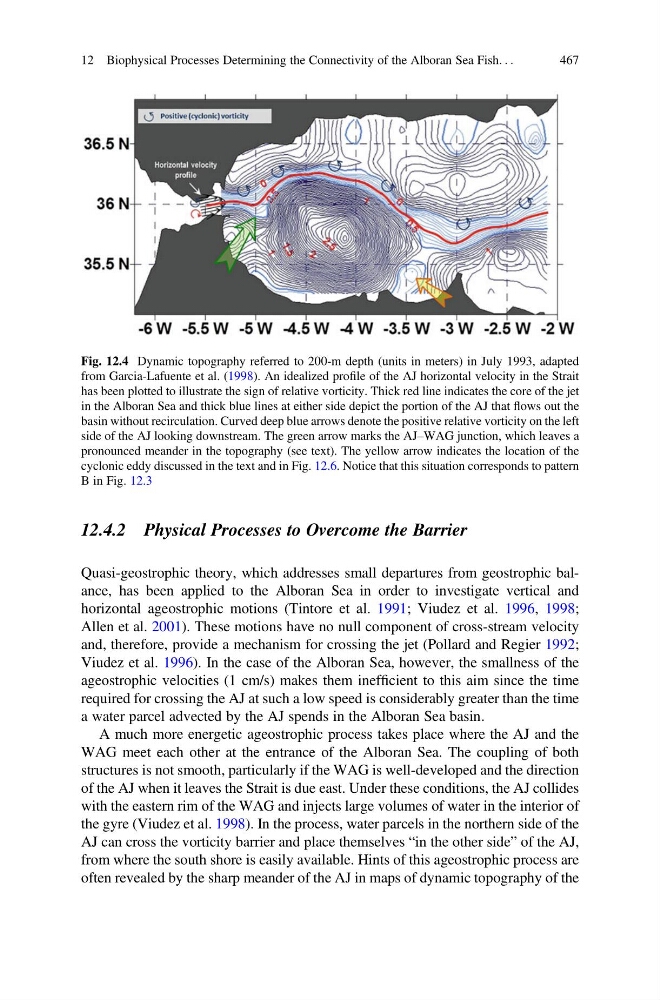
A much more energetic ageostrophic process takes place where the AJ and the
WAG meet each other at the entrance of the Alboran Sea. The coupling of both
structures is not smooth, particularly if the WAG is well-developed and the direction
of the AJ when it leaves the Strait is due east. Under these conditions, the AJ collides
with the eastern rim of the WAG and injects large volumes of water in the interior of
the gyre (Viudez et al. 1998). In the process, water parcels in the northern side of the
AJ can cross the vorticity barrier and place themselves “in the other side” of the AJ,
from where the south shore is easily available. Hints of this ageostrophic process are
often revealed by the sharp meander of the AJ in maps of dynamic topography of the
Fig. 12.4 Dynamic topography referred to 200-m depth (units in meters) in July 1993, adapted
from Garcia-Lafuente et al. (1998). An idealized profile of the AJ horizontal velocity in the Strait
has been plotted to illustrate the sign of relative vorticity. Thick red line indicates the core of the jet
in the Alboran Sea and thick blue lines at either side depict the portion of the AJ that flows out the
basin without recirculation. Curved deep blue arrows denote the positive relative vorticity on the left
side of the AJ looking downstream. The green arrow marks the AJ–WAG junction, which leaves a
pronounced meander in the topography (see text). The yellow arrow indicates the location of the
cyclonic eddy discussed in the text and in Fig. 12.6. Notice that this situation corresponds to pattern
B in Fig. 12.3
12 Biophysical Processes Determining the Connectivity of the Alboran Sea Fish. . .
467
Quasi-geostrophic theory, which addresses small departures from geostrophic balance, has been applied to the Alboran Sea in order to investigate vertical and
horizontal ageostrophic motions (Tintore et al. 1991; Viudez et al. 1996, 1998;
Allen et al. 2001). These motions have no null component of cross-stream velocity
and, therefore, provide a mechanism for crossing the jet (Pollard and Regier 1992;
Viudez et al. 1996). In the case of the Alboran Sea, however, the smallness of the
ageostrophic velocities (1 cm/s) makes them inefficient to this aim since the time
required for crossing the AJ at such a low speed is considerably greater than the time
a water parcel advected by the AJ spends in the Alboran Sea basin.
A much more energetic ageostrophic process takes place where the AJ and the
WAG meet each other at the entrance of the Alboran Sea. The coupling of both
structures is not smooth, particularly if the WAG is well-developed and the direction
of the AJ when it leaves the Strait is due east. Under these conditions, the AJ collides
with the eastern rim of the WAG and injects large volumes of water in the interior of
the gyre (Viudez et al. 1998). In the process, water parcels in the northern side of the
AJ can cross the vorticity barrier and place themselves “in the other side” of the AJ,
from where the south shore is easily available. Hints of this ageostrophic process are
often revealed by the sharp meander of the AJ in maps of dynamic topography of the
Fig. 12.4 Dynamic topography referred to 200-m depth (units in meters) in July 1993, adapted
from Garcia-Lafuente et al. (1998). An idealized profile of the AJ horizontal velocity in the Strait
has been plotted to illustrate the sign of relative vorticity. Thick red line indicates the core of the jet
in the Alboran Sea and thick blue lines at either side depict the portion of the AJ that flows out the
basin without recirculation. Curved deep blue arrows denote the positive relative vorticity on the left
side of the AJ looking downstream. The green arrow marks the AJ–WAG junction, which leaves a
pronounced meander in the topography (see text). The yellow arrow indicates the location of the
cyclonic eddy discussed in the text and in Fig. 12.6. Notice that this situation corresponds to pattern
B in Fig. 12.3
12 Biophysical Processes Determining the Connectivity of the Alboran Sea Fish. . .
467