

12.4 The Meridional (North-to-South) Connectivity
12.4.1 The Atlantic Jet: a Hydrodynamic Barrier
Connectivity between the north and south shores of the Alboran Sea is a more
complex issue. At a first glance, it might not be the case since the AJ heading south
along the eastern edges of the gyres gives chances for north-to-south transport. And
the opposite happens around the western edge of the gyres, which would propitiate
south-to-north connection. However, whatever the mesoscale surface circulation,
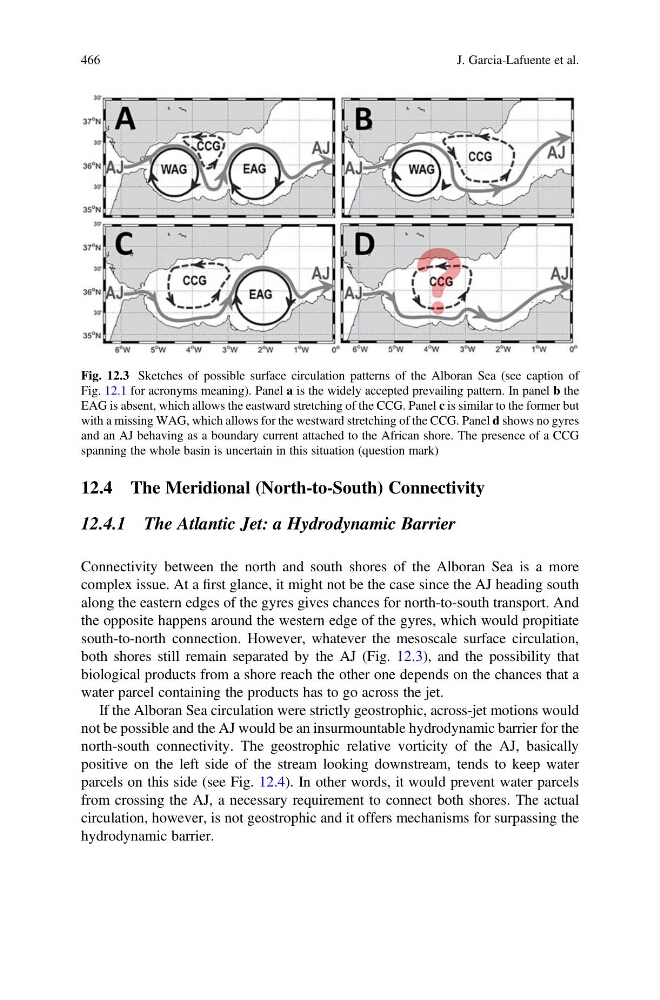
both shores still remain separated by the AJ (Fig. 12.3), and the possibility that
biological products from a shore reach the other one depends on the chances that a
water parcel containing the products has to go across the jet.
If the Alboran Sea circulation were strictly geostrophic, across-jet motions would
not be possible and the AJ would be an insurmountable hydrodynamic barrier for the
north-south connectivity. The geostrophic relative vorticity of the AJ, basically
positive on the left side of the stream looking downstream, tends to keep water
parcels on this side (see Fig. 12.4). In other words, it would prevent water parcels
from crossing the AJ, a necessary requirement to connect both shores. The actual
circulation, however, is not geostrophic and it offers mechanisms for surpassing the
hydrodynamic barrier.
Fig. 12.3 Sketches of possible surface circulation patterns of the Alboran Sea (see caption of
Fig. 12.1 for acronyms meaning). Panel a is the widely accepted prevailing pattern. In panel b the
EAG is absent, which allows the eastward stretching of the CCG. Panel c is similar to the former but
with a missing WAG, which allows for the westward stretching of the CCG. Panel d shows no gyres
and an AJ behaving as a boundary current attached to the African shore. The presence of a CCG
spanning the whole basin is uncertain in this situation (question mark)
466
J. Garcia-Lafuente et al.
12.4.1 The Atlantic Jet: a Hydrodynamic Barrier
Connectivity between the north and south shores of the Alboran Sea is a more
complex issue. At a first glance, it might not be the case since the AJ heading south
along the eastern edges of the gyres gives chances for north-to-south transport. And
the opposite happens around the western edge of the gyres, which would propitiate
south-to-north connection. However, whatever the mesoscale surface circulation,
both shores still remain separated by the AJ (Fig. 12.3), and the possibility that
biological products from a shore reach the other one depends on the chances that a
water parcel containing the products has to go across the jet.
If the Alboran Sea circulation were strictly geostrophic, across-jet motions would
not be possible and the AJ would be an insurmountable hydrodynamic barrier for the
north-south connectivity. The geostrophic relative vorticity of the AJ, basically
positive on the left side of the stream looking downstream, tends to keep water
parcels on this side (see Fig. 12.4). In other words, it would prevent water parcels
from crossing the AJ, a necessary requirement to connect both shores. The actual
circulation, however, is not geostrophic and it offers mechanisms for surpassing the
hydrodynamic barrier.
Fig. 12.3 Sketches of possible surface circulation patterns of the Alboran Sea (see caption of
Fig. 12.1 for acronyms meaning). Panel a is the widely accepted prevailing pattern. In panel b the
EAG is absent, which allows the eastward stretching of the CCG. Panel c is similar to the former but
with a missing WAG, which allows for the westward stretching of the CCG. Panel d shows no gyres
and an AJ behaving as a boundary current attached to the African shore. The presence of a CCG
spanning the whole basin is uncertain in this situation (question mark)
466
J. Garcia-Lafuente et al.