

critically endangered (CR) in 2018 by the Spanish government and then included in
2019 in the same category in the IUCN Red List, after the massive mortality event of
recent years (see Sect. 10.7). Recently, some deep-water species have been included
in the Annex II of the Barcelona Convention, such as the corals Madrepora oculata,
Desmophyllum pertusum and Callogorgia verticillata, or in the IUCN Red List, such
as Desmophyllum dianthus and Dendrophyllia cornigera.
Some species present in the Alboran Sea are of West African origin and present
their only European populations in this area. Examples are the limpet Cymbula
safiana and the bivalve Modiolus lulat, the latter species included in the Andalusian
Red List of endangered species. Other Mediterranean protected molluscs, such as the
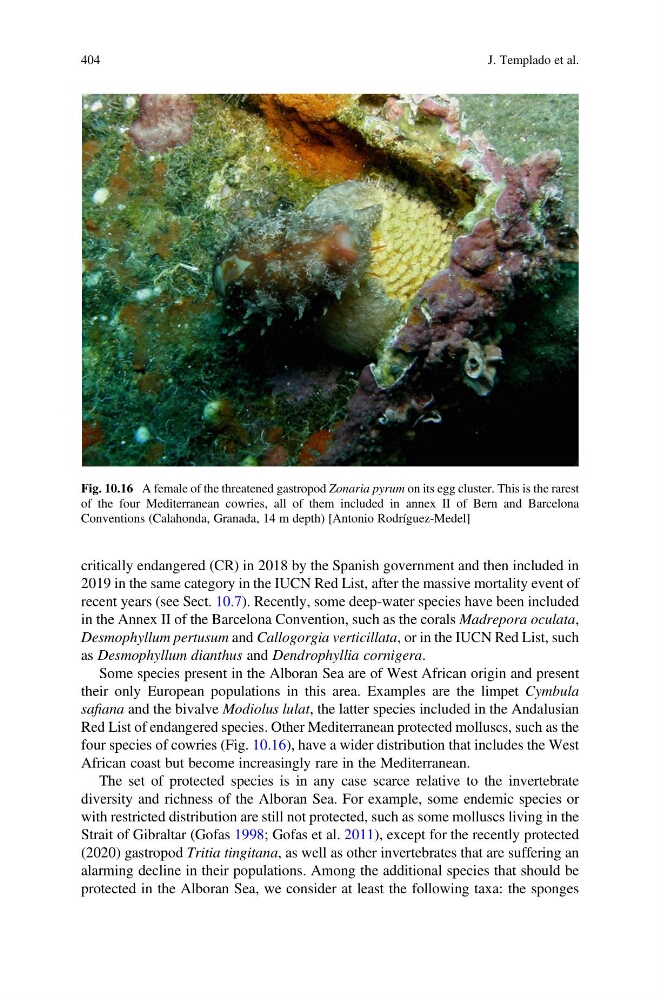
four species of cowries (Fig. 10.16), have a wider distribution that includes the West
African coast but become increasingly rare in the Mediterranean.
The set of protected species is in any case scarce relative to the invertebrate
diversity and richness of the Alboran Sea. For example, some endemic species or
with restricted distribution are still not protected, such as some molluscs living in the
Strait of Gibraltar (Gofas 1998; Gofas et al. 2011), except for the recently protected
(2020) gastropod Tritia tingitana, as well as other invertebrates that are suffering an
alarming decline in their populations. Among the additional species that should be
protected in the Alboran Sea, we consider at least the following taxa: the sponges
Fig. 10.16 A female of the threatened gastropod Zonaria pyrum on its egg cluster. This is the rarest
of the four Mediterranean cowries, all of them included in annex II of Bern and Barcelona
Conventions (Calahonda, Granada, 14 m depth) [Antonio Rodríguez-Medel]
404
J. Templado et al.
2019 in the same category in the IUCN Red List, after the massive mortality event of
recent years (see Sect. 10.7). Recently, some deep-water species have been included
in the Annex II of the Barcelona Convention, such as the corals Madrepora oculata,
Desmophyllum pertusum and Callogorgia verticillata, or in the IUCN Red List, such
as Desmophyllum dianthus and Dendrophyllia cornigera.
Some species present in the Alboran Sea are of West African origin and present
their only European populations in this area. Examples are the limpet Cymbula
safiana and the bivalve Modiolus lulat, the latter species included in the Andalusian
Red List of endangered species. Other Mediterranean protected molluscs, such as the
four species of cowries (Fig. 10.16), have a wider distribution that includes the West
African coast but become increasingly rare in the Mediterranean.
The set of protected species is in any case scarce relative to the invertebrate
diversity and richness of the Alboran Sea. For example, some endemic species or
with restricted distribution are still not protected, such as some molluscs living in the
Strait of Gibraltar (Gofas 1998; Gofas et al. 2011), except for the recently protected
(2020) gastropod Tritia tingitana, as well as other invertebrates that are suffering an
alarming decline in their populations. Among the additional species that should be
protected in the Alboran Sea, we consider at least the following taxa: the sponges
Fig. 10.16 A female of the threatened gastropod Zonaria pyrum on its egg cluster. This is the rarest
of the four Mediterranean cowries, all of them included in annex II of Bern and Barcelona
Conventions (Calahonda, Granada, 14 m depth) [Antonio Rodríguez-Medel]
404
J. Templado et al.