

as scarps, ridges, depressions, and lineations (Vázquez et al. 2014). The N25
E set is
mainly located to the NW and W of the Alboran Ridge, comprising a fault zone that
is 25 km wide and more than 120 km long. The most significant fault in this set is the
Al Idrisi Fault, which has a straight seafloor trace, including continuous segments,
more than 38 km long (Martínez-Garcia et al. 2013; d’Acremont et al. 2014). This
fault displaces the boundary between the Alboran Ridge and Francesc Pagès seamounts (Figs. 6.1b and 6.7). In the northern margin, the activity of the N25
E faults
produces on seafloor marked scarps and sets of longitudinal and rhombic depressions (Vázquez et al. 2018). The N130
E set is mainly located to the N and NE of
the Alboran Ridge, in a zone more than 60 km wide. The main structure of this set is
the Yusuf Fault, which has a straight trace up to 120 km long (Figs. 6.1b and 6.7).
The Averroes Fault is another significant structure in this set, and its trace can be
mapped on the seafloor as a straight scarp and related longitudinal depression. Its
morphology shows evidence of vertical displacements related to dextral strike-slip at
the NW fault edge (Vázquez et al. 2016; Estrada et al. 2018). Several related faults
and scarps with similar directions occur on the seafloor to the east of Averroes Fault
(Pedrera et al. 2015; Estrada et al. 2018). Moreover, other normal faults trending
between N130
E and N170
E have been recognised, mainly west of Campo de
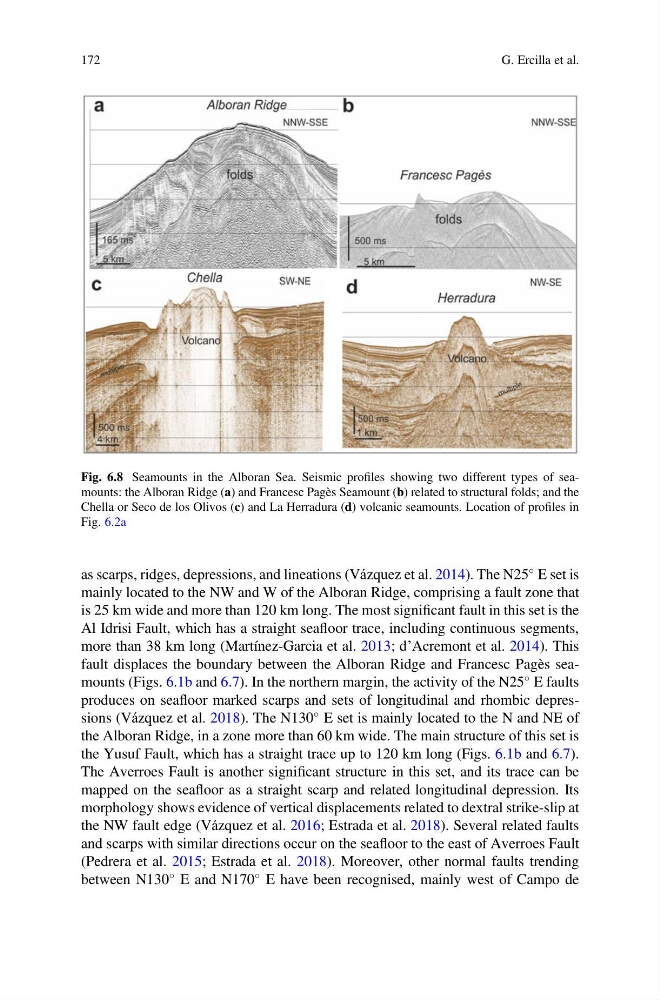
Fig. 6.8 Seamounts in the Alboran Sea. Seismic profiles showing two different types of seamounts: the Alboran Ridge (a) and Francesc Pagès Seamount (b) related to structural folds; and the
Chella or Seco de los Olivos (c) and La Herradura (d) volcanic seamounts. Location of profiles in
Fig. 6.2a
172
G. Ercilla et al.
E set is
mainly located to the NW and W of the Alboran Ridge, comprising a fault zone that
is 25 km wide and more than 120 km long. The most significant fault in this set is the
Al Idrisi Fault, which has a straight seafloor trace, including continuous segments,
more than 38 km long (Martínez-Garcia et al. 2013; d’Acremont et al. 2014). This
fault displaces the boundary between the Alboran Ridge and Francesc Pagès seamounts (Figs. 6.1b and 6.7). In the northern margin, the activity of the N25
E faults
produces on seafloor marked scarps and sets of longitudinal and rhombic depressions (Vázquez et al. 2018). The N130
E set is mainly located to the N and NE of
the Alboran Ridge, in a zone more than 60 km wide. The main structure of this set is
the Yusuf Fault, which has a straight trace up to 120 km long (Figs. 6.1b and 6.7).
The Averroes Fault is another significant structure in this set, and its trace can be
mapped on the seafloor as a straight scarp and related longitudinal depression. Its
morphology shows evidence of vertical displacements related to dextral strike-slip at
the NW fault edge (Vázquez et al. 2016; Estrada et al. 2018). Several related faults
and scarps with similar directions occur on the seafloor to the east of Averroes Fault
(Pedrera et al. 2015; Estrada et al. 2018). Moreover, other normal faults trending
between N130
E and N170
E have been recognised, mainly west of Campo de
Fig. 6.8 Seamounts in the Alboran Sea. Seismic profiles showing two different types of seamounts: the Alboran Ridge (a) and Francesc Pagès Seamount (b) related to structural folds; and the
Chella or Seco de los Olivos (c) and La Herradura (d) volcanic seamounts. Location of profiles in
Fig. 6.2a
172
G. Ercilla et al.