

(centred around 42
N/5
E, Mihanovic et al. 2018; Lebeaupin Brossier et al. 2017;
Smith et al. 2008; Leamann and Schott 1991; MEDOC Group 1970; Anati and
Stommel 1970). The result is the increase in the density of surface waters, which
reach the potential density of LIW (~29.05). As a consequence, the water column
mixes from the surface down to 500–600 m depth. This process is named
pre-conditioning phase. At the end of the winter, the persistence of strong winds
and storms are able to further cool and increase the salinity of these waters that get as
dense as deep waters (~29.1). A violent mixing of the whole water column from the
surface to 2500 m occurs (violent mixing phase). The temperature and salinity of the
homogenized water column is around 12.8
C, 38.43 and this water mass is called
Western Mediterranean Deep Water (WMDW). When severe winter conditions
relax, the newly formed WMDW sinks and spreads around the WMED (spreading
phase). Surface waters are replaced by new AW and the stratification of the upper
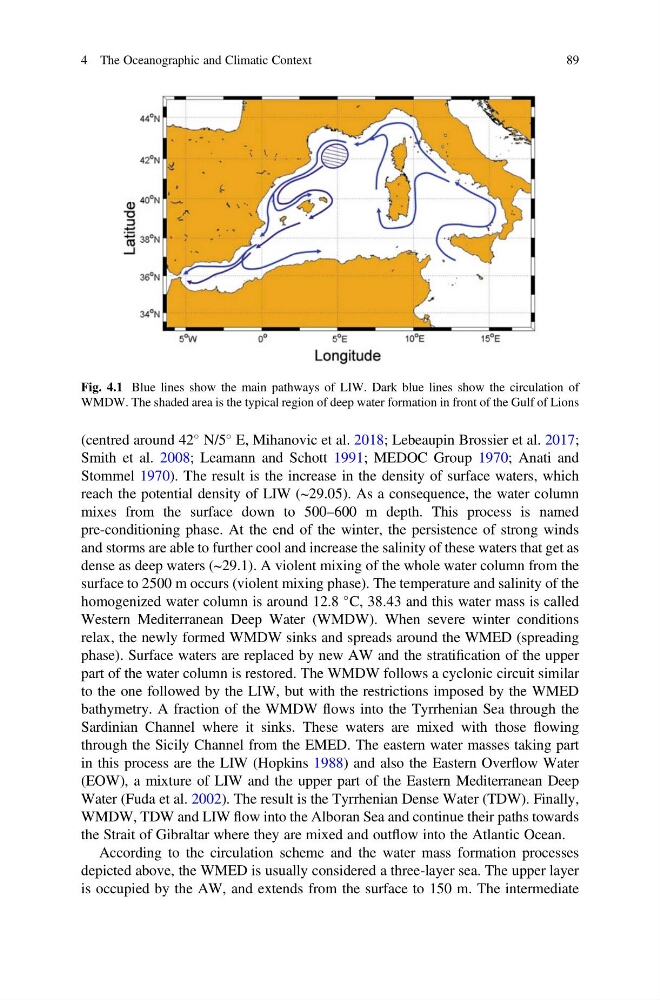
part of the water column is restored. The WMDW follows a cyclonic circuit similar
to the one followed by the LIW, but with the restrictions imposed by the WMED
bathymetry. A fraction of the WMDW flows into the Tyrrhenian Sea through the
Sardinian Channel where it sinks. These waters are mixed with those flowing
through the Sicily Channel from the EMED. The eastern water masses taking part
in this process are the LIW (Hopkins 1988) and also the Eastern Overflow Water
(EOW), a mixture of LIW and the upper part of the Eastern Mediterranean Deep
Water (Fuda et al. 2002). The result is the Tyrrhenian Dense Water (TDW). Finally,
WMDW, TDW and LIW flow into the Alboran Sea and continue their paths towards
the Strait of Gibraltar where they are mixed and outflow into the Atlantic Ocean.
According to the circulation scheme and the water mass formation processes
depicted above, the WMED is usually considered a three-layer sea. The upper layer
is occupied by the AW, and extends from the surface to 150 m. The intermediate
Fig. 4.1 Blue lines show the main pathways of LIW. Dark blue lines show the circulation of
WMDW. The shaded area is the typical region of deep water formation in front of the Gulf of Lions
4 The Oceanographic and Climatic Context
89
N/5
E, Mihanovic et al. 2018; Lebeaupin Brossier et al. 2017;
Smith et al. 2008; Leamann and Schott 1991; MEDOC Group 1970; Anati and
Stommel 1970). The result is the increase in the density of surface waters, which
reach the potential density of LIW (~29.05). As a consequence, the water column
mixes from the surface down to 500–600 m depth. This process is named
pre-conditioning phase. At the end of the winter, the persistence of strong winds
and storms are able to further cool and increase the salinity of these waters that get as
dense as deep waters (~29.1). A violent mixing of the whole water column from the
surface to 2500 m occurs (violent mixing phase). The temperature and salinity of the
homogenized water column is around 12.8
C, 38.43 and this water mass is called
Western Mediterranean Deep Water (WMDW). When severe winter conditions
relax, the newly formed WMDW sinks and spreads around the WMED (spreading
phase). Surface waters are replaced by new AW and the stratification of the upper
part of the water column is restored. The WMDW follows a cyclonic circuit similar
to the one followed by the LIW, but with the restrictions imposed by the WMED
bathymetry. A fraction of the WMDW flows into the Tyrrhenian Sea through the
Sardinian Channel where it sinks. These waters are mixed with those flowing
through the Sicily Channel from the EMED. The eastern water masses taking part
in this process are the LIW (Hopkins 1988) and also the Eastern Overflow Water
(EOW), a mixture of LIW and the upper part of the Eastern Mediterranean Deep
Water (Fuda et al. 2002). The result is the Tyrrhenian Dense Water (TDW). Finally,
WMDW, TDW and LIW flow into the Alboran Sea and continue their paths towards
the Strait of Gibraltar where they are mixed and outflow into the Atlantic Ocean.
According to the circulation scheme and the water mass formation processes
depicted above, the WMED is usually considered a three-layer sea. The upper layer
is occupied by the AW, and extends from the surface to 150 m. The intermediate
Fig. 4.1 Blue lines show the main pathways of LIW. Dark blue lines show the circulation of
WMDW. The shaded area is the typical region of deep water formation in front of the Gulf of Lions
4 The Oceanographic and Climatic Context
89