

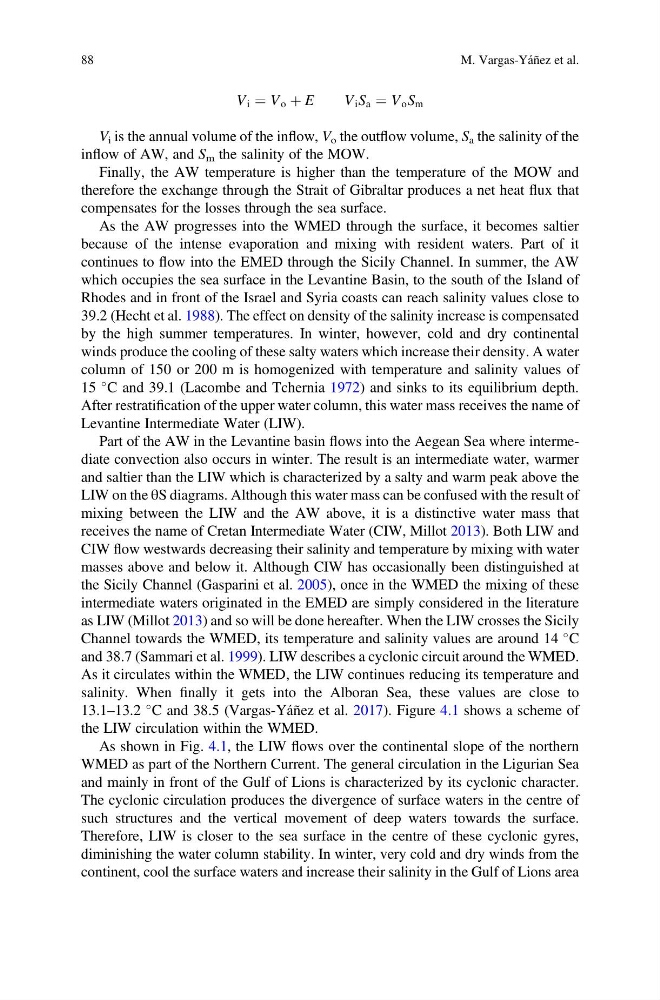
V i ¼ V o þ E
V i S a ¼ V o S m
V i is the annual volume of the inflow, V o the outflow volume, S a the salinity of the
inflow of AW, and S m the salinity of the MOW.
Finally, the AW temperature is higher than the temperature of the MOW and
therefore the exchange through the Strait of Gibraltar produces a net heat flux that
compensates for the losses through the sea surface.
As the AW progresses into the WMED through the surface, it becomes saltier
because of the intense evaporation and mixing with resident waters. Part of it
continues to flow into the EMED through the Sicily Channel. In summer, the AW
which occupies the sea surface in the Levantine Basin, to the south of the Island of
Rhodes and in front of the Israel and Syria coasts can reach salinity values close to
39.2 (Hecht et al. 1988). The effect on density of the salinity increase is compensated
by the high summer temperatures. In winter, however, cold and dry continental
winds produce the cooling of these salty waters which increase their density. A water
column of 150 or 200 m is homogenized with temperature and salinity values of
15
C and 39.1 (Lacombe and Tchernia 1972) and sinks to its equilibrium depth.
After restratification of the upper water column, this water mass receives the name of
Levantine Intermediate Water (LIW).
Part of the AW in the Levantine basin flows into the Aegean Sea where intermediate convection also occurs in winter. The result is an intermediate water, warmer
and saltier than the LIW which is characterized by a salty and warm peak above the
LIW on the θS diagrams. Although this water mass can be confused with the result of
mixing between the LIW and the AW above, it is a distinctive water mass that
receives the name of Cretan Intermediate Water (CIW, Millot 2013). Both LIW and
CIW flow westwards decreasing their salinity and temperature by mixing with water
masses above and below it. Although CIW has occasionally been distinguished at
the Sicily Channel (Gasparini et al. 2005), once in the WMED the mixing of these
intermediate waters originated in the EMED are simply considered in the literature
as LIW (Millot 2013) and so will be done hereafter. When the LIW crosses the Sicily
Channel towards the WMED, its temperature and salinity values are around 14
C
and 38.7 (Sammari et al. 1999). LIW describes a cyclonic circuit around the WMED.
As it circulates within the WMED, the LIW continues reducing its temperature and
salinity. When finally it gets into the Alboran Sea, these values are close to
13.1–13.2
C and 38.5 (Vargas-Yáñez et al. 2017). Figure 4.1 shows a scheme of
the LIW circulation within the WMED.
As shown in Fig. 4.1, the LIW flows over the continental slope of the northern
WMED as part of the Northern Current. The general circulation in the Ligurian Sea
and mainly in front of the Gulf of Lions is characterized by its cyclonic character.
The cyclonic circulation produces the divergence of surface waters in the centre of
such structures and the vertical movement of deep waters towards the surface.
Therefore, LIW is closer to the sea surface in the centre of these cyclonic gyres,
diminishing the water column stability. In winter, very cold and dry winds from the
continent, cool the surface waters and increase their salinity in the Gulf of Lions area
88
M. Vargas-Yáñez et al.
V i S a ¼ V o S m
V i is the annual volume of the inflow, V o the outflow volume, S a the salinity of the
inflow of AW, and S m the salinity of the MOW.
Finally, the AW temperature is higher than the temperature of the MOW and
therefore the exchange through the Strait of Gibraltar produces a net heat flux that
compensates for the losses through the sea surface.
As the AW progresses into the WMED through the surface, it becomes saltier
because of the intense evaporation and mixing with resident waters. Part of it
continues to flow into the EMED through the Sicily Channel. In summer, the AW
which occupies the sea surface in the Levantine Basin, to the south of the Island of
Rhodes and in front of the Israel and Syria coasts can reach salinity values close to
39.2 (Hecht et al. 1988). The effect on density of the salinity increase is compensated
by the high summer temperatures. In winter, however, cold and dry continental
winds produce the cooling of these salty waters which increase their density. A water
column of 150 or 200 m is homogenized with temperature and salinity values of
15
C and 39.1 (Lacombe and Tchernia 1972) and sinks to its equilibrium depth.
After restratification of the upper water column, this water mass receives the name of
Levantine Intermediate Water (LIW).
Part of the AW in the Levantine basin flows into the Aegean Sea where intermediate convection also occurs in winter. The result is an intermediate water, warmer
and saltier than the LIW which is characterized by a salty and warm peak above the
LIW on the θS diagrams. Although this water mass can be confused with the result of
mixing between the LIW and the AW above, it is a distinctive water mass that
receives the name of Cretan Intermediate Water (CIW, Millot 2013). Both LIW and
CIW flow westwards decreasing their salinity and temperature by mixing with water
masses above and below it. Although CIW has occasionally been distinguished at
the Sicily Channel (Gasparini et al. 2005), once in the WMED the mixing of these
intermediate waters originated in the EMED are simply considered in the literature
as LIW (Millot 2013) and so will be done hereafter. When the LIW crosses the Sicily
Channel towards the WMED, its temperature and salinity values are around 14
C
and 38.7 (Sammari et al. 1999). LIW describes a cyclonic circuit around the WMED.
As it circulates within the WMED, the LIW continues reducing its temperature and
salinity. When finally it gets into the Alboran Sea, these values are close to
13.1–13.2
C and 38.5 (Vargas-Yáñez et al. 2017). Figure 4.1 shows a scheme of
the LIW circulation within the WMED.
As shown in Fig. 4.1, the LIW flows over the continental slope of the northern
WMED as part of the Northern Current. The general circulation in the Ligurian Sea
and mainly in front of the Gulf of Lions is characterized by its cyclonic character.
The cyclonic circulation produces the divergence of surface waters in the centre of
such structures and the vertical movement of deep waters towards the surface.
Therefore, LIW is closer to the sea surface in the centre of these cyclonic gyres,
diminishing the water column stability. In winter, very cold and dry winds from the
continent, cool the surface waters and increase their salinity in the Gulf of Lions area
88
M. Vargas-Yáñez et al.