

60
2 – Methods and techniques
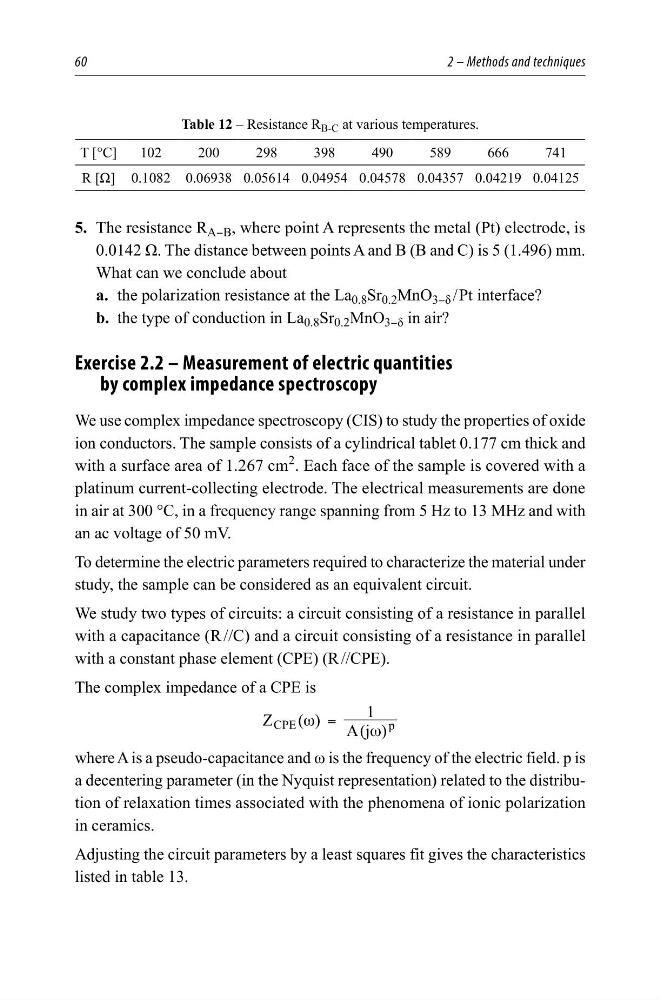
Table 12 – Resistance R B-C at various temperatures.
T [°C]
102
200
298
398
490
589
666
741
R [Ω] 0.1082 0.06938 0.05614 0.04954 0.04578 0.04357 0.04219 0.04125
5. The resistance R A−B , where point A represents the metal (Pt) electrode, is
0.0142 Ω. The distance between points A and B (B and C) is 5 (1.496) mm.
What can we conclude about
a. the polarization resistance at the La 0.8 Sr 0.2 MnO 3−δ / Pt interface?
b. the type of conduction in La 0.8 Sr 0.2 MnO 3−δ in air?
Exercise 2.2 – Measurement of electric quantities
by complex impedance spectroscopy
We use complex impedance spectroscopy (CIS) to study the properties of oxide
ion conductors. The sample consists of a cylindrical tablet 0.177 cm thick and
with a surface area of 1.267 cm
2
. Each face of the sample is covered with a
platinum current-collecting electrode. The electrical measurements are done
in air at 300 °C, in a frequency range spanning from 5 Hz to 13 MHz and with
an ac voltage of 50 mV.
To determine the electric parameters required to characterize the material under
study, the sample can be considered as an equivalent circuit.
We study two types of circuits: a circuit consisting of a resistance in parallel
with a capacitance (R //C) and a circuit consisting of a resistance in parallel
with a constant phase element (CPE) (R //CPE).
The complex impedance of a CPE is
Z
( )
A(j )
1
CPE
p
ω
ω
=
where A is a pseudo-capacitance and ω is the frequency of the electric field. p is
a decentering parameter (in the Nyquist representation) related to the distribution of relaxation times associated with the phenomena of ionic polarization
in ceramics.
Adjusting the circuit parameters by a least squares fit gives the characteristics
listed in table 13.
2 – Methods and techniques
Table 12 – Resistance R B-C at various temperatures.
T [°C]
102
200
298
398
490
589
666
741
R [Ω] 0.1082 0.06938 0.05614 0.04954 0.04578 0.04357 0.04219 0.04125
5. The resistance R A−B , where point A represents the metal (Pt) electrode, is
0.0142 Ω. The distance between points A and B (B and C) is 5 (1.496) mm.
What can we conclude about
a. the polarization resistance at the La 0.8 Sr 0.2 MnO 3−δ / Pt interface?
b. the type of conduction in La 0.8 Sr 0.2 MnO 3−δ in air?
Exercise 2.2 – Measurement of electric quantities
by complex impedance spectroscopy
We use complex impedance spectroscopy (CIS) to study the properties of oxide
ion conductors. The sample consists of a cylindrical tablet 0.177 cm thick and
with a surface area of 1.267 cm
2
. Each face of the sample is covered with a
platinum current-collecting electrode. The electrical measurements are done
in air at 300 °C, in a frequency range spanning from 5 Hz to 13 MHz and with
an ac voltage of 50 mV.
To determine the electric parameters required to characterize the material under
study, the sample can be considered as an equivalent circuit.
We study two types of circuits: a circuit consisting of a resistance in parallel
with a capacitance (R //C) and a circuit consisting of a resistance in parallel
with a constant phase element (CPE) (R //CPE).
The complex impedance of a CPE is
Z
( )
A(j )
1
CPE
p
ω
ω
=
where A is a pseudo-capacitance and ω is the frequency of the electric field. p is
a decentering parameter (in the Nyquist representation) related to the distribution of relaxation times associated with the phenomena of ionic polarization
in ceramics.
Adjusting the circuit parameters by a least squares fit gives the characteristics
listed in table 13.