

56
2 – Methods and techniques
t
M I
z FS x
c
τ
ρΔ
=
where z is the charge of the cation, S is the electrode-electrolyte contact area,
ρ is the crystal density, I is the electrolysis current, M is the molar mass of the
crystal, and τ is the electrolysis time.
2.2.5 – Electrochemical semipermeability
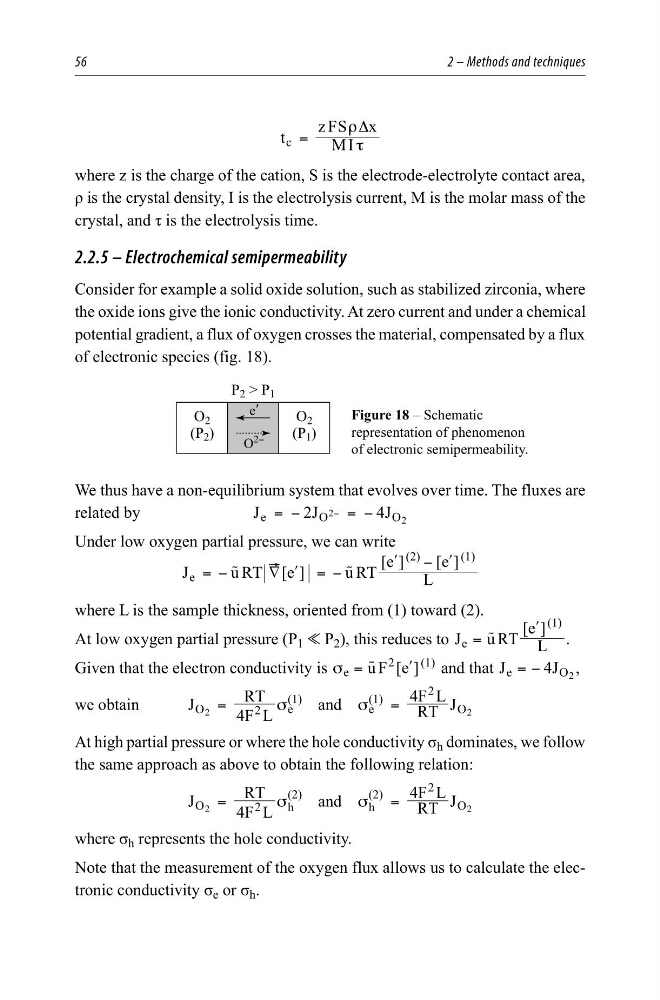
Consider for example a solid oxide solution, such as stabilized zirconia, where
the oxide ions give the ionic conductivity. At zero current and under a chemical
potential gradient, a flux of oxygen crosses the material, compensated by a flux
of electronic species (fig. 18).
Figure 18 – Schematic
representation of phenomenon
of electronic semipermeability.
We thus have a non-equilibrium system that evolves over time. The fluxes are
related by
J
J
J
2
4
e
O
O
2
2
= −
= −
−
Under low oxygen partial pressure, we can write
J
uRT
u RT
L
[e ]
[e ]
[e ]
e
(2)
( 1)
d
= −
= −
−
l
l
l
u
u
where L is the sample thickness, oriented from (1) toward (2).
At low oxygen partial pressure (P 1 % P 2 ), this reduces to
[ ] .
J
uRT L
e
( )
e
1
=
l
u
Given that the electron conductivity is
u F [e ]
e
2
(1)
σ =
l
u
and that J
J
4
e
O 2
= −
,
we obtain
J
4F L
RT
and
RT
4F L
J
O
2
e
(1)
e
(1)
2
O
2
2
σ
σ
=
=
At high partial pressure or where the hole conductivity σ h dominates, we follow
the same approach as above to obtain the following relation:
J
4F L
RT
and
RT
4F L
J
O
2
h
(2)
h
(2)
2
O
2
2
σ
σ
=
=
where σ h represents the hole conductivity.
Note that the measurement of the oxygen flux allows us to calculate the electronic conductivity σ e or σ h .
2
3
3 !3
2
3
Hƍ
2
<
2 – Methods and techniques
t
M I
z FS x
c
τ
ρΔ
=
where z is the charge of the cation, S is the electrode-electrolyte contact area,
ρ is the crystal density, I is the electrolysis current, M is the molar mass of the
crystal, and τ is the electrolysis time.
2.2.5 – Electrochemical semipermeability
Consider for example a solid oxide solution, such as stabilized zirconia, where
the oxide ions give the ionic conductivity. At zero current and under a chemical
potential gradient, a flux of oxygen crosses the material, compensated by a flux
of electronic species (fig. 18).
Figure 18 – Schematic
representation of phenomenon
of electronic semipermeability.
We thus have a non-equilibrium system that evolves over time. The fluxes are
related by
J
J
J
2
4
e
O
O
2
2
= −
= −
−
Under low oxygen partial pressure, we can write
J
uRT
u RT
L
[e ]
[e ]
[e ]
e
(2)
( 1)
d
= −
= −
−
l
l
l
u
u
where L is the sample thickness, oriented from (1) toward (2).
At low oxygen partial pressure (P 1 % P 2 ), this reduces to
[ ] .
J
uRT L
e
( )
e
1
=
l
u
Given that the electron conductivity is
u F [e ]
e
2
(1)
σ =
l
u
and that J
J
4
e
O 2
= −
,
we obtain
J
4F L
RT
and
RT
4F L
J
O
2
e
(1)
e
(1)
2
O
2
2
σ
σ
=
=
At high partial pressure or where the hole conductivity σ h dominates, we follow
the same approach as above to obtain the following relation:
J
4F L
RT
and
RT
4F L
J
O
2
h
(2)
h
(2)
2
O
2
2
σ
σ
=
=
where σ h represents the hole conductivity.
Note that the measurement of the oxygen flux allows us to calculate the electronic conductivity σ e or σ h .
2
3
3 !3
2
3
Hƍ
2
<