

54
2 – Methods and techniques
t e
t
e
σ
σ
=
Note that this method implies that the ionic conductivity remains constant
throughout the range over which total conductivity varies. Given the large
difference between ionic and electronic mobilities, this is a reasonable hypothesis, particularly when the species responsible for ionic transport is extrinsic
(e.g., doping).
Finally, this method is above all applicable to mixed conductors with nonnegligible electronic transport number.
2.2.3 – Tubandt method
This method is based on that of Hittorf, which is used in the electrochemistry of
solutions. Schematically, it is based on exploiting the consecutive mass balances
of an electrolysis in a (cathode or anode) compartment, taking into account
2 the formation or disappearance of the ionic species present in the electrolyte following the electrode reaction, and,
2 in the compartment under consideration, the arrival or departure by migration of the ionic species.
When applied to an MX compound, the method consists of measuring the amount
of substance that appears or disappears in one (or several) compartments upon
considering the following electrode reaction:
2
1 X 2 + e m X
−
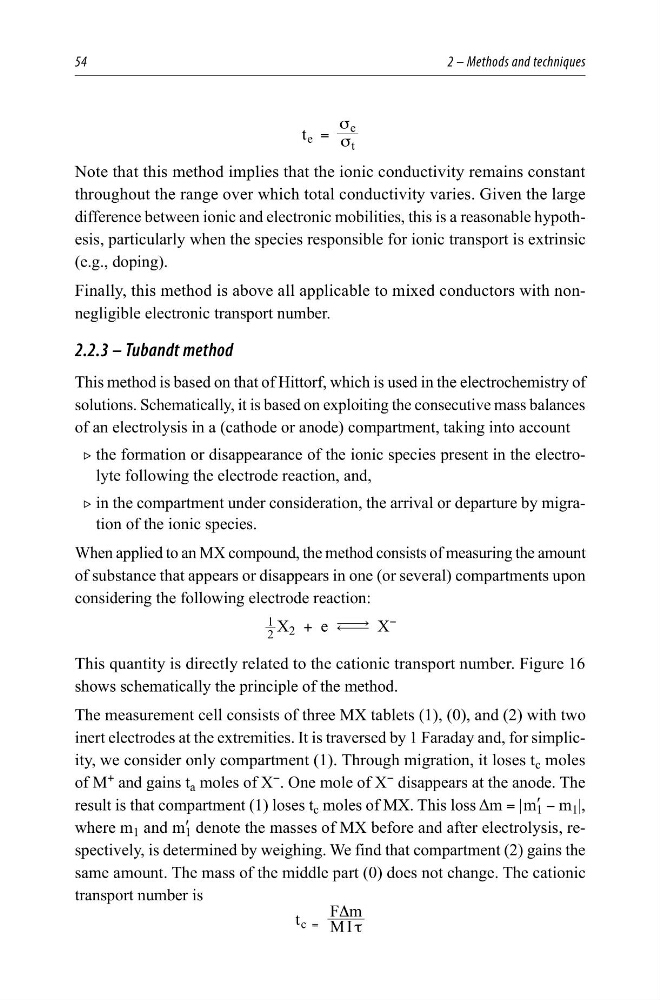
This quantity is directly related to the cationic transport number. Figure 16
shows schematically the principle of the method.
The measurement cell consists of three MX tablets (1), (0), and (2) with two
inert electrodes at the extremities. It is traversed by 1 Faraday and, for simplicity, we consider only compartment (1). Through migration, it loses t c moles
of M
+
and gains t a moles of X
−
. One mole of X
−
disappears at the anode. The
result is that compartment (1) loses t c moles of MX. This loss Δm = | m ′
1 − m 1 |,
where m 1 and m ′ 1 denote the masses of MX before and after electrolysis, respectively, is determined by weighing. We find that compartment (2) gains the
same amount. The mass of the middle part (0) does not change. The cationic
transport number is
t
M I
F m
c
τ
Δ
=
2 – Methods and techniques
t e
t
e
σ
σ
=
Note that this method implies that the ionic conductivity remains constant
throughout the range over which total conductivity varies. Given the large
difference between ionic and electronic mobilities, this is a reasonable hypothesis, particularly when the species responsible for ionic transport is extrinsic
(e.g., doping).
Finally, this method is above all applicable to mixed conductors with nonnegligible electronic transport number.
2.2.3 – Tubandt method
This method is based on that of Hittorf, which is used in the electrochemistry of
solutions. Schematically, it is based on exploiting the consecutive mass balances
of an electrolysis in a (cathode or anode) compartment, taking into account
2 the formation or disappearance of the ionic species present in the electrolyte following the electrode reaction, and,
2 in the compartment under consideration, the arrival or departure by migration of the ionic species.
When applied to an MX compound, the method consists of measuring the amount
of substance that appears or disappears in one (or several) compartments upon
considering the following electrode reaction:
2
1 X 2 + e m X
−
This quantity is directly related to the cationic transport number. Figure 16
shows schematically the principle of the method.
The measurement cell consists of three MX tablets (1), (0), and (2) with two
inert electrodes at the extremities. It is traversed by 1 Faraday and, for simplicity, we consider only compartment (1). Through migration, it loses t c moles
of M
+
and gains t a moles of X
−
. One mole of X
−
disappears at the anode. The
result is that compartment (1) loses t c moles of MX. This loss Δm = | m ′
1 − m 1 |,
where m 1 and m ′ 1 denote the masses of MX before and after electrolysis, respectively, is determined by weighing. We find that compartment (2) gains the
same amount. The mass of the middle part (0) does not change. The cationic
transport number is
t
M I
F m
c
τ
Δ
=