

32
1 – Description of ionic crystals
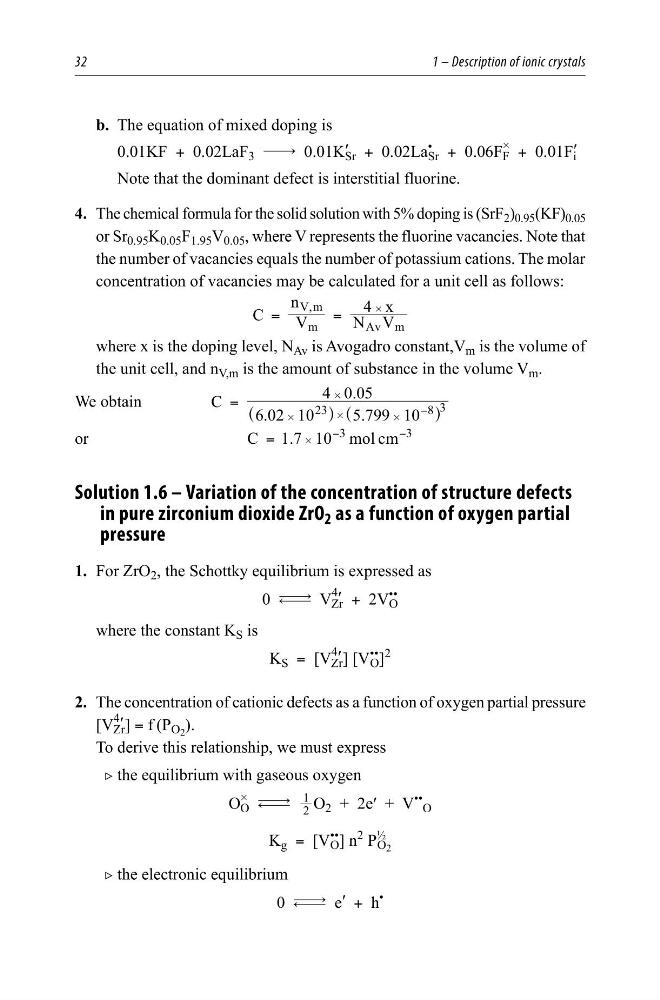
b. The equation of mixed doping is
0.01KF + 0.02LaF 3 $ 0.01K ′
Sr + 0.02La
•
Sr + 0.06F
#
F + 0.01F ′
i
Note that the dominant defect is interstitial fluorine.
4. The chemical formula for the solid solution with 5% doping is (SrF 2 ) 0.95 (KF) 0.05
or Sr 0.95 K 0.05 F 1.95 V 0.05 , where V represents the fluorine vacancies. Note that
the number of vacancies equals the number of potassium cations. The molar
concentration of vacancies may be calculated for a unit cell as follows:
C
V
n
N V
x
4
,
m
V m
Av m
=
=
#
where x is the doping level, N Av is Avogadro constant,V m is the volume of
the unit cell, and n V,m is the amount of substance in the volume V m .
We obtain
.
.
.
C
6 02 10
5799 10
4 0 05
23
8 3
#
#
#
#
=
−
^
^
h
h
or
.
C
m ol cm
1 7 10
3
3
#
=
−
−
Solution 1.6 – Variation of the concentration of structure defects
in pure zirconium dioxide ZrO 2 as a function of oxygen partial
pressure
1. For ZrO 2 , the Schottky equilibrium is expressed as
0 m V
4
′
Zr + 2V
••
O
where the constant K S is
K S = [V
4
′
Zr ] [V
••
O ]
2
2. The concentration of cationic defects as a function of oxygen partial pressure
[V
4
′
Zr ] = f (P O 2 ).
To derive this relationship, we must express
2 the equilibrium with gaseous oxygen
O
#
O m 2
1
O 2 + 2e′ + V
•• O
K g = [V
••
O ] n
2
P
½
O 2
2 the electronic equilibrium
0 m e ′ + h
•
1 – Description of ionic crystals
b. The equation of mixed doping is
0.01KF + 0.02LaF 3 $ 0.01K ′
Sr + 0.02La
•
Sr + 0.06F
#
F + 0.01F ′
i
Note that the dominant defect is interstitial fluorine.
4. The chemical formula for the solid solution with 5% doping is (SrF 2 ) 0.95 (KF) 0.05
or Sr 0.95 K 0.05 F 1.95 V 0.05 , where V represents the fluorine vacancies. Note that
the number of vacancies equals the number of potassium cations. The molar
concentration of vacancies may be calculated for a unit cell as follows:
C
V
n
N V
x
4
,
m
V m
Av m
=
=
#
where x is the doping level, N Av is Avogadro constant,V m is the volume of
the unit cell, and n V,m is the amount of substance in the volume V m .
We obtain
.
.
.
C
6 02 10
5799 10
4 0 05
23
8 3
#
#
#
#
=
−
^
^
h
h
or
.
C
m ol cm
1 7 10
3
3
#
=
−
−
Solution 1.6 – Variation of the concentration of structure defects
in pure zirconium dioxide ZrO 2 as a function of oxygen partial
pressure
1. For ZrO 2 , the Schottky equilibrium is expressed as
0 m V
4
′
Zr + 2V
••
O
where the constant K S is
K S = [V
4
′
Zr ] [V
••
O ]
2
2. The concentration of cationic defects as a function of oxygen partial pressure
[V
4
′
Zr ] = f (P O 2 ).
To derive this relationship, we must express
2 the equilibrium with gaseous oxygen
O
#
O m 2
1
O 2 + 2e′ + V
•• O
K g = [V
••
O ] n
2
P
½
O 2
2 the electronic equilibrium
0 m e ′ + h
•