

Solutions to exercises
31
or
.
C
m L
ol
4 185
V
1
=
−
This is a high concentration compared with the usual aqueous solutions.
Solution 1.5 – Doping strontium fluoride
1. Given that anionic Frenkel disorder is the dominant ionic disorder in strontium fluoride SrF 2 , we have the following equilibrium:
F
#
F m V
•
F + F ′
i
The equations for introducing dopants are
KF $ K ′
Sr + F
#
F + V
•
F
LaF 3 $ La
•
Sr + 2F
#
F + F ′
i
For simultaneous doping, the reaction is obtained by combining the two
preceding individual reactions:
KF + LaF 3 $ K ′
Sr + La
•
Sr + 3F
#
F + V
•
F + F ′
i
The structure defects in the final phase are
V
•
F , F ′
i , K ′
Sr , and La
•
Sr
2. For conduction by ionic vacancy to be the dominant mechanism, we must use
KF as dopant because it will increase the concentration of anionic vacancies.
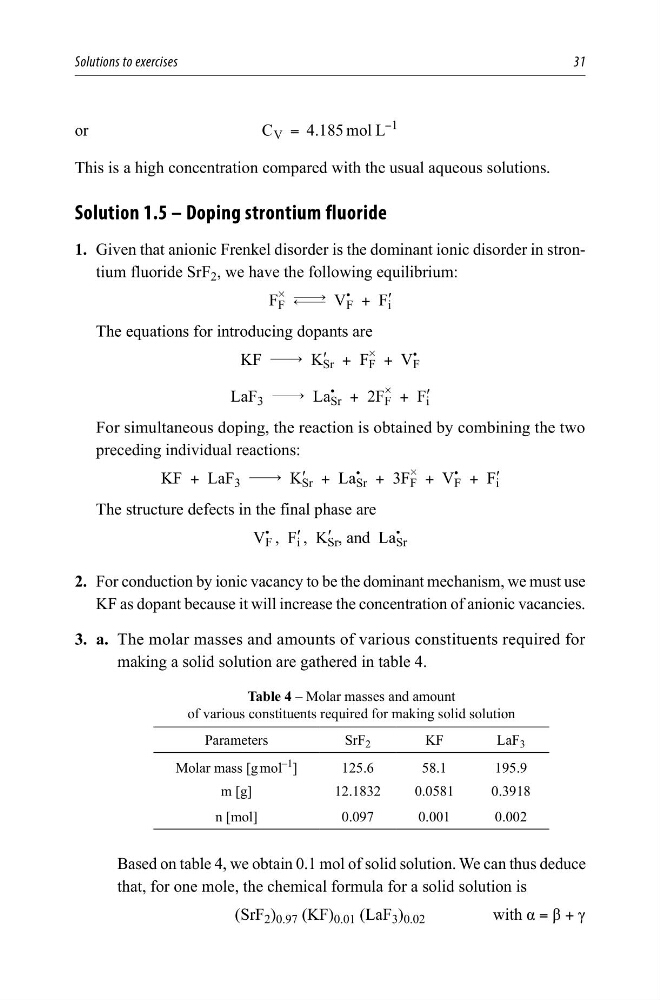
3. a. The molar masses and amounts of various constituents required for
making a solid solution are gathered in table 4.
Table 4 – Molar masses and amount
of various constituents required for making solid solution
Parameters
SrF 2
KF
LaF 3
Molar mass [g mol
–1
]
125.6
58.1
195.9
m [g]
12.1832
0.0581
0.3918
n [mol]
0.097
0.001
0.002
Based on table 4, we obtain 0.1 mol of solid solution. We can thus deduce
that, for one mole, the chemical formula for a solid solution is
(SrF 2 ) 0.97 (KF) 0.01 (LaF 3 ) 0.02
with α = β + γ
31
or
.
C
m L
ol
4 185
V
1
=
−
This is a high concentration compared with the usual aqueous solutions.
Solution 1.5 – Doping strontium fluoride
1. Given that anionic Frenkel disorder is the dominant ionic disorder in strontium fluoride SrF 2 , we have the following equilibrium:
F
#
F m V
•
F + F ′
i
The equations for introducing dopants are
KF $ K ′
Sr + F
#
F + V
•
F
LaF 3 $ La
•
Sr + 2F
#
F + F ′
i
For simultaneous doping, the reaction is obtained by combining the two
preceding individual reactions:
KF + LaF 3 $ K ′
Sr + La
•
Sr + 3F
#
F + V
•
F + F ′
i
The structure defects in the final phase are
V
•
F , F ′
i , K ′
Sr , and La
•
Sr
2. For conduction by ionic vacancy to be the dominant mechanism, we must use
KF as dopant because it will increase the concentration of anionic vacancies.
3. a. The molar masses and amounts of various constituents required for
making a solid solution are gathered in table 4.
Table 4 – Molar masses and amount
of various constituents required for making solid solution
Parameters
SrF 2
KF
LaF 3
Molar mass [g mol
–1
]
125.6
58.1
195.9
m [g]
12.1832
0.0581
0.3918
n [mol]
0.097
0.001
0.002
Based on table 4, we obtain 0.1 mol of solid solution. We can thus deduce
that, for one mole, the chemical formula for a solid solution is
(SrF 2 ) 0.97 (KF) 0.01 (LaF 3 ) 0.02
with α = β + γ