

Glossary
311
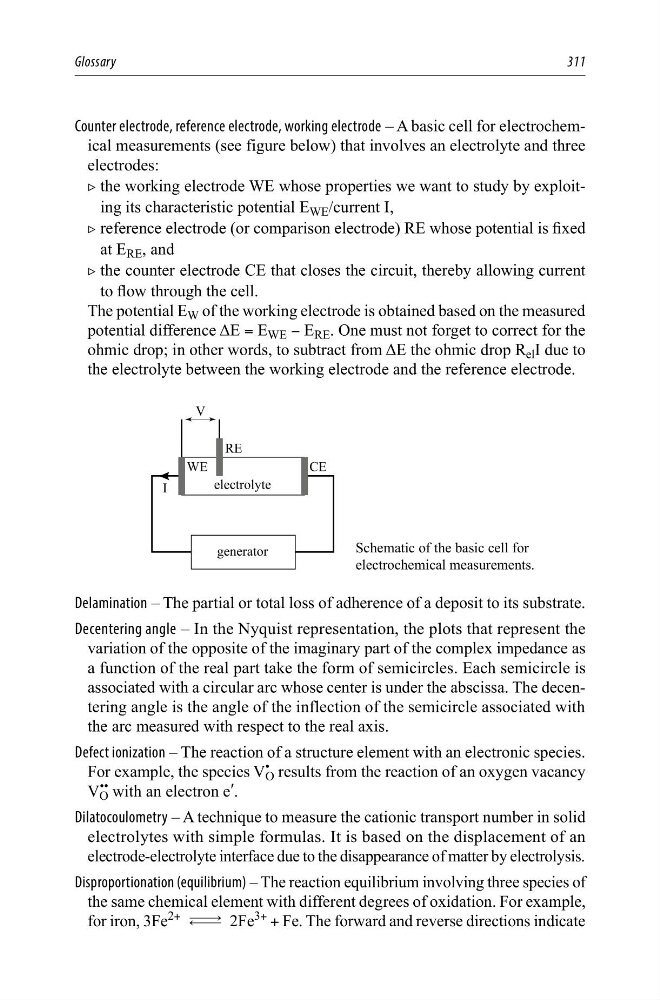
Counter electrode, reference electrode, working electrode – A basic cell for electrochemical measurements (see figure below) that involves an electrolyte and three
electrodes:
2 the working electrode WE whose properties we want to study by exploiting its characteristic potential E WE /current I,
2 reference electrode (or comparison electrode) RE whose potential is fixed
at E RE , and
2 the counter electrode CE that closes the circuit, thereby allowing current
to flow through the cell.
The potential E W of the working electrode is obtained based on the measured
potential difference ΔE = E WE − E RE . One must not forget to correct for the
ohmic drop; in other words, to subtract from ΔE the ohmic drop R el I due to
the electrolyte between the working electrode and the reference electrode.
Schematic of the basic cell for
electrochemical measurements.
Delamination – The partial or total loss of adherence of a deposit to its substrate.
Decentering angle – In the Nyquist representation, the plots that represent the
variation of the opposite of the imaginary part of the complex impedance as
a function of the real part take the form of semicircles. Each semicircle is
associated with a circular arc whose center is under the abscissa. The decentering angle is the angle of the inflection of the semicircle associated with
the arc measured with respect to the real axis.
Defect ionization – The reaction of a structure element with an electronic species.
For example, the species V
•
O results from the reaction of an oxygen vacancy
V O
••
with an electron e ′ .
Dilatocoulometry – A technique to measure the cationic transport number in solid
electrolytes with simple formulas. It is based on the displacement of an
electrode-electrolyte interface due to the disappearance of matter by electrolysis.
Disproportionation (equilibrium) – The reaction equilibrium involving three species of
the same chemical element with different degrees of oxidation. For example,
for iron, 3Fe
2+
m 2Fe
3+ + Fe. The forward and reverse directions indicate
9
5(
:(
&(
JHQHUDWRU
HOHFWURO\WH
,
311
Counter electrode, reference electrode, working electrode – A basic cell for electrochemical measurements (see figure below) that involves an electrolyte and three
electrodes:
2 the working electrode WE whose properties we want to study by exploiting its characteristic potential E WE /current I,
2 reference electrode (or comparison electrode) RE whose potential is fixed
at E RE , and
2 the counter electrode CE that closes the circuit, thereby allowing current
to flow through the cell.
The potential E W of the working electrode is obtained based on the measured
potential difference ΔE = E WE − E RE . One must not forget to correct for the
ohmic drop; in other words, to subtract from ΔE the ohmic drop R el I due to
the electrolyte between the working electrode and the reference electrode.
Schematic of the basic cell for
electrochemical measurements.
Delamination – The partial or total loss of adherence of a deposit to its substrate.
Decentering angle – In the Nyquist representation, the plots that represent the
variation of the opposite of the imaginary part of the complex impedance as
a function of the real part take the form of semicircles. Each semicircle is
associated with a circular arc whose center is under the abscissa. The decentering angle is the angle of the inflection of the semicircle associated with
the arc measured with respect to the real axis.
Defect ionization – The reaction of a structure element with an electronic species.
For example, the species V
•
O results from the reaction of an oxygen vacancy
V O
••
with an electron e ′ .
Dilatocoulometry – A technique to measure the cationic transport number in solid
electrolytes with simple formulas. It is based on the displacement of an
electrode-electrolyte interface due to the disappearance of matter by electrolysis.
Disproportionation (equilibrium) – The reaction equilibrium involving three species of
the same chemical element with different degrees of oxidation. For example,
for iron, 3Fe
2+
m 2Fe
3+ + Fe. The forward and reverse directions indicate
9
5(
:(
&(
JHQHUDWRU
HOHFWURO\WH
,