

10
1 – Description of ionic crystals
1.2.2 – Writing the reactions
In the electrochemistry of crystalline solids, a written reaction must satisfy:
2 mass balance;
2 electroneutrality, which involves the effective charges of the species that
partake in the reaction;
2 sitoneutrality: the ratio of the number of cationic sites to the number of
anionic sites is conserved, with the perfect crystal serving as reference.
For example, for a crystal with the formula MX 2 (M
2+
, 2X
−
), all written
reactions must satisfy the condition
Number of anionic sites
Number of cationic sites
2
1
=
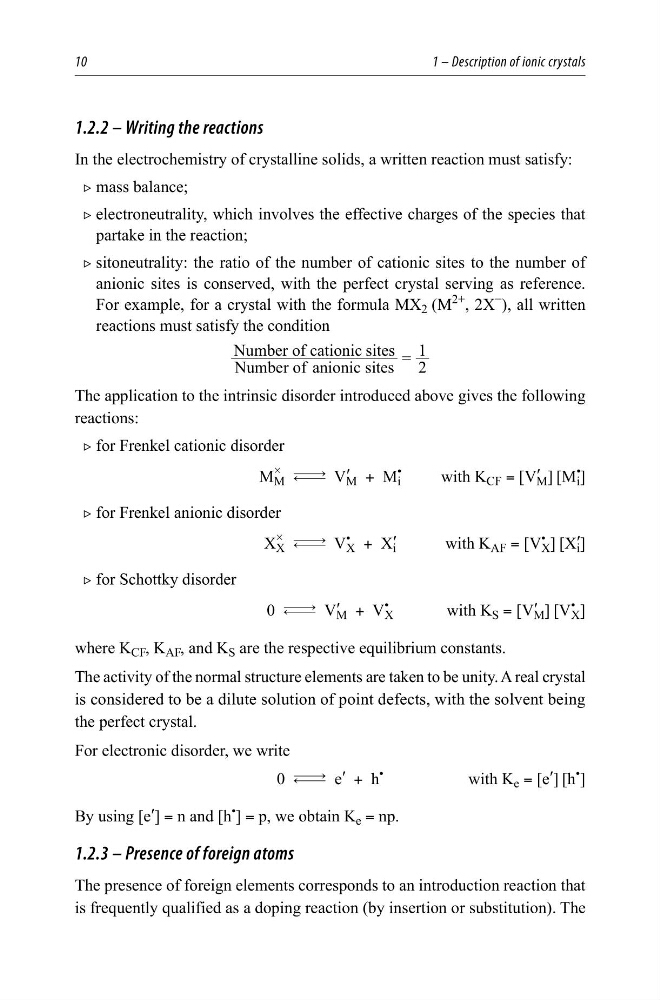
The application to the intrinsic disorder introduced above gives the following
reactions:
2 for Frenkel cationic disorder
M
#
M m V ′
M + M
•
i
with K CF = [V ′
M ] [M
•
i ]
2 for Frenkel anionic disorder
X
#
X m V
•
X + X ′
i
with K AF = [V
•
X ] [X ′
i ]
2 for Schottky disorder
0 m V ′
M + V
•
X
with K S = [V ′
M ] [V
•
X ]
where K CF , K AF , and K S are the respective equilibrium constants.
The activity of the normal structure elements are taken to be unity. A real crystal
is considered to be a dilute solution of point defects, with the solvent being
the perfect crystal.
For electronic disorder, we write
0 m e ′ + h
•
with K e = [e ′ ] [h
•
]
By using [e ′ ] = n and [h
•
] = p, we obtain K e = np.
1.2.3 – Presence of foreign atoms
The presence of foreign elements corresponds to an introduction reaction that
is frequently qualified as a doping reaction (by insertion or substitution). The
1 – Description of ionic crystals
1.2.2 – Writing the reactions
In the electrochemistry of crystalline solids, a written reaction must satisfy:
2 mass balance;
2 electroneutrality, which involves the effective charges of the species that
partake in the reaction;
2 sitoneutrality: the ratio of the number of cationic sites to the number of
anionic sites is conserved, with the perfect crystal serving as reference.
For example, for a crystal with the formula MX 2 (M
2+
, 2X
−
), all written
reactions must satisfy the condition
Number of anionic sites
Number of cationic sites
2
1
=
The application to the intrinsic disorder introduced above gives the following
reactions:
2 for Frenkel cationic disorder
M
#
M m V ′
M + M
•
i
with K CF = [V ′
M ] [M
•
i ]
2 for Frenkel anionic disorder
X
#
X m V
•
X + X ′
i
with K AF = [V
•
X ] [X ′
i ]
2 for Schottky disorder
0 m V ′
M + V
•
X
with K S = [V ′
M ] [V
•
X ]
where K CF , K AF , and K S are the respective equilibrium constants.
The activity of the normal structure elements are taken to be unity. A real crystal
is considered to be a dilute solution of point defects, with the solvent being
the perfect crystal.
For electronic disorder, we write
0 m e ′ + h
•
with K e = [e ′ ] [h
•
]
By using [e ′ ] = n and [h
•
] = p, we obtain K e = np.
1.2.3 – Presence of foreign atoms
The presence of foreign elements corresponds to an introduction reaction that
is frequently qualified as a doping reaction (by insertion or substitution). The