

244
5 – Applications
2 (O F V F )
#
O ′
F + V
•
F m (O F V F )
#
……
2 (Y Ca O F )
#
Y
•
Ca + O ′
F m (Y Ca O F )
#
……
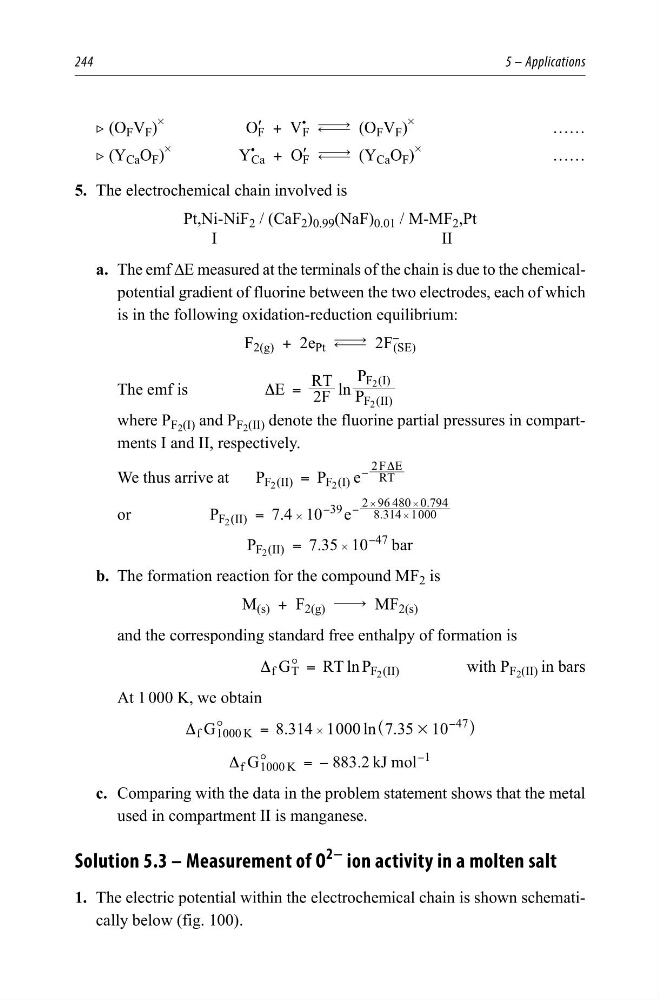
5. The electrochemical chain involved is
Pt,Ni-NiF 2 / (CaF 2 ) 0.99 (NaF) 0.01 / M-MF 2 ,Pt
I
II
a. The emf ∆E measured at the terminals of the chain is due to the chemicalpotential gradient of fluorine between the two electrodes, each of which
is in the following oxidation-reduction equilibrium:
F 2(g) + 2e Pt m 2F
−
(SE)
The emf is
E
2F
RT
ln P
P
F (II)
F (I)
2
2
Δ =
where P F 2 (I) and P F 2 (II) denote the fluorine partial pressures in compartments I and II, respectively.
We thus arrive at
P
P
e
F (II)
F (I)
RT
2 F E
2
2
=
Δ
−
or
.
P
e
7 4 10
( )
.
.
F II
39
8 314 1000
2 96 480 0 794
2
#
=
#
#
#
−
−
.
P
b ar
7 35 10
( )
F II
47
2
#
=
−
b. The formation reaction for the compound MF 2 is
M (s) + F 2(g) $ MF 2(s)
and the corresponding standard free enthalpy of formation is
G
RT ln P
f T
F (II)
2
Δ
=
°
with P F 2 (II) in bars
At 1 000 K, we obtain
G
8.314 1000 ln 7.35 10
f 1000 K
47
#
Δ
=
−
#
°
^
h
G
883.2 kJ mol
f 1000 K
1
Δ
=−
−
°
c. Comparing with the data in the problem statement shows that the metal
used in compartment II is manganese.
Solution 5.3 – Measurement of O
2−
ion activity in a molten salt
1. The electric potential within the electrochemical chain is shown schematically below (fig. 100).
5 – Applications
2 (O F V F )
#
O ′
F + V
•
F m (O F V F )
#
……
2 (Y Ca O F )
#
Y
•
Ca + O ′
F m (Y Ca O F )
#
……
5. The electrochemical chain involved is
Pt,Ni-NiF 2 / (CaF 2 ) 0.99 (NaF) 0.01 / M-MF 2 ,Pt
I
II
a. The emf ∆E measured at the terminals of the chain is due to the chemicalpotential gradient of fluorine between the two electrodes, each of which
is in the following oxidation-reduction equilibrium:
F 2(g) + 2e Pt m 2F
−
(SE)
The emf is
E
2F
RT
ln P
P
F (II)
F (I)
2
2
Δ =
where P F 2 (I) and P F 2 (II) denote the fluorine partial pressures in compartments I and II, respectively.
We thus arrive at
P
P
e
F (II)
F (I)
RT
2 F E
2
2
=
Δ
−
or
.
P
e
7 4 10
( )
.
.
F II
39
8 314 1000
2 96 480 0 794
2
#
=
#
#
#
−
−
.
P
b ar
7 35 10
( )
F II
47
2
#
=
−
b. The formation reaction for the compound MF 2 is
M (s) + F 2(g) $ MF 2(s)
and the corresponding standard free enthalpy of formation is
G
RT ln P
f T
F (II)
2
Δ
=
°
with P F 2 (II) in bars
At 1 000 K, we obtain
G
8.314 1000 ln 7.35 10
f 1000 K
47
#
Δ
=
−
#
°
^
h
G
883.2 kJ mol
f 1000 K
1
Δ
=−
−
°
c. Comparing with the data in the problem statement shows that the metal
used in compartment II is manganese.
Solution 5.3 – Measurement of O
2−
ion activity in a molten salt
1. The electric potential within the electrochemical chain is shown schematically below (fig. 100).