

Exercises
241
Data at 298 K
Compound
∆ f H° [kJ mol
−1
]
C ° p [J mol
−1
K
−1
]
S° [J mol
−1
K
−1
]
CH 4(g)
− 74.9
23.6
186.2
O 2(g)
0
29.97
205
CO 2(g)
− 393.5
30.01
213.6
H 2 O (g)
− 241.8
44.16
188.7
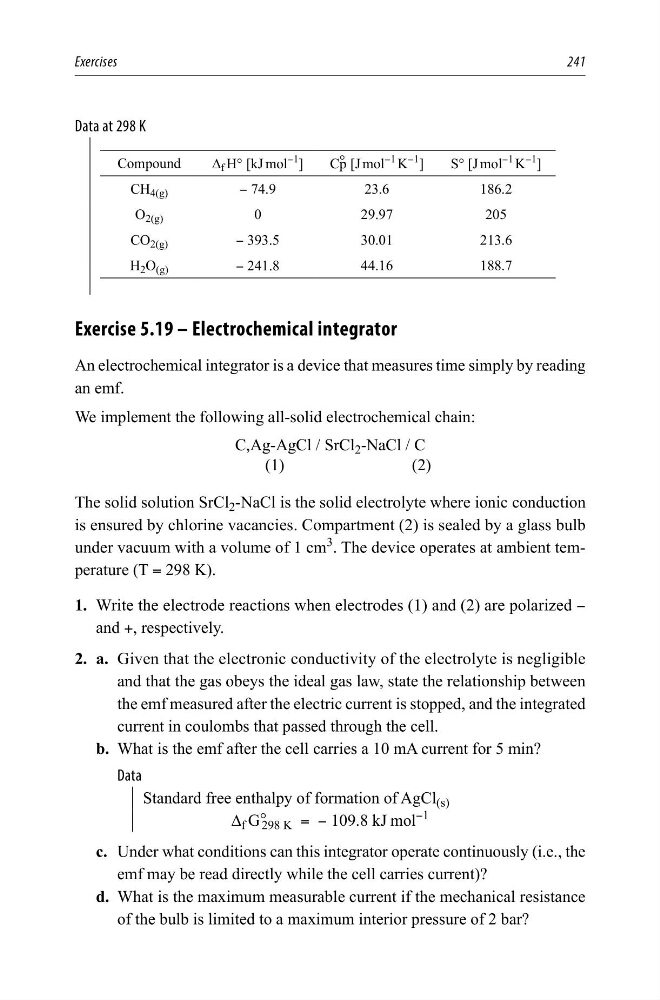
Exercise 5.19 – Electrochemical integrator
An electrochemical integrator is a device that measures time simply by reading
an emf.
We implement the following all-solid electrochemical chain:
C,Ag-AgCl / SrCl 2 -NaCl / C
(1)
(2)
The solid solution SrCl 2 -NaCl is the solid electrolyte where ionic conduction
is ensured by chlorine vacancies. Compartment (2) is sealed by a glass bulb
under vacuum with a volume of 1 cm
3
. The device operates at ambient temperature (T = 298 K).
1. Write the electrode reactions when electrodes (1) and (2) are polarized −
and +, respectively.
2. a. Given that the electronic conductivity of the electrolyte is negligible
and that the gas obeys the ideal gas law, state the relationship between
the emf measured after the electric current is stopped, and the integrated
current in coulombs that passed through the cell.
b. What is the emf after the cell carries a 10 mA current for 5 min?
Data
Standard free enthalpy of formation of AgCl (s)
∆ f G ° 298 K = − 109.8 kJ mol
−1
c. Under what conditions can this integrator operate continuously (i.e., the
emf may be read directly while the cell carries current)?
d. What is the maximum measurable current if the mechanical resistance
of the bulb is limited to a maximum interior pressure of 2 bar?
241
Data at 298 K
Compound
∆ f H° [kJ mol
−1
]
C ° p [J mol
−1
K
−1
]
S° [J mol
−1
K
−1
]
CH 4(g)
− 74.9
23.6
186.2
O 2(g)
0
29.97
205
CO 2(g)
− 393.5
30.01
213.6
H 2 O (g)
− 241.8
44.16
188.7
Exercise 5.19 – Electrochemical integrator
An electrochemical integrator is a device that measures time simply by reading
an emf.
We implement the following all-solid electrochemical chain:
C,Ag-AgCl / SrCl 2 -NaCl / C
(1)
(2)
The solid solution SrCl 2 -NaCl is the solid electrolyte where ionic conduction
is ensured by chlorine vacancies. Compartment (2) is sealed by a glass bulb
under vacuum with a volume of 1 cm
3
. The device operates at ambient temperature (T = 298 K).
1. Write the electrode reactions when electrodes (1) and (2) are polarized −
and +, respectively.
2. a. Given that the electronic conductivity of the electrolyte is negligible
and that the gas obeys the ideal gas law, state the relationship between
the emf measured after the electric current is stopped, and the integrated
current in coulombs that passed through the cell.
b. What is the emf after the cell carries a 10 mA current for 5 min?
Data
Standard free enthalpy of formation of AgCl (s)
∆ f G ° 298 K = − 109.8 kJ mol
−1
c. Under what conditions can this integrator operate continuously (i.e., the
emf may be read directly while the cell carries current)?
d. What is the maximum measurable current if the mechanical resistance
of the bulb is limited to a maximum interior pressure of 2 bar?