

240
5 – Applications
The water-vapor content in the fuel introduced at the anode or, more precisely,
the ratio R = S/C (steam S and carbon C) determines the direct internal operation and reforming (for a stoichiometric ratio S/C = 1) or the gradual internal
reforming (GIR) (for a stoichiometric ratio S/C < 1). For this exercise, all
species are assumed to be in the gas phase.
1. Establish the expression for the emf ΔE of the fuel cell operating on methane.
2. Calculate the standard emf ΔE° of the pair CH 4 /CO 2 at 298 K and at 1 073 K.
Comment on how temperature affects ΔE°.
3. Calculate the theoretical emf of the direct internal reforming cell and in GIR
for the ratios S/C = ½ and ¼. Consider a residual CO 2 pressure of 4 # 10
−3
bar
at the anode and an oxygen partial pressure of 0.21 bar at the cathode. At
the anode, 10% of the gas introduced consists of a mixture of H 2 O/CH 4 in
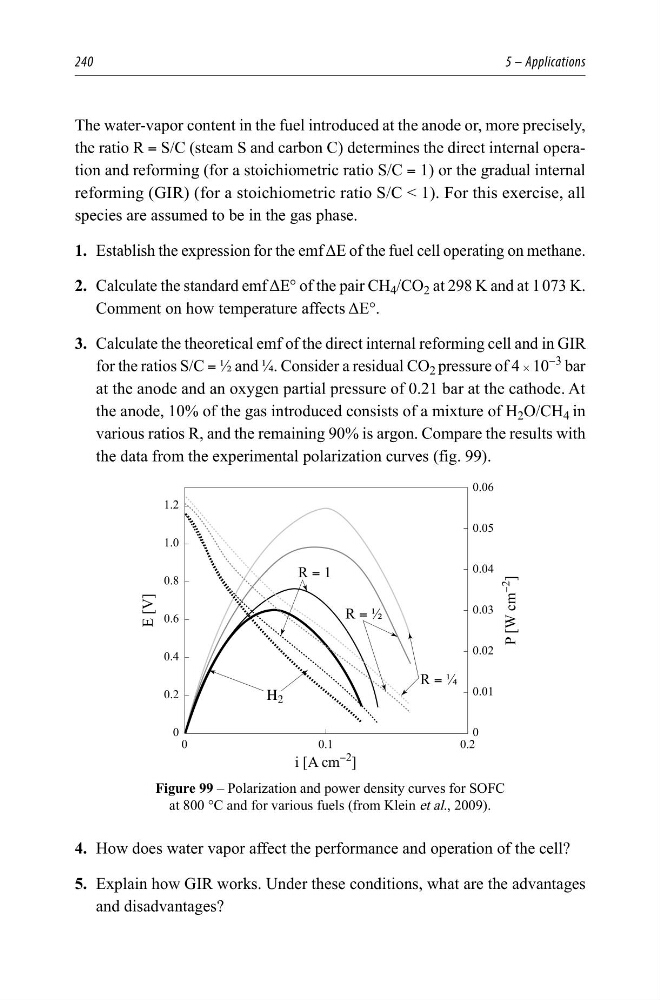
various ratios R, and the remaining 90% is argon. Compare the results with
the data from the experimental polarization curves (fig. 99).
+
(>9@
3>:FP
<
@
L>$FP
<
@
5
5ò
5ó
Figure 99 – Polarization and power density curves for SOFC
at 800 °C and for various fuels (from Klein et al., 2009).
4. How does water vapor affect the performance and operation of the cell?
5. Explain how GIR works. Under these conditions, what are the advantages
and disadvantages?
5 – Applications
The water-vapor content in the fuel introduced at the anode or, more precisely,
the ratio R = S/C (steam S and carbon C) determines the direct internal operation and reforming (for a stoichiometric ratio S/C = 1) or the gradual internal
reforming (GIR) (for a stoichiometric ratio S/C < 1). For this exercise, all
species are assumed to be in the gas phase.
1. Establish the expression for the emf ΔE of the fuel cell operating on methane.
2. Calculate the standard emf ΔE° of the pair CH 4 /CO 2 at 298 K and at 1 073 K.
Comment on how temperature affects ΔE°.
3. Calculate the theoretical emf of the direct internal reforming cell and in GIR
for the ratios S/C = ½ and ¼. Consider a residual CO 2 pressure of 4 # 10
−3
bar
at the anode and an oxygen partial pressure of 0.21 bar at the cathode. At
the anode, 10% of the gas introduced consists of a mixture of H 2 O/CH 4 in
various ratios R, and the remaining 90% is argon. Compare the results with
the data from the experimental polarization curves (fig. 99).
+
(>9@
3>:FP
<
@
L>$FP
<
@
5
5ò
5ó
Figure 99 – Polarization and power density curves for SOFC
at 800 °C and for various fuels (from Klein et al., 2009).
4. How does water vapor affect the performance and operation of the cell?
5. Explain how GIR works. Under these conditions, what are the advantages
and disadvantages?