

228
5 – Applications
5. Titanium oxide TiO 2 was used as active material in an oxygen sensor, mainly
to regulate the exhaust gas. Based on the properties discussed in questions 2
and (3), describe the operation of this oxygen sensor by stating the main
advantages and disadvantages related to its use.
Exercise 5.11 – Amperometric oxygen sensor
1. State the operating principle of an amperometric oxygen sensor. Describe the
form of the current-voltage curve for the case of an O 2 -Ar gaseous mixture.
2. Propose a detection scheme in which the oxygen supply is limited by a small
hole.
3. How is the limiting current I ℓ related to the molar fraction of oxygen in the
gaseous mixture?
a. in the case of normal diffusion,
b. in the case of Knudsen diffusion?
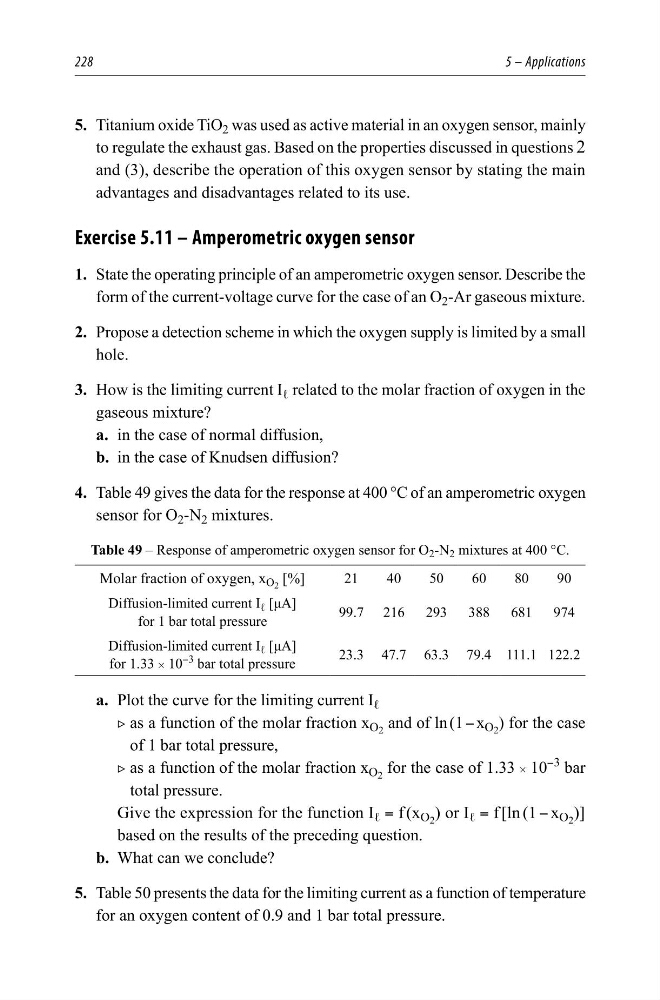
4. Table 49 gives the data for the response at 400 °C of an amperometric oxygen
sensor for O 2 -N 2 mixtures.
Table 49 – Response of amperometric oxygen sensor for O 2 -N 2 mixtures at 400 °C.
Molar fraction of oxygen, x O 2 [%]
21
40
50
60
80
90
Diffusion-limited current I ℓ [μA]
for 1 bar total pressure
99.7 216 293 388 681 974
Diffusion-limited current I ℓ [μA]
for 1.33 # 10
−3
bar total pressure
23.3 47.7 63.3 79.4 111.1 122.2
a. Plot the curve for the limiting current I ℓ
2 as a function of the molar fraction x O 2 and of ln (1 − x O 2 ) for the case
of 1 bar total pressure,
2 as a function of the molar fraction x O 2 for the case of 1.33 # 10
−3
bar
total pressure.
Give the expression for the function I ℓ = f (x O 2 ) or I ℓ = f [ln (1 − x O 2 )]
based on the results of the preceding question.
b. What can we conclude?
5. Table 50 presents the data for the limiting current as a function of temperature
for an oxygen content of 0.9 and 1 bar total pressure.
5 – Applications
5. Titanium oxide TiO 2 was used as active material in an oxygen sensor, mainly
to regulate the exhaust gas. Based on the properties discussed in questions 2
and (3), describe the operation of this oxygen sensor by stating the main
advantages and disadvantages related to its use.
Exercise 5.11 – Amperometric oxygen sensor
1. State the operating principle of an amperometric oxygen sensor. Describe the
form of the current-voltage curve for the case of an O 2 -Ar gaseous mixture.
2. Propose a detection scheme in which the oxygen supply is limited by a small
hole.
3. How is the limiting current I ℓ related to the molar fraction of oxygen in the
gaseous mixture?
a. in the case of normal diffusion,
b. in the case of Knudsen diffusion?
4. Table 49 gives the data for the response at 400 °C of an amperometric oxygen
sensor for O 2 -N 2 mixtures.
Table 49 – Response of amperometric oxygen sensor for O 2 -N 2 mixtures at 400 °C.
Molar fraction of oxygen, x O 2 [%]
21
40
50
60
80
90
Diffusion-limited current I ℓ [μA]
for 1 bar total pressure
99.7 216 293 388 681 974
Diffusion-limited current I ℓ [μA]
for 1.33 # 10
−3
bar total pressure
23.3 47.7 63.3 79.4 111.1 122.2
a. Plot the curve for the limiting current I ℓ
2 as a function of the molar fraction x O 2 and of ln (1 − x O 2 ) for the case
of 1 bar total pressure,
2 as a function of the molar fraction x O 2 for the case of 1.33 # 10
−3
bar
total pressure.
Give the expression for the function I ℓ = f (x O 2 ) or I ℓ = f [ln (1 − x O 2 )]
based on the results of the preceding question.
b. What can we conclude?
5. Table 50 presents the data for the limiting current as a function of temperature
for an oxygen content of 0.9 and 1 bar total pressure.