

Exercises
185
T
A
e k T
0.85 eV
σ =
−
where A is a constant and k is the Boltzmann constant.
a. Calculate the electrolytic resistance.
b. Deduce the emf |ΔU| generated in this experiment if we ignore the anodic
overpotential.
Exercise 4.4 – Determination of exchange current
We want to determine the exchange current I 0 that corresponds to the O 2 ,Pt /
composite / YSZ electrode, where YSZ is the solid electrolyte (ZrO 2 ) 0.92 (Y 2 O 3 ) 0.08
and the composite is a mix of YSZ and the electrode material La 0.8 Sr 0.2 MnO 3−δ .
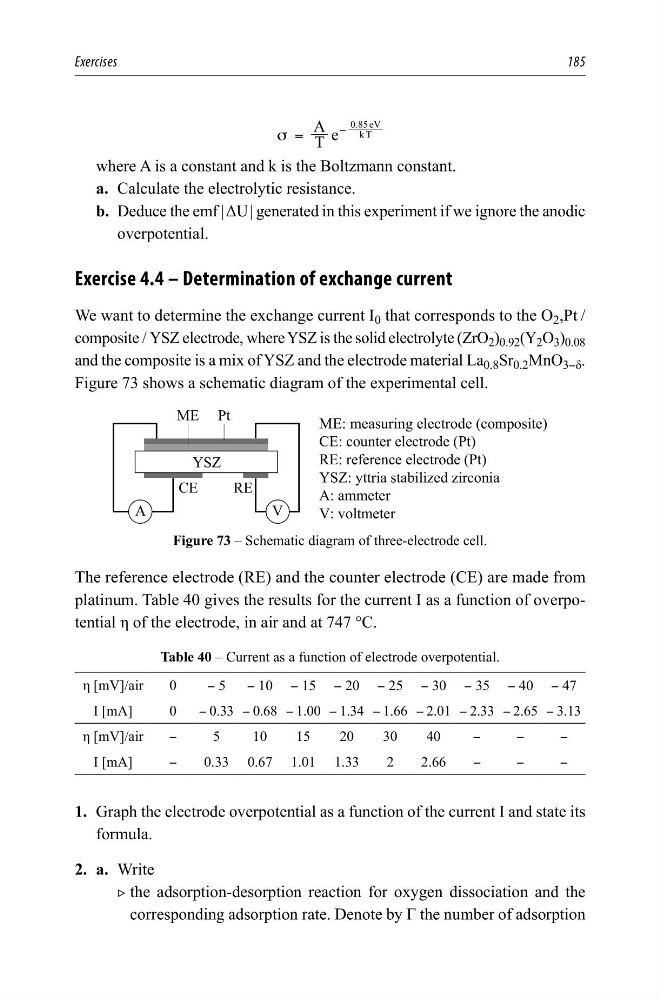
Figure 73 shows a schematic diagram of the experimental cell.
9
$
5(
&(
0( 3W
0(PHDVXULQJHOHFWURGHFRPSRVLWH
&(FRXQWHUHOHFWURGH3W
5(UHIHUHQFHHOHFWURGH3W
<6=\WWULDVWDELOL]HG]LUFRQLD
$DPPHWHU
9YROWPHWHU
<6=
Figure 73 – Schematic diagram of three-electrode cell.
The reference electrode (RE) and the counter electrode (CE) are made from
platinum. Table 40 gives the results for the current I as a function of overpotential η of the electrode, in air and at 747 °C.
Table 40 – Current as a function of electrode overpotential.
η [mV]/air
0
− 5 − 10 − 15 − 20 − 25 − 30 − 35 − 40 − 47
I [mA]
0
− 0.33 − 0.68 − 1.00 − 1.34 − 1.66 − 2.01 − 2.33 − 2.65 − 3.13
η [mV]/air
−
5
10
15
20
30
40
−
−
−
I [mA]
−
0.33 0.67 1.01 1.33
2
2.66
−
−
−
1. Graph the electrode overpotential as a function of the current I and state its
formula.
2. a. Write
2 the adsorption-desorption reaction for oxygen dissociation and the
corresponding adsorption rate. Denote by Г the number of adsorption
185
T
A
e k T
0.85 eV
σ =
−
where A is a constant and k is the Boltzmann constant.
a. Calculate the electrolytic resistance.
b. Deduce the emf |ΔU| generated in this experiment if we ignore the anodic
overpotential.
Exercise 4.4 – Determination of exchange current
We want to determine the exchange current I 0 that corresponds to the O 2 ,Pt /
composite / YSZ electrode, where YSZ is the solid electrolyte (ZrO 2 ) 0.92 (Y 2 O 3 ) 0.08
and the composite is a mix of YSZ and the electrode material La 0.8 Sr 0.2 MnO 3−δ .
Figure 73 shows a schematic diagram of the experimental cell.
9
$
5(
&(
0( 3W
0(PHDVXULQJHOHFWURGHFRPSRVLWH
&(FRXQWHUHOHFWURGH3W
5(UHIHUHQFHHOHFWURGH3W
<6=\WWULDVWDELOL]HG]LUFRQLD
$DPPHWHU
9YROWPHWHU
<6=
Figure 73 – Schematic diagram of three-electrode cell.
The reference electrode (RE) and the counter electrode (CE) are made from
platinum. Table 40 gives the results for the current I as a function of overpotential η of the electrode, in air and at 747 °C.
Table 40 – Current as a function of electrode overpotential.
η [mV]/air
0
− 5 − 10 − 15 − 20 − 25 − 30 − 35 − 40 − 47
I [mA]
0
− 0.33 − 0.68 − 1.00 − 1.34 − 1.66 − 2.01 − 2.33 − 2.65 − 3.13
η [mV]/air
−
5
10
15
20
30
40
−
−
−
I [mA]
−
0.33 0.67 1.01 1.33
2
2.66
−
−
−
1. Graph the electrode overpotential as a function of the current I and state its
formula.
2. a. Write
2 the adsorption-desorption reaction for oxygen dissociation and the
corresponding adsorption rate. Denote by Г the number of adsorption