

182
4 – Electrode reactions
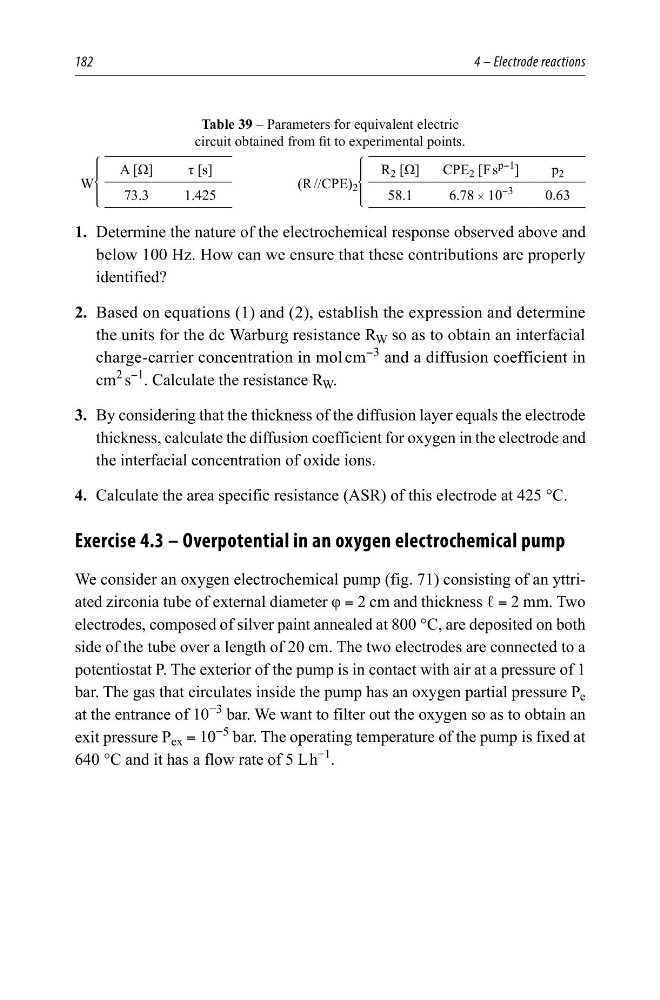
Table 39 – Parameters for equivalent electric
circuit obtained from fit to experimental points.
W*
A [Ω]
τ [s]
(R //CPE) 2 *
R 2 [Ω]
CPE 2 [F s
p−1
]
p 2
73.3
1.425
58.1
6.78 # 10
−3
0.63
1. Determine the nature of the electrochemical response observed above and
below 100 Hz. How can we ensure that these contributions are properly
identified?
2. Based on equations (1) and (2), establish the expression and determine
the units for the dc Warburg resistance R W so as to obtain an interfacial
charge-carrier concentration in mol cm
−3
and a diffusion coefficient in
cm
2
s
−1
. Calculate the resistance R W .
3. By considering that the thickness of the diffusion layer equals the electrode
thickness, calculate the diffusion coefficient for oxygen in the electrode and
the interfacial concentration of oxide ions.
4. Calculate the area specific resistance (ASR) of this electrode at 425 °C.
Exercise 4.3 – Overpotential in an oxygen electrochemical pump
We consider an oxygen electrochemical pump (fig. 71) consisting of an yttriated zirconia tube of external diameter φ = 2 cm and thickness ℓ = 2 mm. Two
electrodes, composed of silver paint annealed at 800 °C, are deposited on both
side of the tube over a length of 20 cm. The two electrodes are connected to a
potentiostat P. The exterior of the pump is in contact with air at a pressure of 1
bar. The gas that circulates inside the pump has an oxygen partial pressure P e
at the entrance of 10
−3
bar. We want to filter out the oxygen so as to obtain an
exit pressure P ex = 10
−5
bar. The operating temperature of the pump is fixed at
640 °C and it has a flow rate of 5 L h
−1
.
4 – Electrode reactions
Table 39 – Parameters for equivalent electric
circuit obtained from fit to experimental points.
W*
A [Ω]
τ [s]
(R //CPE) 2 *
R 2 [Ω]
CPE 2 [F s
p−1
]
p 2
73.3
1.425
58.1
6.78 # 10
−3
0.63
1. Determine the nature of the electrochemical response observed above and
below 100 Hz. How can we ensure that these contributions are properly
identified?
2. Based on equations (1) and (2), establish the expression and determine
the units for the dc Warburg resistance R W so as to obtain an interfacial
charge-carrier concentration in mol cm
−3
and a diffusion coefficient in
cm
2
s
−1
. Calculate the resistance R W .
3. By considering that the thickness of the diffusion layer equals the electrode
thickness, calculate the diffusion coefficient for oxygen in the electrode and
the interfacial concentration of oxide ions.
4. Calculate the area specific resistance (ASR) of this electrode at 425 °C.
Exercise 4.3 – Overpotential in an oxygen electrochemical pump
We consider an oxygen electrochemical pump (fig. 71) consisting of an yttriated zirconia tube of external diameter φ = 2 cm and thickness ℓ = 2 mm. Two
electrodes, composed of silver paint annealed at 800 °C, are deposited on both
side of the tube over a length of 20 cm. The two electrodes are connected to a
potentiostat P. The exterior of the pump is in contact with air at a pressure of 1
bar. The gas that circulates inside the pump has an oxygen partial pressure P e
at the entrance of 10
−3
bar. We want to filter out the oxygen so as to obtain an
exit pressure P ex = 10
−5
bar. The operating temperature of the pump is fixed at
640 °C and it has a flow rate of 5 L h
−1
.