

Solutions to exercises
165
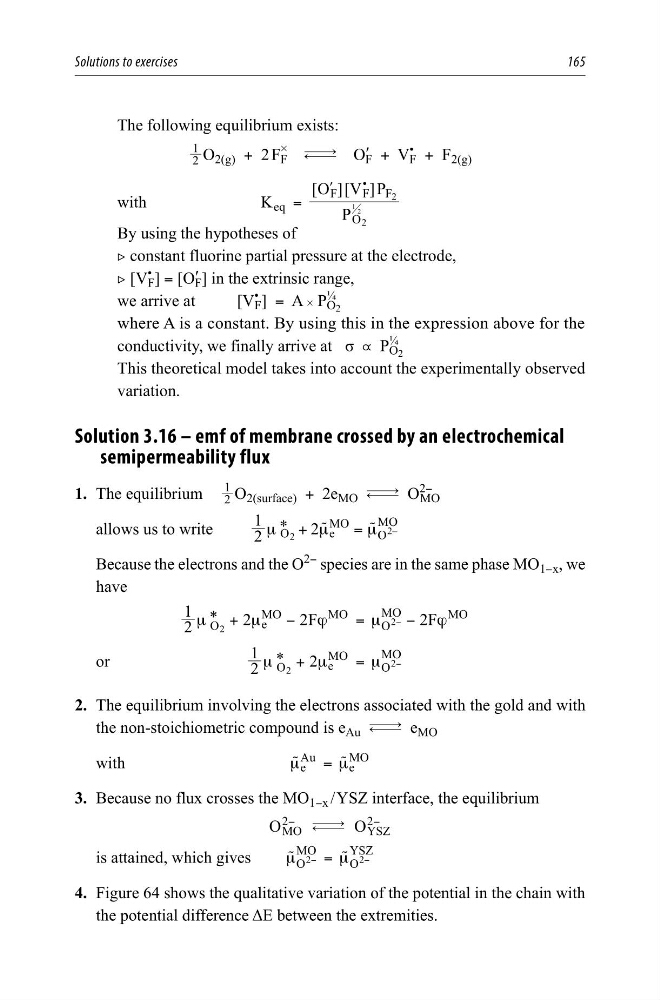
The following equilibrium exists:
2
1
O 2(g) + 2 F
#
F m O ′
F + V
•
F + F 2(g)
with
[ ][ ]
K
P
O V P
eq
O
F
F F
•
2
2
1 2
=
l
By using the hypotheses of
2 constant fluorine partial pressure at the electrode,
2 [V
•
F ] = [O ′
F ] in the extrinsic range,
we arrive at
[V
•
F ] = A # P
¼
O 2
where A is a constant. By using this in the expression above for the
conductivity, we finally arrive at σ \ P
¼
O 2
This theoretical model takes into account the experimentally observed
variation.
Solution 3.16 – emf of membrane crossed by an electrochemical
semipermeability flux
1. The equilibrium 2
1
O 2(surface) + 2e MO m O
2−
MO
allows us to write
2μ
μ
+
=
*
2
1 O
e
MO
O
MO
2
2–
μ
u
u
Because the electrons and the O
2−
species are in the same phase MO 1−x , we
have
2
2F
2 F
μ
ϕ
μ
ϕ
+
−
=
−
*
2
1
O
e
MO
MO
O
MO
MO
2
2
μ
−
or
2μ
μ
+
=
*
2
1
O
e
MO
O
MO
2
2
μ
−
2. The equilibrium involving the electrons associated with the gold and with
the non-stoichiometric compound is e Au m e MO
with
e
Au
e
MO
μ
μ
=
u
u
3. Because no flux crosses the MO 1−x / YSZ interface, the equilibrium
O MO
2−
m O YSZ
2−
is attained, which gives
O
MO
O
YSZ
2
2
μ
μ
=
−
−
u
u
4. Figure 64 shows the qualitative variation of the potential in the chain with
the potential difference ΔE between the extremities.
165
The following equilibrium exists:
2
1
O 2(g) + 2 F
#
F m O ′
F + V
•
F + F 2(g)
with
[ ][ ]
K
P
O V P
eq
O
F
F F
•
2
2
1 2
=
l
By using the hypotheses of
2 constant fluorine partial pressure at the electrode,
2 [V
•
F ] = [O ′
F ] in the extrinsic range,
we arrive at
[V
•
F ] = A # P
¼
O 2
where A is a constant. By using this in the expression above for the
conductivity, we finally arrive at σ \ P
¼
O 2
This theoretical model takes into account the experimentally observed
variation.
Solution 3.16 – emf of membrane crossed by an electrochemical
semipermeability flux
1. The equilibrium 2
1
O 2(surface) + 2e MO m O
2−
MO
allows us to write
2μ
μ
+
=
*
2
1 O
e
MO
O
MO
2
2–
μ
u
u
Because the electrons and the O
2−
species are in the same phase MO 1−x , we
have
2
2F
2 F
μ
ϕ
μ
ϕ
+
−
=
−
*
2
1
O
e
MO
MO
O
MO
MO
2
2
μ
−
or
2μ
μ
+
=
*
2
1
O
e
MO
O
MO
2
2
μ
−
2. The equilibrium involving the electrons associated with the gold and with
the non-stoichiometric compound is e Au m e MO
with
e
Au
e
MO
μ
μ
=
u
u
3. Because no flux crosses the MO 1−x / YSZ interface, the equilibrium
O MO
2−
m O YSZ
2−
is attained, which gives
O
MO
O
YSZ
2
2
μ
μ
=
−
−
u
u
4. Figure 64 shows the qualitative variation of the potential in the chain with
the potential difference ΔE between the extremities.