

Solutions to exercises
163
starting at the temperature T 0 , but overtakes thermally activated hopping
(i.e., Arrhenius type) only starting at 500 °C.
Solution 3.15 – Study of single-crystal calcium fluoride CaF 2
in the presence of oxygen
1. Equilibria involved
2 intrinsic equilibrium: F
#
F m V
•
F + F ′
i
2 introduction of oxygen: 2
1
O 2(g) + 2F
#
F m O ′
F + V
•
F + F 2(g)
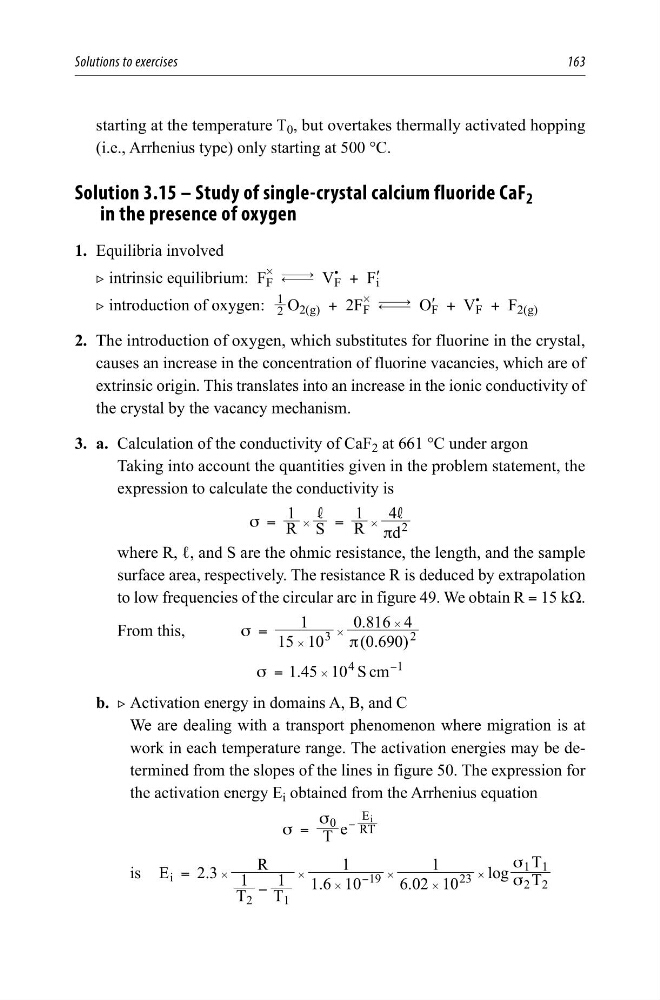
2. The introduction of oxygen, which substitutes for fluorine in the crystal,
causes an increase in the concentration of fluorine vacancies, which are of
extrinsic origin. This translates into an increase in the ionic conductivity of
the crystal by the vacancy mechanism.
3. a. Calculation of the conductivity of CaF 2 at 661 °C under argon
Taking into account the quantities given in the problem statement, the
expression to calculate the conductivity is
R
1 S
R
1
d
4
2
,
,
σ
π
=
=
#
#
where R, ℓ, and S are the ohmic resistance, the length, and the sample
surface area, respectively. The resistance R is deduced by extrapolation
to low frequencies of the circular arc in figure 49. We obtain R = 15 kΩ.
From this,
15 10
1
(0.690)
0.816 4
3
2
#
σ
π
=
#
#
1.45 10 S cm
4
1
#
σ =
−
b. 2 Activation energy in domains A, B, and C
We are dealing with a transport phenomenon where migration is at
work in each temperature range. The activation energies may be determined from the slopes of the lines in figure 50. The expression for
the activation energy E i obtained from the Arrhenius equation
T e
0
RT
E i
σ
σ
=
−
is E
2.3
T
1
T
1
R
1.6 10
1
6.02 10
1
log T
T
i
2
1
19
23
2 2
1 1
#
#
σ
σ
=
−
−
#
#
#
#
163
starting at the temperature T 0 , but overtakes thermally activated hopping
(i.e., Arrhenius type) only starting at 500 °C.
Solution 3.15 – Study of single-crystal calcium fluoride CaF 2
in the presence of oxygen
1. Equilibria involved
2 intrinsic equilibrium: F
#
F m V
•
F + F ′
i
2 introduction of oxygen: 2
1
O 2(g) + 2F
#
F m O ′
F + V
•
F + F 2(g)
2. The introduction of oxygen, which substitutes for fluorine in the crystal,
causes an increase in the concentration of fluorine vacancies, which are of
extrinsic origin. This translates into an increase in the ionic conductivity of
the crystal by the vacancy mechanism.
3. a. Calculation of the conductivity of CaF 2 at 661 °C under argon
Taking into account the quantities given in the problem statement, the
expression to calculate the conductivity is
R
1 S
R
1
d
4
2
,
,
σ
π
=
=
#
#
where R, ℓ, and S are the ohmic resistance, the length, and the sample
surface area, respectively. The resistance R is deduced by extrapolation
to low frequencies of the circular arc in figure 49. We obtain R = 15 kΩ.
From this,
15 10
1
(0.690)
0.816 4
3
2
#
σ
π
=
#
#
1.45 10 S cm
4
1
#
σ =
−
b. 2 Activation energy in domains A, B, and C
We are dealing with a transport phenomenon where migration is at
work in each temperature range. The activation energies may be determined from the slopes of the lines in figure 50. The expression for
the activation energy E i obtained from the Arrhenius equation
T e
0
RT
E i
σ
σ
=
−
is E
2.3
T
1
T
1
R
1.6 10
1
6.02 10
1
log T
T
i
2
1
19
23
2 2
1 1
#
#
σ
σ
=
−
−
#
#
#
#