

160
3 – Transport in ionic solids
3. Study of conductivity of the system 2SiO 2 -K 2 O
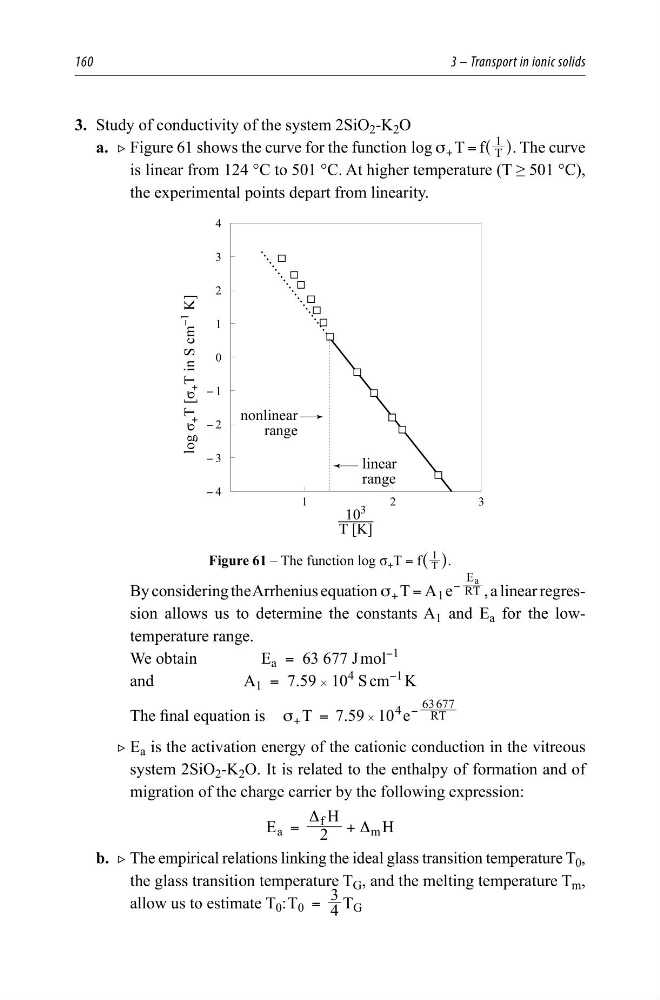
a. 2 Figure 61 shows the curve for the function log T f T
1
σ =
+
^ h. The curve
is linear from 124 °C to 501 °C. At higher temperature (T ≥ 501 °C),
the experimental points depart from linearity.
<
<
<
<
OLQHDU
UDQJH
QRQOLQHDU
UDQJH
—
7>.@
ORJı
7>ı
7LQ6FP
<
.@
Figure 61 – The function log σ + T = f T
1
^ h.
By considering the Arrhenius equation T A e
1
RT
E a
σ =
+
−
, a linear regression allows us to determine the constants A 1 and E a for the lowtemperature range.
We obtain
E a = 63 677 J mol
−1
and
A 1 = 7.59 # 10
4
S cm
−1
K
The final equation is
T 7.59 10 e
4
RT
63 677
#
σ
=
+
−
2 E a is the activation energy of the cationic conduction in the vitreous
system 2SiO 2 -K 2 O. It is related to the enthalpy of formation and of
migration of the charge carrier by the following expression:
E
2
H
H
a
f
m
Δ
Δ
=
+
b. 2 The empirical relations linking the ideal glass transition temperature T 0 ,
the glass transition temperature T G , and the melting temperature T m ,
allow us to estimate T 0 : T
T
4
3 G
0 =
3 – Transport in ionic solids
3. Study of conductivity of the system 2SiO 2 -K 2 O
a. 2 Figure 61 shows the curve for the function log T f T
1
σ =
+
^ h. The curve
is linear from 124 °C to 501 °C. At higher temperature (T ≥ 501 °C),
the experimental points depart from linearity.
<
<
<
<
OLQHDU
UDQJH
QRQOLQHDU
UDQJH
—
7>.@
ORJı
7>ı
7LQ6FP
<
.@
Figure 61 – The function log σ + T = f T
1
^ h.
By considering the Arrhenius equation T A e
1
RT
E a
σ =
+
−
, a linear regression allows us to determine the constants A 1 and E a for the lowtemperature range.
We obtain
E a = 63 677 J mol
−1
and
A 1 = 7.59 # 10
4
S cm
−1
K
The final equation is
T 7.59 10 e
4
RT
63 677
#
σ
=
+
−
2 E a is the activation energy of the cationic conduction in the vitreous
system 2SiO 2 -K 2 O. It is related to the enthalpy of formation and of
migration of the charge carrier by the following expression:
E
2
H
H
a
f
m
Δ
Δ
=
+
b. 2 The empirical relations linking the ideal glass transition temperature T 0 ,
the glass transition temperature T G , and the melting temperature T m ,
allow us to estimate T 0 : T
T
4
3 G
0 =