

144
3 – Transport in ionic solids
This equilibrium is shifted to the left (right) at low (high) oxygen pressure.
Because the atomic defects dominate at the highest P O 2 , the nickel vacancies
are singly ionized.
4. Given the preceding results and considering the slopes found in figure 58,
the ionization equilibrium of the nickel vacancies,
V ′′ Ni + h
•
m V ′
Ni
is shifted to the left at high temperature.
Solution 3.9 – Ionic conductivity-activity relationship of oxide
modifier in oxide-based glasses
1. In glasses of the type (SiO 2 ) 1−α (Na 2 O) α , silicon dioxide SiO 2 (silica) is the
glass former and the monoxide Na 2 O is the glass modifier.
Examples of other glass formers: P 2 O 5 , B 2 O 3 .
Examples of other glass modifiers: K 2 O, CaO.
2. In terms of the metal-oxygen bonds in vitreous oxides, the covalence is
greater for the glass former. The ionicity is greater for the glass modifier.
3. In silica-based glasses, the coordination index is 4 for silicon (tetrahedral
environment) and 2 for oxygen.
4. a. Expression for the potential difference ΔE between the terminals of the cell
(Hg, Na)
(1)
/ (SiO 2 ) 1−α (Na 2 O) α / (Hg,Na)
(2)
The following equilibrium holds at each electrode:
Na
+ + e m Na
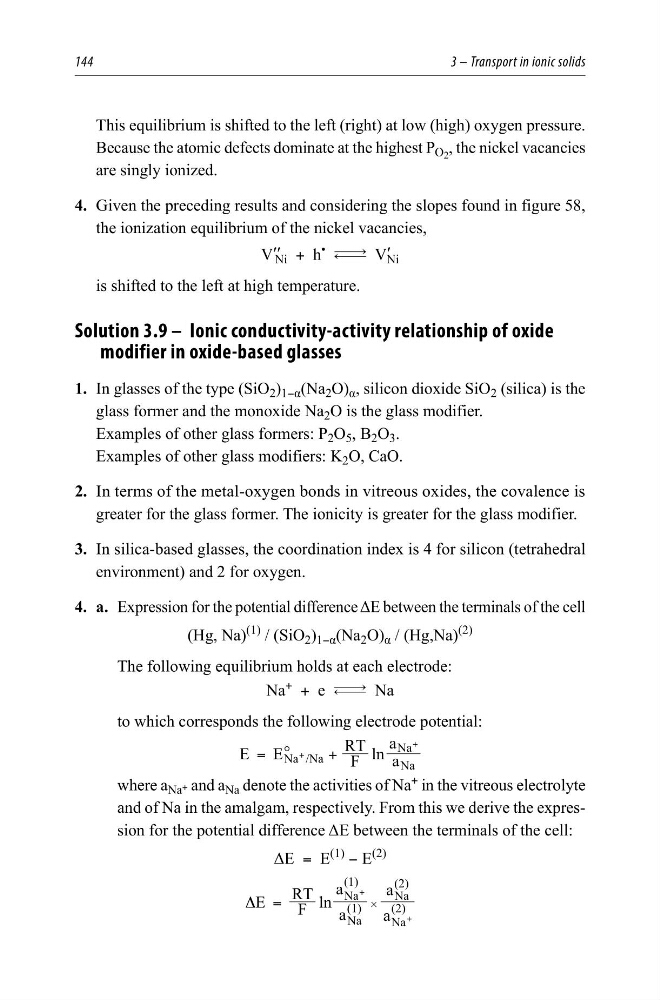
to which corresponds the following electrode potential:
ln
E E
F
RT
a
a
/
Na Na
Na
Na
=
+
+
+
°
where a Na + and a Na denote the activities of Na
+
in the vitreous electrolyte
and of Na in the amalgam, respectively. From this we derive the expression for the potential difference ΔE between the terminals of the cell:
ΔE = E
(1) − E
(2)
E
F
RT
ln a
a
a
a
Na
(1)
Na
(1)
Na
(2)
Na
(2)
Δ =
#
+
+
3 – Transport in ionic solids
This equilibrium is shifted to the left (right) at low (high) oxygen pressure.
Because the atomic defects dominate at the highest P O 2 , the nickel vacancies
are singly ionized.
4. Given the preceding results and considering the slopes found in figure 58,
the ionization equilibrium of the nickel vacancies,
V ′′ Ni + h
•
m V ′
Ni
is shifted to the left at high temperature.
Solution 3.9 – Ionic conductivity-activity relationship of oxide
modifier in oxide-based glasses
1. In glasses of the type (SiO 2 ) 1−α (Na 2 O) α , silicon dioxide SiO 2 (silica) is the
glass former and the monoxide Na 2 O is the glass modifier.
Examples of other glass formers: P 2 O 5 , B 2 O 3 .
Examples of other glass modifiers: K 2 O, CaO.
2. In terms of the metal-oxygen bonds in vitreous oxides, the covalence is
greater for the glass former. The ionicity is greater for the glass modifier.
3. In silica-based glasses, the coordination index is 4 for silicon (tetrahedral
environment) and 2 for oxygen.
4. a. Expression for the potential difference ΔE between the terminals of the cell
(Hg, Na)
(1)
/ (SiO 2 ) 1−α (Na 2 O) α / (Hg,Na)
(2)
The following equilibrium holds at each electrode:
Na
+ + e m Na
to which corresponds the following electrode potential:
ln
E E
F
RT
a
a
/
Na Na
Na
Na
=
+
+
+
°
where a Na + and a Na denote the activities of Na
+
in the vitreous electrolyte
and of Na in the amalgam, respectively. From this we derive the expression for the potential difference ΔE between the terminals of the cell:
ΔE = E
(1) − E
(2)
E
F
RT
ln a
a
a
a
Na
(1)
Na
(1)
Na
(2)
Na
(2)
Δ =
#
+
+