

Solutions to exercises
143
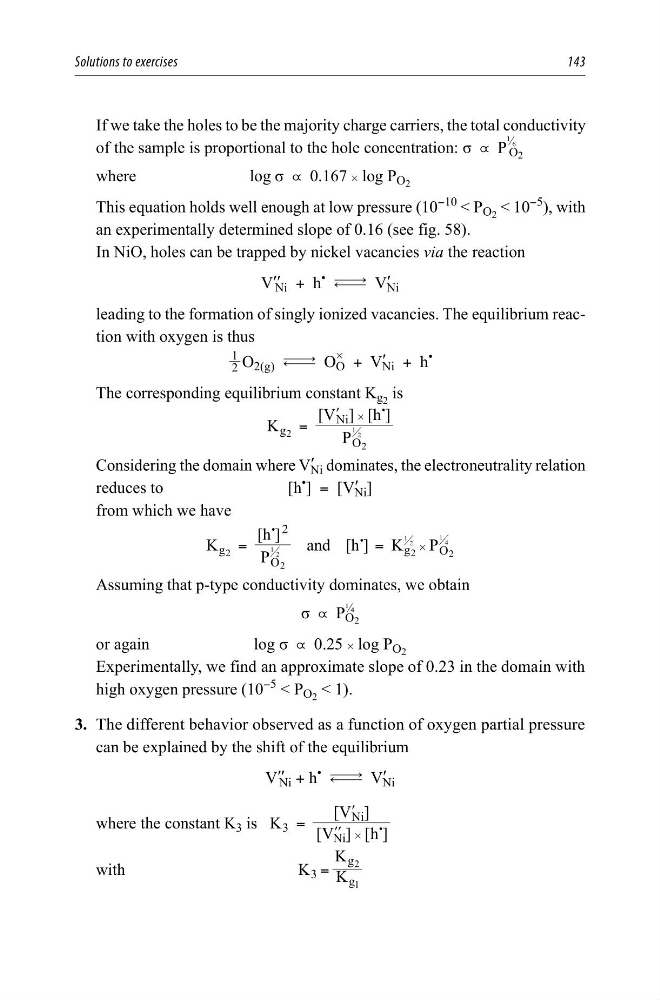
If we take the holes to be the majority charge carriers, the total conductivity
of the sample is proportional to the hole concentration: σ \ P
¹⁄6
O 2
where
log σ \ 0.167 # log P O 2
This equation holds well enough at low pressure (10
−10
< P O 2 < 10
−5
), with
an experimentally determined slope of 0.16 (see fig. 58).
In NiO, holes can be trapped by nickel vacancies via the reaction
V ′′ Ni + h
•
m V ′
Ni
leading to the formation of singly ionized vacancies. The equilibrium reaction with oxygen is thus
2
1
O 2(g) m O
#
O + V ′
Ni + h
•
The corresponding equilibrium constant K g 2 is
[
] [ ]
K
P
V
h
g
O
Ni
2
2
1 2
=
:
#
l
Considering the domain where V ′
Ni dominates, the electroneutrality relation
reduces to
[h
•
] = [V ′
Ni ]
from which we have
[ ]
[ ]
K
P
h
and h
K
P
g
O
g
O
2
2
2
2
2
1 2
1 2
1 4
=
=
:
:
#
Assuming that p-type conductivity dominates, we obtain
σ \ P
¼
O 2
or again
log σ \ 0.25 # log P O 2
Experimentally, we find an approximate slope of 0.23 in the domain with
high oxygen pressure (10
−5
< P O 2 < 1).
3. The different behavior observed as a function of oxygen partial pressure
can be explained by the shift of the equilibrium
V ′′ Ni + h
•
m V ′
Ni
where the constant K 3 is
] [ ]
[
]
K
h
V
Ni
Ni
3 =
:
#
[Vll
l
with
K
K
K
g
g
3
l
2
=
143
If we take the holes to be the majority charge carriers, the total conductivity
of the sample is proportional to the hole concentration: σ \ P
¹⁄6
O 2
where
log σ \ 0.167 # log P O 2
This equation holds well enough at low pressure (10
−10
< P O 2 < 10
−5
), with
an experimentally determined slope of 0.16 (see fig. 58).
In NiO, holes can be trapped by nickel vacancies via the reaction
V ′′ Ni + h
•
m V ′
Ni
leading to the formation of singly ionized vacancies. The equilibrium reaction with oxygen is thus
2
1
O 2(g) m O
#
O + V ′
Ni + h
•
The corresponding equilibrium constant K g 2 is
[
] [ ]
K
P
V
h
g
O
Ni
2
2
1 2
=
:
#
l
Considering the domain where V ′
Ni dominates, the electroneutrality relation
reduces to
[h
•
] = [V ′
Ni ]
from which we have
[ ]
[ ]
K
P
h
and h
K
P
g
O
g
O
2
2
2
2
2
1 2
1 2
1 4
=
=
:
:
#
Assuming that p-type conductivity dominates, we obtain
σ \ P
¼
O 2
or again
log σ \ 0.25 # log P O 2
Experimentally, we find an approximate slope of 0.23 in the domain with
high oxygen pressure (10
−5
< P O 2 < 1).
3. The different behavior observed as a function of oxygen partial pressure
can be explained by the shift of the equilibrium
V ′′ Ni + h
•
m V ′
Ni
where the constant K 3 is
] [ ]
[
]
K
h
V
Ni
Ni
3 =
:
#
[Vll
l
with
K
K
K
g
g
3
l
2
=