

Solutions to exercises
133
dt
d E
30 24 3600
10 10
3.858 10 V s
3
9
1
#
#
Δ =
=
−
−
−
#
#
x
6 10
( )
Ag
2
4
#
=
−
n
M
m
M
V
200 10
13600 10 10
6.8 10 mol
Hg
Hg
Hg
Hg
Hg
Hg
3
9
4
#
#
#
ρ
=
=
=
=
−
−
−
#
#
x Hg = 1 − x Ag = 1 − 6 # 10
−4 = 0.9994
n
x
n
0.9994
6.8 10
6.804 10 mol
T
Hg
Hg
4
4
#
#
=
=
=
−
−
∆E = 0.85 V
or R
96 480
8.314 300
0.85 6.804 10
1
6 10
1
3.858 10
1
e
2
4
4
9
#
#
#
=
−
−
−
#
#
#
#
#
R e $ 1.15 # 10
8 Ω
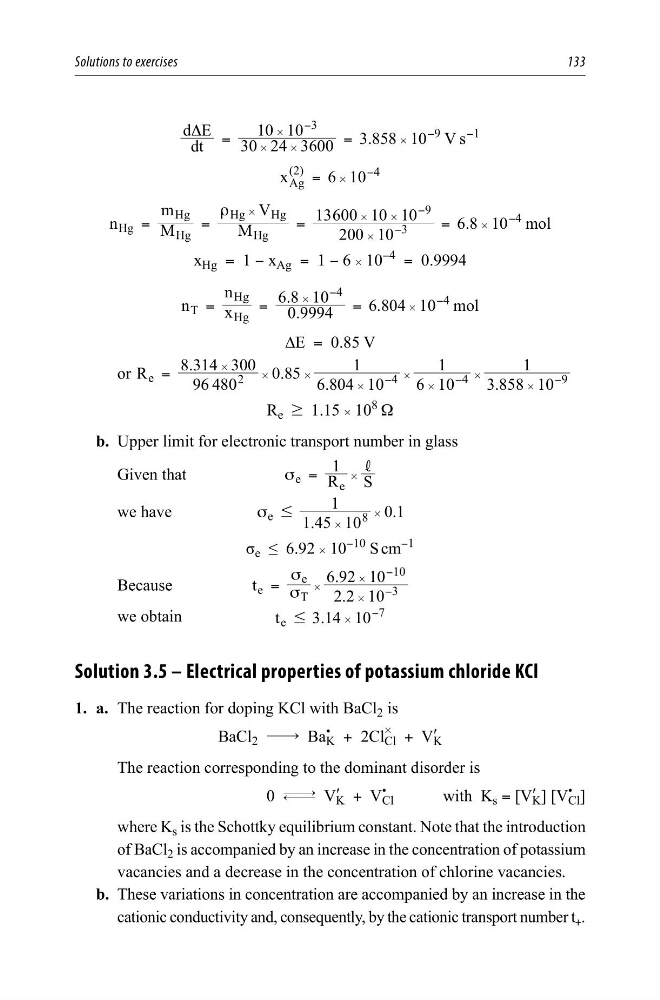
b. Upper limit for electronic transport number in glass
Given that
R
1 S
e
e
,
σ =
#
we have
1.45 10
1
0.1
e
8
#
#
σ
#
σ e ≤ 6.92 # 10
−10
S cm
−1
Because
t
2.2 10
6.92 10
e
T
e
3
10
#
#
σ
σ
=
−
−
#
we obtain
.
t
314 10
e
7
#
#
−
Solution 3.5 – Electrical properties of potassium chloride KCl
1. a. The reaction for doping KCl with BaCl 2 is
BaCl 2 $ Ba
•
K + 2Cl
#
Cl + V ′
K
The reaction corresponding to the dominant disorder is
0 m V ′
K + V
•
Cl
with K s = [V ′
K ] [V
•
Cl ]
where K s is the Schottky equilibrium constant. Note that the introduction
of BaCl 2 is accompanied by an increase in the concentration of potassium
vacancies and a decrease in the concentration of chlorine vacancies.
b. These variations in concentration are accompanied by an increase in the
cationic conductivity and, consequently, by the cationic transport number t + .
133
dt
d E
30 24 3600
10 10
3.858 10 V s
3
9
1
#
#
Δ =
=
−
−
−
#
#
x
6 10
( )
Ag
2
4
#
=
−
n
M
m
M
V
200 10
13600 10 10
6.8 10 mol
Hg
Hg
Hg
Hg
Hg
Hg
3
9
4
#
#
#
ρ
=
=
=
=
−
−
−
#
#
x Hg = 1 − x Ag = 1 − 6 # 10
−4 = 0.9994
n
x
n
0.9994
6.8 10
6.804 10 mol
T
Hg
Hg
4
4
#
#
=
=
=
−
−
∆E = 0.85 V
or R
96 480
8.314 300
0.85 6.804 10
1
6 10
1
3.858 10
1
e
2
4
4
9
#
#
#
=
−
−
−
#
#
#
#
#
R e $ 1.15 # 10
8 Ω
b. Upper limit for electronic transport number in glass
Given that
R
1 S
e
e
,
σ =
#
we have
1.45 10
1
0.1
e
8
#
#
σ
#
σ e ≤ 6.92 # 10
−10
S cm
−1
Because
t
2.2 10
6.92 10
e
T
e
3
10
#
#
σ
σ
=
−
−
#
we obtain
.
t
314 10
e
7
#
#
−
Solution 3.5 – Electrical properties of potassium chloride KCl
1. a. The reaction for doping KCl with BaCl 2 is
BaCl 2 $ Ba
•
K + 2Cl
#
Cl + V ′
K
The reaction corresponding to the dominant disorder is
0 m V ′
K + V
•
Cl
with K s = [V ′
K ] [V
•
Cl ]
where K s is the Schottky equilibrium constant. Note that the introduction
of BaCl 2 is accompanied by an increase in the concentration of potassium
vacancies and a decrease in the concentration of chlorine vacancies.
b. These variations in concentration are accompanied by an increase in the
cationic conductivity and, consequently, by the cationic transport number t + .