

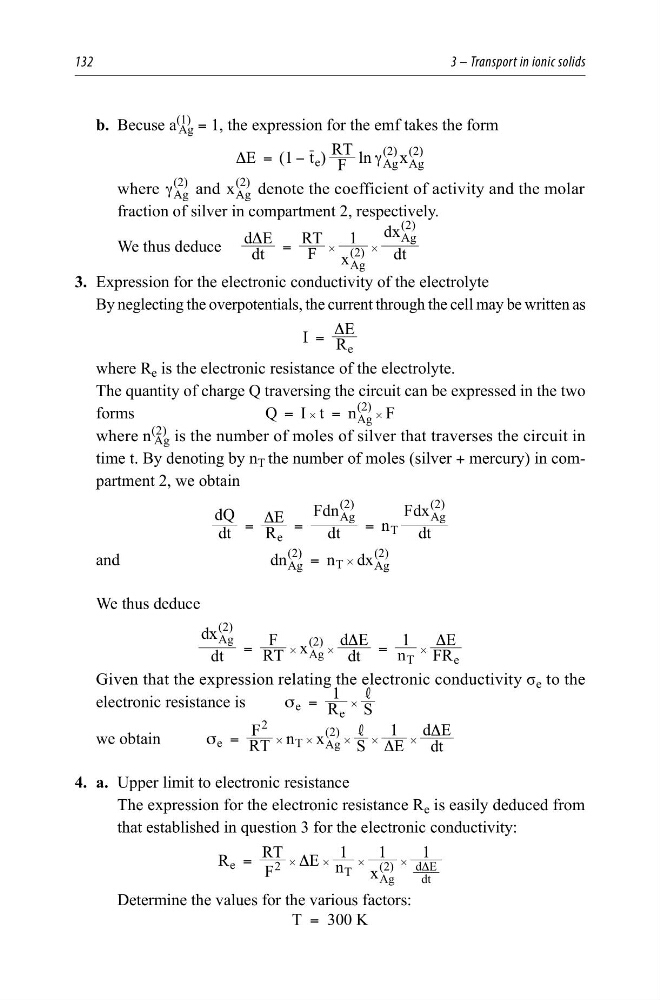
132
3 – Transport in ionic solids
b. Becuse a
(1)
Ag = 1, the expression for the emf takes the form
E (1 t ) F
RT
ln
x
e
Ag
(2)
Ag
(2)
γ
Δ = − r
where Ag
(2)
γ and x Ag
(2)
denote the coefficient of activity and the molar
fraction of silver in compartment 2, respectively.
We thus deduce
dt
d E
F
RT
x
1
dt
dx
Ag
(2)
Ag
(2)
Δ =
#
#
3. Expression for the electronic conductivity of the electrolyte
By neglecting the overpotentials, the current through the cell may be written as
I
R
E
e
Δ
=
where R e is the electronic resistance of the electrolyte.
The quantity of charge Q traversing the circuit can be expressed in the two
forms
Q I t n
F
( )
Ag
2
=
=
#
#
where n
(2)
Ag is the number of moles of silver that traverses the circuit in
time t. By denoting by n T the number of moles (silver + mercury) in compartment 2, we obtain
dt
dQ
R
E
dt
Fdn
n
dt
Fdx
e
Ag
(2)
T
Ag
(2)
Δ
=
=
=
and
dn
n dx
Ag
(2)
T
Ag
(2)
=
#
We thus deduce
dt
dx
RT
F
x
dt
d E
n
1 FR
E
Ag
(2)
Ag
(2)
T
e
Δ
Δ
=
=
#
#
#
Given that the expression relating the electronic conductivity σ e to the
electronic resistance is
R
1 S
e
e
,
σ =
#
we obtain
RT
F
n x
S
E
1
dt
d E
e
2
T
Ag
(2) ,
σ
Δ
Δ
=
#
#
#
#
#
4. a. Upper limit to electronic resistance
The expression for the electronic resistance R e is easily deduced from
that established in question 3 for the electronic conductivity:
R
F
RT
E n
1
x
1
1
e
2
T
Ag
(2)
dt
d E
Δ
=
Δ
#
#
#
#
Determine the values for the various factors:
T = 300 K
3 – Transport in ionic solids
b. Becuse a
(1)
Ag = 1, the expression for the emf takes the form
E (1 t ) F
RT
ln
x
e
Ag
(2)
Ag
(2)
γ
Δ = − r
where Ag
(2)
γ and x Ag
(2)
denote the coefficient of activity and the molar
fraction of silver in compartment 2, respectively.
We thus deduce
dt
d E
F
RT
x
1
dt
dx
Ag
(2)
Ag
(2)
Δ =
#
#
3. Expression for the electronic conductivity of the electrolyte
By neglecting the overpotentials, the current through the cell may be written as
I
R
E
e
Δ
=
where R e is the electronic resistance of the electrolyte.
The quantity of charge Q traversing the circuit can be expressed in the two
forms
Q I t n
F
( )
Ag
2
=
=
#
#
where n
(2)
Ag is the number of moles of silver that traverses the circuit in
time t. By denoting by n T the number of moles (silver + mercury) in compartment 2, we obtain
dt
dQ
R
E
dt
Fdn
n
dt
Fdx
e
Ag
(2)
T
Ag
(2)
Δ
=
=
=
and
dn
n dx
Ag
(2)
T
Ag
(2)
=
#
We thus deduce
dt
dx
RT
F
x
dt
d E
n
1 FR
E
Ag
(2)
Ag
(2)
T
e
Δ
Δ
=
=
#
#
#
Given that the expression relating the electronic conductivity σ e to the
electronic resistance is
R
1 S
e
e
,
σ =
#
we obtain
RT
F
n x
S
E
1
dt
d E
e
2
T
Ag
(2) ,
σ
Δ
Δ
=
#
#
#
#
#
4. a. Upper limit to electronic resistance
The expression for the electronic resistance R e is easily deduced from
that established in question 3 for the electronic conductivity:
R
F
RT
E n
1
x
1
1
e
2
T
Ag
(2)
dt
d E
Δ
=
Δ
#
#
#
#
Determine the values for the various factors:
T = 300 K