

128
3 – Transport in ionic solids
We find that this function is linear. It can be expressed in the form
u u e
0
RT
E a
=
−
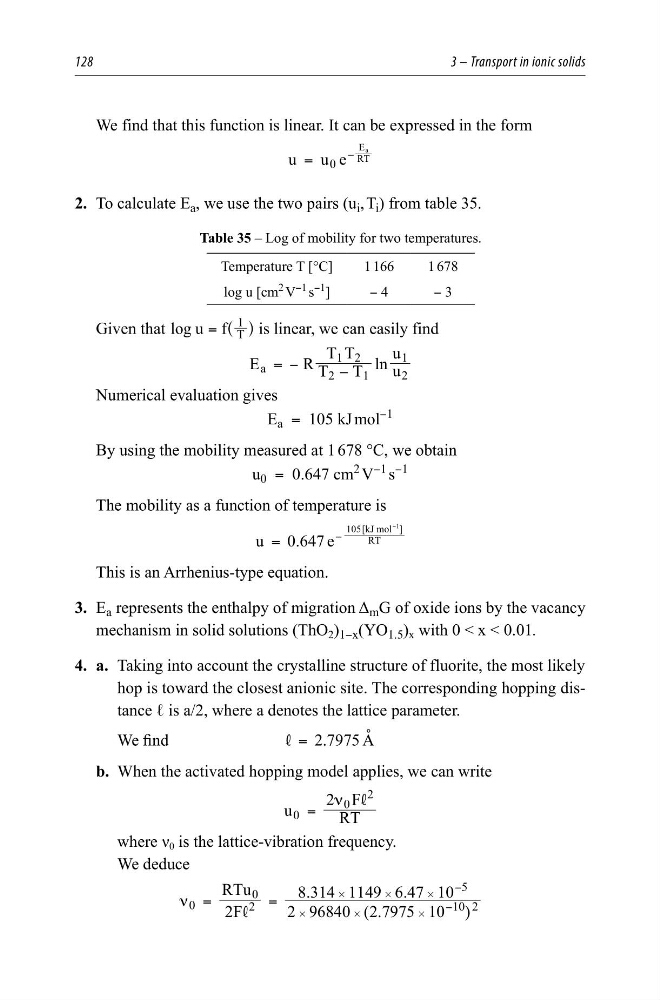
2. To calculate E a , we use the two pairs (u i , T i ) from table 35.
Table 35 – Log of mobility for two temperatures.
Temperature T [°C]
1 166
1 678
log u [cm
2
V
−1
s
−1
]
− 4
− 3
Given that log u f T
1
= ^ h is linear, we can easily find
ln
E
R T T
T T
u
u
a
2
1
1 2
2
1
= −
−
Numerical evaluation gives
E a = 105 kJ mol
−1
By using the mobility measured at 1 678 °C, we obtain
u 0 = 0.647 cm
2
V
−1
s
−1
The mobility as a function of temperature is
.
u
e
0 647
[
]
RT
kJ mol
105
1
=
−
−
This is an Arrhenius-type equation.
3. E a represents the enthalpy of migration Δ m G of oxide ions by the vacancy
mechanism in solid solutions (ThO 2 ) 1−x (YO 1.5 ) x with 0 < x < 0.01.
4. a. Taking into account the crystalline structure of fluorite, the most likely
hop is toward the closest anionic site. The corresponding hopping distance ℓ is a/2, where a denotes the lattice parameter.
We find
.
A
2 7975
, =
c
b. When the activated hopping model applies, we can write
u
RT
2 F
0
0
2
,
ν
=
where ν 0 is the lattice-vibration frequency.
We deduce
2F
RTu
2 96840 (2.7975 10 )
8.314 1149 6.47 10
0
2
0
10 2
5
#
#
,
ν =
=
−
−
#
#
#
#
3 – Transport in ionic solids
We find that this function is linear. It can be expressed in the form
u u e
0
RT
E a
=
−
2. To calculate E a , we use the two pairs (u i , T i ) from table 35.
Table 35 – Log of mobility for two temperatures.
Temperature T [°C]
1 166
1 678
log u [cm
2
V
−1
s
−1
]
− 4
− 3
Given that log u f T
1
= ^ h is linear, we can easily find
ln
E
R T T
T T
u
u
a
2
1
1 2
2
1
= −
−
Numerical evaluation gives
E a = 105 kJ mol
−1
By using the mobility measured at 1 678 °C, we obtain
u 0 = 0.647 cm
2
V
−1
s
−1
The mobility as a function of temperature is
.
u
e
0 647
[
]
RT
kJ mol
105
1
=
−
−
This is an Arrhenius-type equation.
3. E a represents the enthalpy of migration Δ m G of oxide ions by the vacancy
mechanism in solid solutions (ThO 2 ) 1−x (YO 1.5 ) x with 0 < x < 0.01.
4. a. Taking into account the crystalline structure of fluorite, the most likely
hop is toward the closest anionic site. The corresponding hopping distance ℓ is a/2, where a denotes the lattice parameter.
We find
.
A
2 7975
, =
c
b. When the activated hopping model applies, we can write
u
RT
2 F
0
0
2
,
ν
=
where ν 0 is the lattice-vibration frequency.
We deduce
2F
RTu
2 96840 (2.7975 10 )
8.314 1149 6.47 10
0
2
0
10 2
5
#
#
,
ν =
=
−
−
#
#
#
#