

124
3 – Transport in ionic solids
The membrane consists of stabilized zirconia with 9% yttrium oxide. The
electrochemical chain is
Pt,I / Oxide electrolyte / YSZ Point / Pt,O 2 / Pt,II
α
β
γ
δ
The oxygen partial pressure is denoted P 1 at the entrance, P 2 at the exit, P* at
the membrane surface, and P 3 on the air side (fig. 52).
1. According to the hypotheses of the Wagner theory, the membrane surfaces
are in equilibrium with the gaseous environment. Recall the expression of
the semipermeability flux as a function of partial pressures P 2 and P 3 on
one side and the other of the membrane.
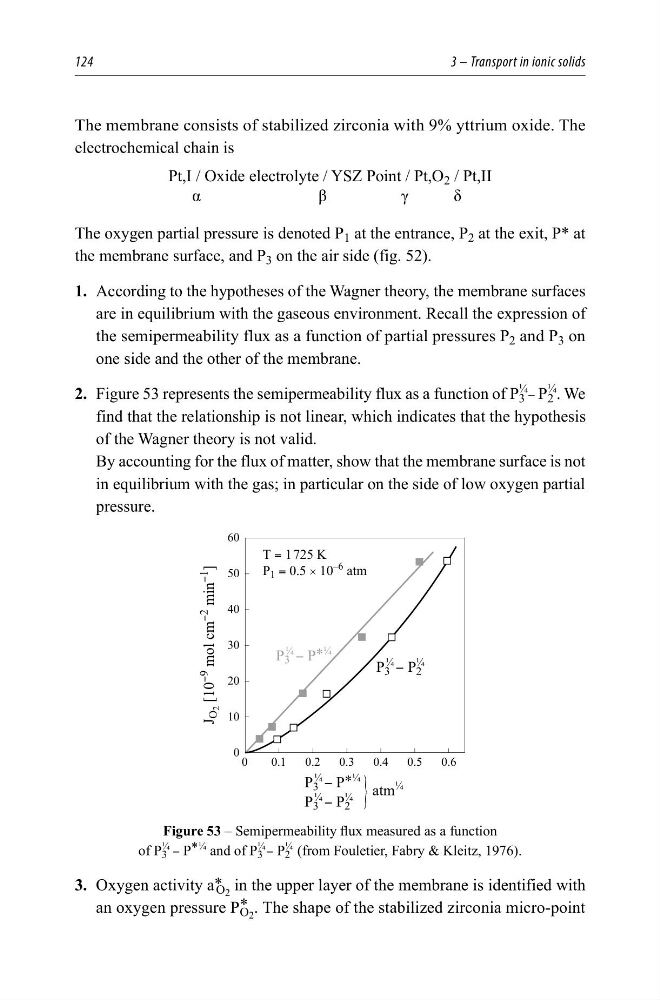
2. Figure 53 represents the semipermeability flux as a function of P
¼
3 − P
¼
2 . We
find that the relationship is not linear, which indicates that the hypothesis
of the Wagner theory is not valid.
By accounting for the flux of matter, show that the membrane surface is not
in equilibrium with the gas; in particular on the side of low oxygen partial
pressure.
3
ó <3 ó
3
ó
<3
ó
3
ó <3 ó
3
ó <3
ó
7.
3 #
±
DWP
-
2
>
<
PROFP
<
PLQ
<
@
` DWP
ó
Figure 53 – Semipermeability flux measured as a function
of P
¼
3 − P * ¼ and of P
¼
3 − P
¼
2 (from Fouletier, Fabry & Kleitz, 1976).
3. Oxygen activity a * O 2 in the upper layer of the membrane is identified with
an oxygen pressure P * O 2 . The shape of the stabilized zirconia micro-point
3 – Transport in ionic solids
The membrane consists of stabilized zirconia with 9% yttrium oxide. The
electrochemical chain is
Pt,I / Oxide electrolyte / YSZ Point / Pt,O 2 / Pt,II
α
β
γ
δ
The oxygen partial pressure is denoted P 1 at the entrance, P 2 at the exit, P* at
the membrane surface, and P 3 on the air side (fig. 52).
1. According to the hypotheses of the Wagner theory, the membrane surfaces
are in equilibrium with the gaseous environment. Recall the expression of
the semipermeability flux as a function of partial pressures P 2 and P 3 on
one side and the other of the membrane.
2. Figure 53 represents the semipermeability flux as a function of P
¼
3 − P
¼
2 . We
find that the relationship is not linear, which indicates that the hypothesis
of the Wagner theory is not valid.
By accounting for the flux of matter, show that the membrane surface is not
in equilibrium with the gas; in particular on the side of low oxygen partial
pressure.
3
ó <3 ó
3
ó
<3
ó
3
ó <3 ó
3
ó <3
ó
7.
3 #
±
DWP
-
2
>
<
PROFP
<
PLQ
<
@
` DWP
ó
Figure 53 – Semipermeability flux measured as a function
of P
¼
3 − P * ¼ and of P
¼
3 − P
¼
2 (from Fouletier, Fabry & Kleitz, 1976).
3. Oxygen activity a * O 2 in the upper layer of the membrane is identified with
an oxygen pressure P * O 2 . The shape of the stabilized zirconia micro-point