

Exercises
113
the anode serving as reference electrode, the potential difference measured
between the two electrodes is − 1 V in these conditions.
a. What is the partial pressure in the cathodic compartment before any
current flows?
b. After the current flows, the single crystal undergoes a blue coloration
near the cathode, whereas it was perfectly transparent prior to current
flow.
2 Write the reactions of the anodic and cathodic electrodes.
2 What is the origin of the coloration?
c. When the current is stopped, the residual potential difference of − 2.5 V
is observed. What is the proportion of color centers in the single crystal
with respect to the anionic vacancies?
5. In a final experiment, we introduce bromine at P Br 2 = 1 bar into one compartment and in the other we introduce potassium vapor at a partial pressure
of P K = 10
−4
bar.
a. Does the crystal turn blue? If it does, near what compartment does it turn
blue? Give the concentration of the majority species at each interface
when the interfaces are at equilibrium.
Data
Standard free enthalpy of dissociation of solid KBr in gaseous bromine
Br 2 and in gaseous potassium at 627 °C: Δ d G° 627 °C = 327.4 kJ mol
−1
b. What macroscopic phenomenon should we observe over a large timescale
if the two compartments are closed and have a small volume?
c. Give a qualitative summary of the displacement of the various charges.
d. How does the measured potential difference evolve?
Exercise 3.11 – Oxygen diffusion in gadolinia-doped ceria
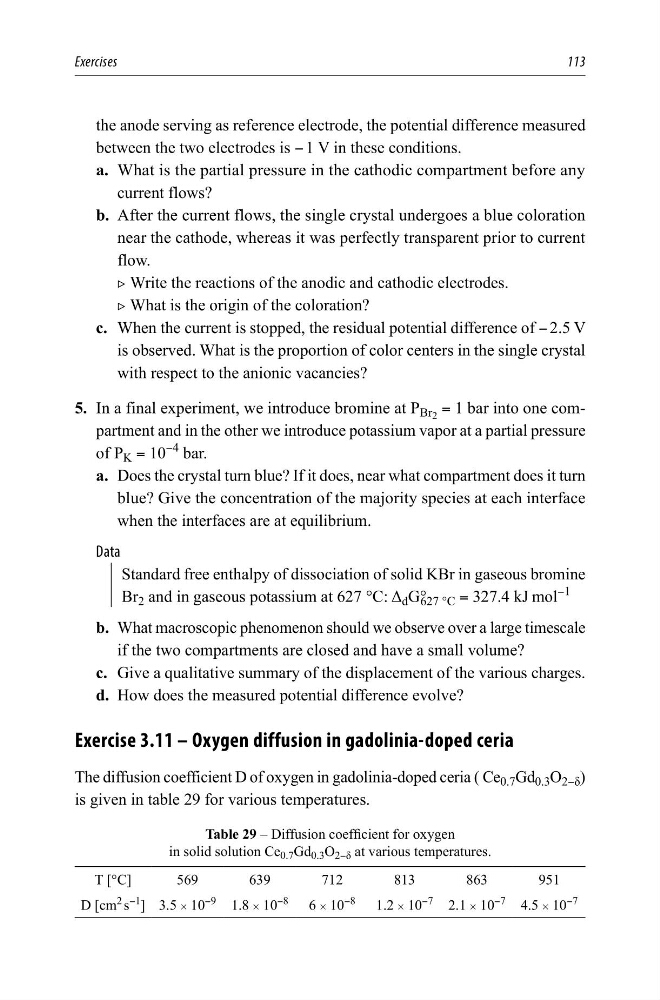
The diffusion coefficient D of oxygen in gadolinia-doped ceria ( Ce 0.7 Gd 0.3 O 2−δ )
is given in table 29 for various temperatures.
Table 29 – Diffusion coefficient for oxygen
in solid solution Ce 0.7 Gd 0.3 O 2−δ at various temperatures.
T [°C]
569
639
712
813
863
951
D [cm
2
s
−1
] 3.5 # 10
−9
1.8 # 10
−8
6 # 10
−8
1.2 # 10
−7
2.1 # 10
−7
4.5 # 10
−7
113
the anode serving as reference electrode, the potential difference measured
between the two electrodes is − 1 V in these conditions.
a. What is the partial pressure in the cathodic compartment before any
current flows?
b. After the current flows, the single crystal undergoes a blue coloration
near the cathode, whereas it was perfectly transparent prior to current
flow.
2 Write the reactions of the anodic and cathodic electrodes.
2 What is the origin of the coloration?
c. When the current is stopped, the residual potential difference of − 2.5 V
is observed. What is the proportion of color centers in the single crystal
with respect to the anionic vacancies?
5. In a final experiment, we introduce bromine at P Br 2 = 1 bar into one compartment and in the other we introduce potassium vapor at a partial pressure
of P K = 10
−4
bar.
a. Does the crystal turn blue? If it does, near what compartment does it turn
blue? Give the concentration of the majority species at each interface
when the interfaces are at equilibrium.
Data
Standard free enthalpy of dissociation of solid KBr in gaseous bromine
Br 2 and in gaseous potassium at 627 °C: Δ d G° 627 °C = 327.4 kJ mol
−1
b. What macroscopic phenomenon should we observe over a large timescale
if the two compartments are closed and have a small volume?
c. Give a qualitative summary of the displacement of the various charges.
d. How does the measured potential difference evolve?
Exercise 3.11 – Oxygen diffusion in gadolinia-doped ceria
The diffusion coefficient D of oxygen in gadolinia-doped ceria ( Ce 0.7 Gd 0.3 O 2−δ )
is given in table 29 for various temperatures.
Table 29 – Diffusion coefficient for oxygen
in solid solution Ce 0.7 Gd 0.3 O 2−δ at various temperatures.
T [°C]
569
639
712
813
863
951
D [cm
2
s
−1
] 3.5 # 10
−9
1.8 # 10
−8
6 # 10
−8
1.2 # 10
−7
2.1 # 10
−7
4.5 # 10
−7