

112
3 – Transport in ionic solids
°
K
K e
S
.
kT
eV
2 2
=
−
(1)
D
D e
w here D
c m s
10
K
K
K
2
2 1
.
kT
eV
1 26
=
=
−
−
−
°
°
(2)
D
D e
w here D
c m s
3 10
Br
Br
Br
4
2 1
.
kT
eV
2 61
#
=
=
−
−
°
°
(3)
1. Give the literal expressions for the partial ionic conductivities as a function of
the parameters in the expressions (1) to (3). Assume that the concentrations
n and p of the electronic species e ′ and h
•
, respectively, are negligible.
2. Calculate the ratio of partial ionic conductivities, σ K / σ Br , at 627 °C and
deduce the transport number t K of potassium given that the electronic transport number is negligible.
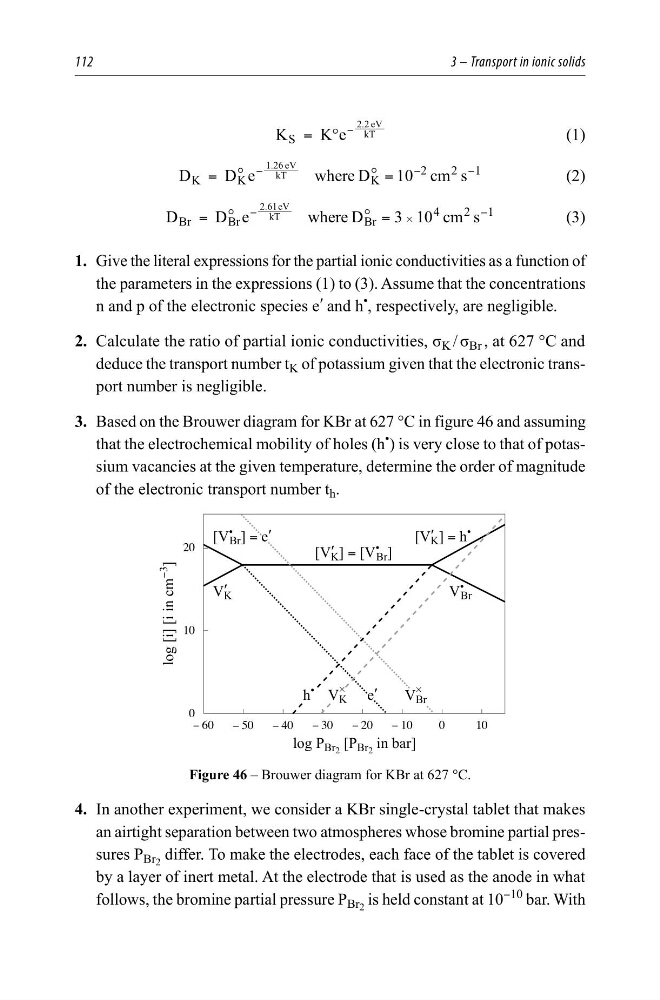
3. Based on the Brouwer diagram for KBr at 627 °C in figure 46 and assuming
that the electrochemical mobility of holes (h
•
) is very close to that of potassium vacancies at the given temperature, determine the order of magnitude
of the electronic transport number t h .
ORJ>L@>LLQFP
<
@
ORJ3 %U >3 %U LQEDU@
<
<
<
<
<
<
9ƍ .
>9ƍ . @>9
%U @
>9ƍ . @K
9
%U
>9
%U @Hƍ
K
H ƍ
9
#
%U
9
#
.
Figure 46 – Brouwer diagram for KBr at 627 °C.
4. In another experiment, we consider a KBr single-crystal tablet that makes
an airtight separation between two atmospheres whose bromine partial pressures P Br 2 differ. To make the electrodes, each face of the tablet is covered
by a layer of inert metal. At the electrode that is used as the anode in what
follows, the bromine partial pressure P Br 2 is held constant at 10
−10
bar. With
3 – Transport in ionic solids
°
K
K e
S
.
kT
eV
2 2
=
−
(1)
D
D e
w here D
c m s
10
K
K
K
2
2 1
.
kT
eV
1 26
=
=
−
−
−
°
°
(2)
D
D e
w here D
c m s
3 10
Br
Br
Br
4
2 1
.
kT
eV
2 61
#
=
=
−
−
°
°
(3)
1. Give the literal expressions for the partial ionic conductivities as a function of
the parameters in the expressions (1) to (3). Assume that the concentrations
n and p of the electronic species e ′ and h
•
, respectively, are negligible.
2. Calculate the ratio of partial ionic conductivities, σ K / σ Br , at 627 °C and
deduce the transport number t K of potassium given that the electronic transport number is negligible.
3. Based on the Brouwer diagram for KBr at 627 °C in figure 46 and assuming
that the electrochemical mobility of holes (h
•
) is very close to that of potassium vacancies at the given temperature, determine the order of magnitude
of the electronic transport number t h .
ORJ>L@>LLQFP
<
@
ORJ3 %U >3 %U LQEDU@
<
<
<
<
<
<
9ƍ .
>9ƍ . @>9
%U @
>9ƍ . @K
9
%U
>9
%U @Hƍ
K
H ƍ
9
#
%U
9
#
.
Figure 46 – Brouwer diagram for KBr at 627 °C.
4. In another experiment, we consider a KBr single-crystal tablet that makes
an airtight separation between two atmospheres whose bromine partial pressures P Br 2 differ. To make the electrodes, each face of the tablet is covered
by a layer of inert metal. At the electrode that is used as the anode in what
follows, the bromine partial pressure P Br 2 is held constant at 10
−10
bar. With